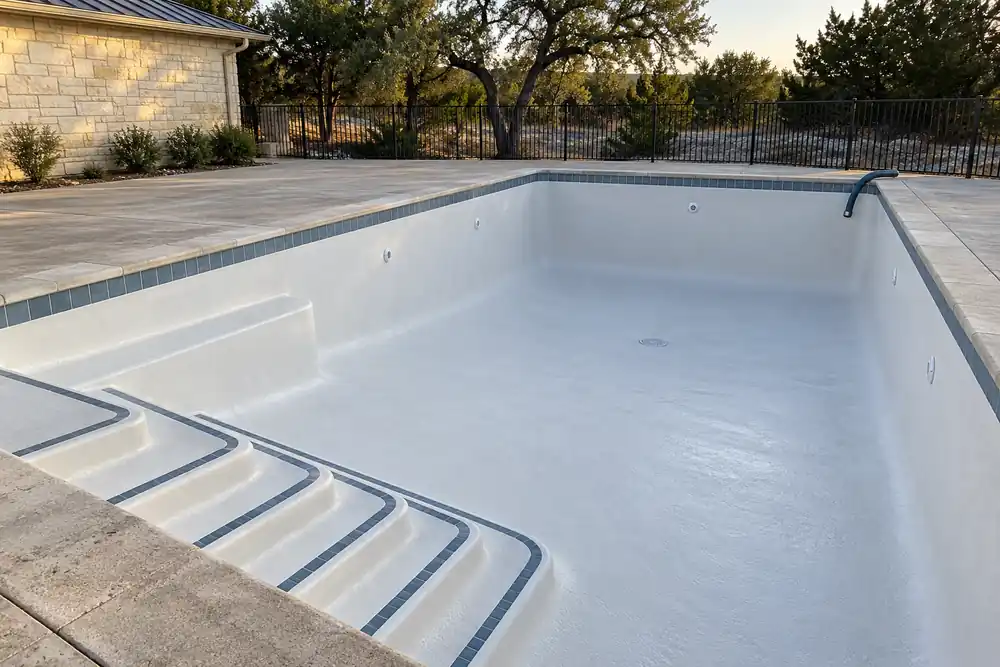
Pool Finishes Compared: Plaster, Quartz, Pebble and Polished
Leander Pool Resurfacing compares the pool finishes Leander, Texas owners choose between when a concrete pool is resurfaced: white or colored plaster, quartz, pebble and polished aggregate. The National Plasterers Council says each is a special cement mix designed for pools, placed and finished in one single application, and that the choice made at the planning stage has a significant effect on how well a pool keeps its looks.
This guide sets the four side by side: what goes into each, how it feels underfoot, how it looks as it ages, how it copes with Leander's hard water and what it costs in 2026. Fiberglass shells and painted pools take other surfaces and aren't compared here. Every price below is a published average, not a quote.
Call or request a free estimate any time, 24/7
What each pool finish is made of
Plaster: white, colored and modified
Plaster is the plainest mix. CL Industries lists water, Portland cement and either marble dust or silica sand, and calls plaster the least expensive finish and the one with the shortest lifespan. Colored and modified plasters start from the same base with pigment or admixtures added, and the Council says color accentuates everything normal in white plaster, mottling included. White and colored plaster are both applied through pool replastering.
Quartz
Quartz finishes add a silicate mineral aggregate that the Council calls one of nature's hardest minerals and one that doesn't react with pool chemicals. SGM explains the gain over marble: quartz is completely insoluble even in strong acid, and polymer-modifying the cement increases hardness, improves bonding and cuts water penetration. The Council says a quartz finish can range from smooth to textured and counts it an affordable option. Diamond Brite and NPT's QuartzScapes are two of the product lines behind a quartz pool finish.
Pebble
Pebble finishes are small pebbles, glass and other materials, hard-troweled, compacted and then exposed, in a broad range of colors. Pebble Technology International sources naturally tumbled stones from New Zealand to Chile and screens each one for size so the texture comes out uniform. PebbleTec, PebbleSheen and NPT's StoneScapes are all lines of pebble pool finish.
Polished and glass bead
Polished finishes look like exposed aggregate but feel smooth, because the mix of aggregates is revealed by polishing as the last finishing step. SGM polishes its Durazzo marble finish with diamond disks for a glass-like surface; CL Industries says its Hydrazzo resists spot etching, permanent scale and algae; and NPT says its PolishedScapes can be re-polished over its life to bring back the luster. Glass bead finishes are a close relative: NPT's JewelScapes Classic is 100 percent glass beads in white cement with colored pigment, smooth to the touch.
By the Council's own ratings, pebble lasts longest at a 12 to 18 year surface, then quartz at 10 to 15, polished at 8 to 12 and traditional white plaster at 5 to 8. Makers quote other figures for their own lines, such as SGM's 8 to 12 years for Diamond Brite.
Call or request a free estimate any time, 24/7.
(737) 212-9378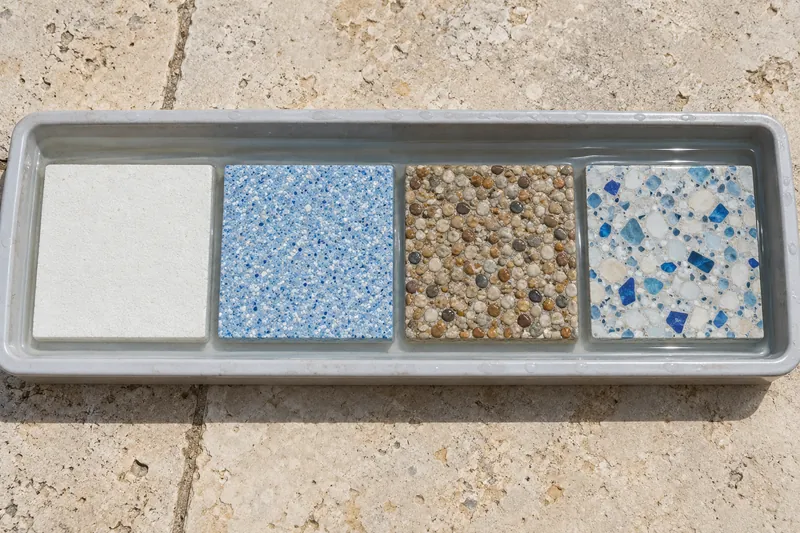
How the finishes feel underfoot
Smooth plaster and textured aggregate
The Council describes a properly hard-troweled plaster as no rougher than very fine sandpaper, 220-grit or finer, like an eggshell, though it wants steps, benches and walk-out areas left less smooth so they aren't slippery. Exposed-aggregate finishes are judged by texture instead of smoothness, since the cement binder is taken away to leave the sand or rock raised, and the trade hasn't yet set a tolerance for that texture.
Stone size, polish and glass
Within pebble, stone size sets the feel. Pebble Technology International's original PebbleTec uses its largest stones, PebbleSheen slightly smaller ones and PebbleFina the smallest natural pebbles, and NPT's StoneScapes runs from Micro, the smoothest, to Regular, whose pebbles are smooth but can be felt underfoot. CL Industries says the more polished a finish, the smoother it feels, and Pebble Technology International says the glass beads in its PebbleBrilliance add foot comfort along with sparkle.
Slip resistance
Pebble Technology International publishes a wet dynamic coefficient of friction of 0.63 for PebbleTec, and in Tile Council of North America tests NPT's StoneScapes measured 0.73 in White Regular and 0.67 in a blend with 25 percent glass bead.
Call or request a free estimate any time, 24/7.
(737) 212-9378Water color and how each finish ages
What sets the water's color
Makers agree the base color drives the water's color but sort black differently. CL Industries puts black with white, blue and gray as finish colors that give blue water, while Premix-Marbletite groups black with green, tan and brown as bases that give a blue-green tone, and adds that darker colors tend to hold warmth while lighter pools stay cooler. Light changes it too: the more direct the sun, the lighter the water looks, per CL Industries, and NPT says shade from tall trees or buildings darkens it, while the shallow end looks lighter than deeper water.
Mottling, staining and wear
Because finishes are troweled by hand, the Council says minor variation in texture and color is unavoidable. It calls normal mottling, a uniform shaded or cloudy look from differences in moisture and hydration, something that isn't a defect, needs no remedy and typically lessens over time. Texture can help: SGM says pebble's texture breaks up minor staining, while smoother Diamond Brite quartz surfaces, especially in lighter colors, show mineral staining and mottling earlier.
Call or request a free estimate any time, 24/7.
(737) 212-9378Pool finishes in Leander's hard water
Leander's City water comes from Lake Travis, and its 2024 water report, the latest that lists these figures, shows 194 ppm of hardness, 156 ppm of total alkalinity and a pH of 8.2. The finishes answer to that water differently.
- White plaster is relatively soft and more affected by water chemistry than newer products, the Council says, and its look changes over its life, from slight shading or scaling to, in extreme cases, staining, etching, cracking or delamination.
- Quartz made with colored ceramic quartz aggregates is much harder than standard plaster and far more resistant to changing water chemistry, by the Council's account, though still open to surface problems when the chemistry goes to extremes.
- Pebble is the Council's most durable surface, because river pebble is chemically inert and unlikely to react with pool water, with damage still possible under the most extreme chemical conditions.
- Polished finishes can be polished again: NPT calls re-polishing the most benign fix, one that can avoid patching or replastering.
The Council's overall verdict is that any of these surfaces can give years of reliable performance in a well-made, well-maintained pool. Leander Pool Resurfacing will talk through which finish suits your fill water, your budget and how the pool is used.
Call or request a free estimate any time, 24/7.
(737) 212-9378Pool finish cost in the Austin area
On a standard residential gunite pool, typical Austin-metro prices for 2026 run roughly $4,500 to $6,500 for standard white plaster, $6,000 to $8,500 for colored or upgraded plaster, $7,000 to $11,000 for quartz and $8,000 to $13,000 for pebble aggregate. Replacing the waterline tile and coping at the same time takes a full resurface to $12,000 to $18,000 or more.
National averages for 2026 run higher and wider: $5,000 to $10,000 for basic plaster, $7,000 to $15,000 for quartz aggregate and $9,000 to $20,000 or more for pebble. For the smoother tiers, national 2024 figures priced PebbleSheen and the glass bead finish BeadCrete alongside Pebble Tec at about $9,000 to $13,000, and SGM says its polished Durazzo sits at a higher price point because of its natural marble and the extra polishing step. None of these is a quote from Leander Pool Resurfacing; a price for your pool comes with a free estimate.
- White plaster, standard gunite pool, Austin (2026)
- $4,500–$6,500
- Colored or upgraded plaster, Austin (2026)
- $6,000–$8,500
- Quartz, Austin (2026)
- $7,000–$11,000
- Pebble aggregate, Austin (2026)
- $8,000–$13,000
- Full resurface with new tile and coping, Austin (2026)
- $12,000–$18,000+
- Pebble Tec, PebbleSheen or BeadCrete, national (2024)
- $9,000–$13,000
Published Austin-metro figures and a national figure. Not a quote.
Call or request a free estimate any time, 24/7.
(737) 212-9378Pool finish questions
What are the best finishes for swimming pools?
The National Plasterers Council doesn't name a single best finish; it says the key is to understand each surface's strengths and weaknesses and choose wisely. On its ratings, pebble has the longest surface life and is the most durable, plaster costs least, quartz sits between them on both counts, and polished finishes sit at the smooth end.
When can you judge how a new pool finish really looks?
After the start-up, and in the right light. Pebble Technology International says to allow about 28 days before judging the final water and finish color. The National Plasterers Council says to look with the pool full of clean, balanced water, in the morning, the afternoon or on a cloudy day, not with the sun directly overhead, on a windy day or at night under the pool lights, which exaggerate imperfections; Pebble Technology International likewise says light shining across the surface exaggerates waviness.
Get a free estimate on a new pool finish
Leander Pool Resurfacing answers calls and estimate requests 24/7 across Leander and nearby towns. Tell us what finish the pool has now and which of these you are weighing, and we'll talk through what the shell needs first.