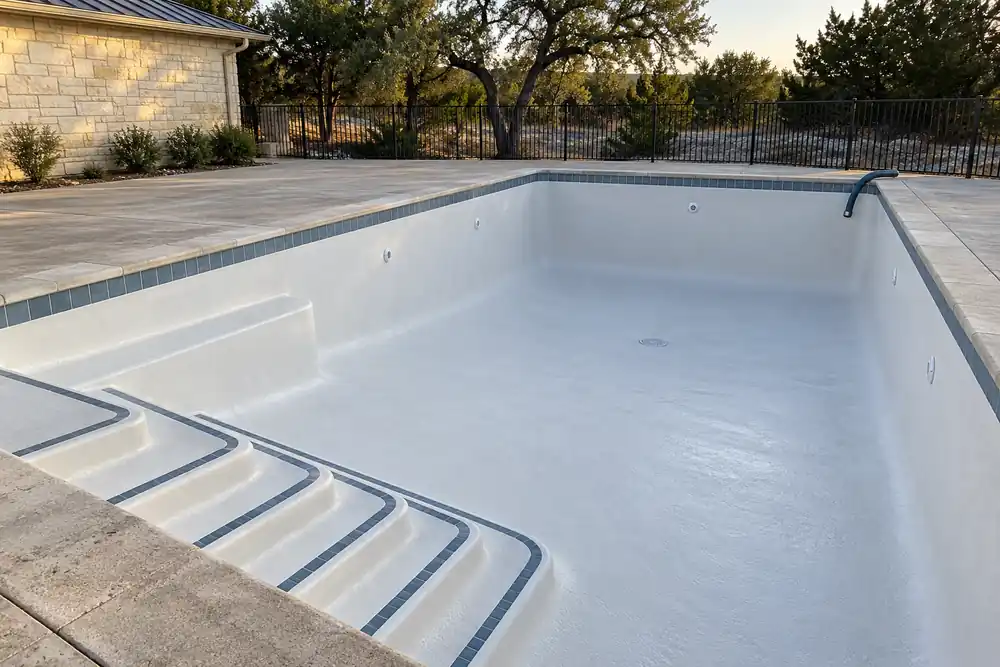
Pool Replastering in Leander, TX
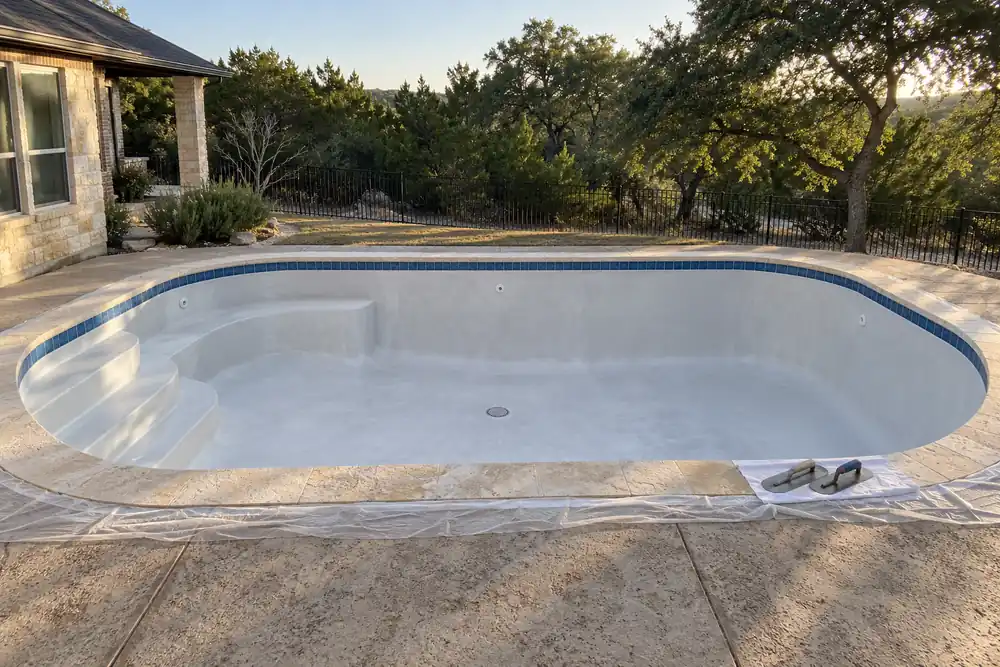
Leander Pool Resurfacing handles pool replastering in Leander, Texas: white plaster (marcite), colored and modified plaster, applied over a bond coat on sound old plaster or after a full chip-out. The National Plasterers Council calls standard white plaster "the tried and true pool and spa surface finish", hard-troweled smooth and the economical option.
Call or send the form for a free estimate. We'll talk through white or colored plaster for your fill water, what the old surface needs before the new coat, and the start-up after the fill.
Call or request a free estimate any time, 24/7
No charge · answered 24/7
Get free estimates
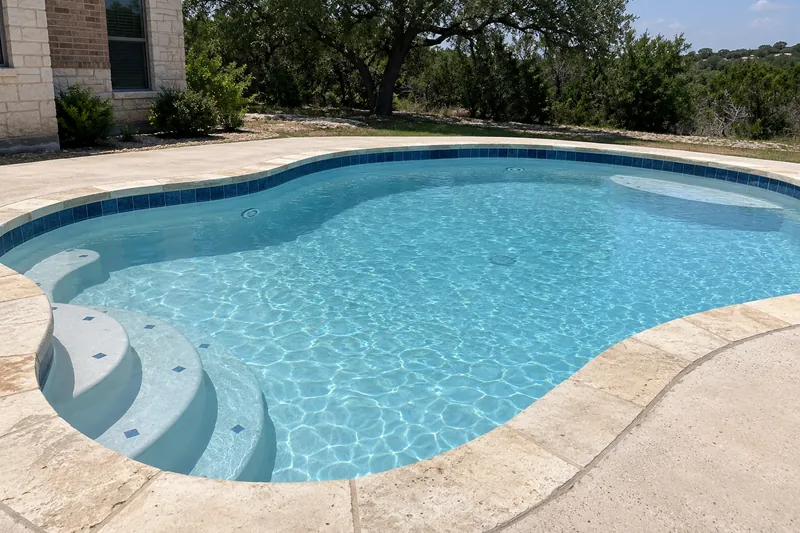
White plaster, colored plaster and modified blends
White plaster (marcite)
Marcite is the trade's other name for white pool plaster. The Council describes it as white cement, white marble aggregate and water, giving a brilliant, light blue look underwater, but a relatively soft finish that water chemistry affects more than newer products, and one that will change in appearance over its life.
Colored plaster
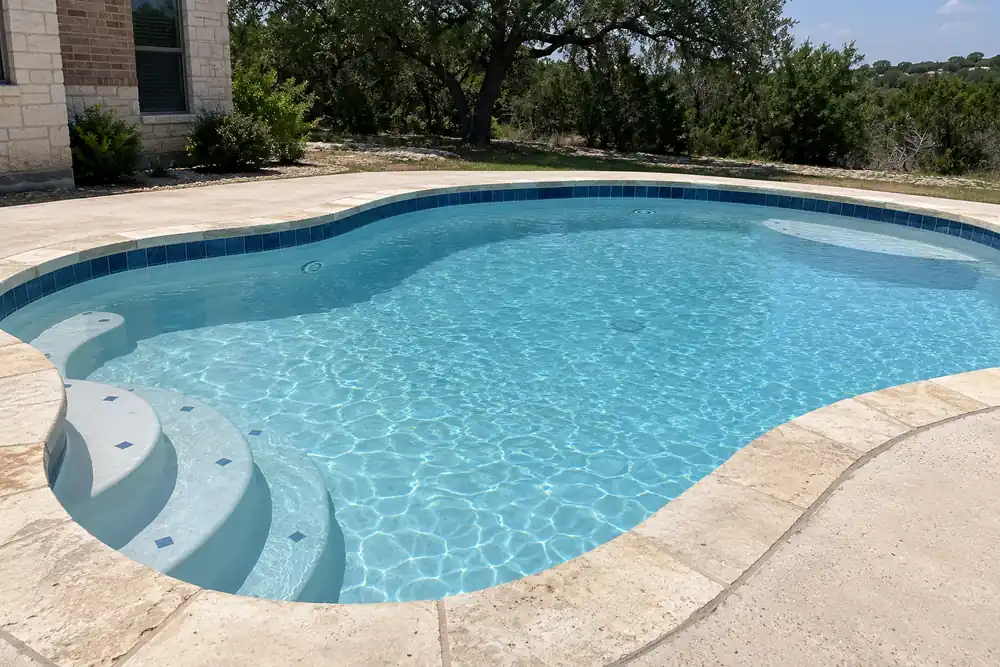
Colored plaster brings out everything normal in white plaster: mottling can be more pronounced, and pigment streaks, uneven color and checking show more, none of which the Council counts as a product defect. It says sun and UV are not the main cause of faded color; the materials, the application and the water chemistry are. Premix-Marbletite suggests setting a color sample in 6 inches of water to preview the result.
Admixtures, and when to step up
Pozzolan admixtures tie up calcium hydroxide, plaster's weakest element, and reduce etching, cracking and mottling, though the Council says they aren't fool-proof. A step up in durability means aggregate: quartz pool finishes are harder and far more resistant to changing water chemistry, and pebble pool finishes rate longest of all. Side by side, pool finishes trade cost against surface life.
For a free estimate on white or colored plaster, call Leander Pool Resurfacing or send the form.
Call or request a free estimate any time, 24/7.
(737) 212-9378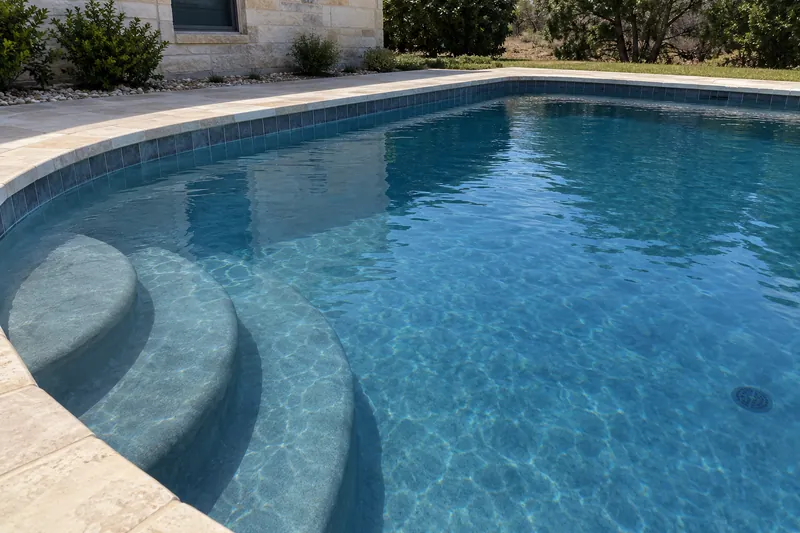
Chip-out or bond coat: getting the old surface ready
Finding hollow plaster
Universal White Cement calls tapping the simplest and most reliable test: solid plaster sounds crisp, delaminated plaster dull and drum-like, and a drained pool gives the clearest result. SGM's manual removes every hollow or delaminated area before resurfacing, sawing 3 inches outside each spot and filling the holes with patching cement. Isolated spots can sometimes be handled with pool plaster repair instead.
Bond coats over sound plaster
A bond coat is a cement-and-resin layer that grips the new plaster. SGM's Bond Kote, a resin and dry-mix kit covering about 500 square feet, is rolled on and stippled and cures at least 6 hours before plastering. Premix-Marbletite calls its bond coat "absolutely mandatory" on every renovation, and CL Industries says its PermaKote removes the need for sandblasting and stripping.
Stripping to the shell
Pebble Technology International's remodel process strips off the existing surface instead, and SGM says a bond coat may not be needed where the old finish was chipped or sandblasted off. Either way, SGM's prep removes loose material, kills algae with a chlorine wash and stops any water seeping through the shell. Leander Pool Resurfacing will talk through whether your old plaster can take a bond coat.
Thickness and edges
The Council sets a finish's average thickness at 3/8 to 3/4 inch and says it can't be used to level an uneven shell beyond that. SGM undercuts the old plaster at all tile and fittings, 2 inches back and 3/8 inch deep, so the new coat doesn't feather out to nothing at the edges.
Call or request a free estimate any time, 24/7.
(737) 212-9378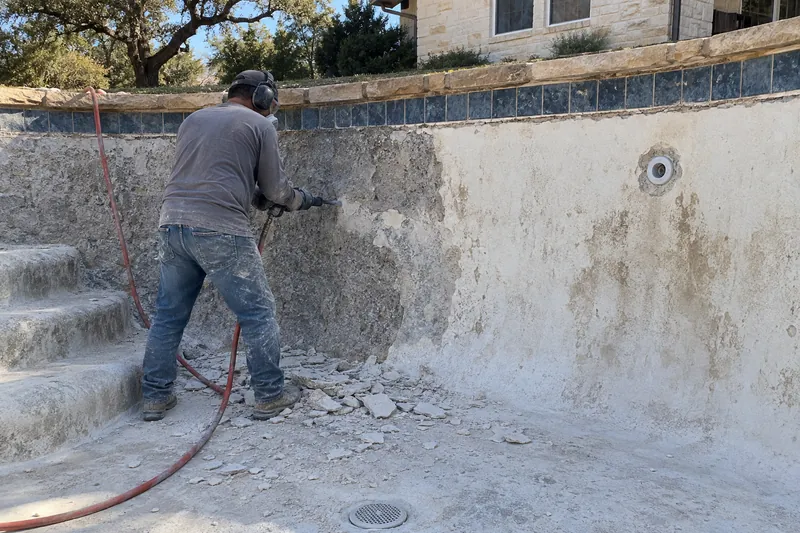
Plaster day, the fill and the start-up
On plaster day
The Council stresses that the finish is placed and finished in one single application. SGM's order is a scratch coat on the deep-end bowl first, then the walls from the shady side toward the sunny side, then a finish coat over the whole pool, on a shell that is cool and damp but not dripping. In heat, the Council suggests more experienced plasterers, an earlier start and cooling the mix with cold water or ice; it finds wind the dominant cause of shrinkage cracking.
Filling the pool
Traditional white plaster without modifiers should be filled as soon as possible after final set. The hose goes in the deepest spot with a clean cloth tied to its end, and the fill runs without stopping to the middle of the skimmer: an interruption can leave a discolored bowl ring.
The 28-day start-up
The Council's start-up card sets alkalinity at 80 to 100 ppm and pH at 7.2 to 7.6 on day 1, runs the filter nonstop for seven days, brushes at least twice a day, holds chlorine for 48 hours and brings calcium to at least 200 ppm from day 4. Research funded by the Independent Pool & Spa Service Association rated a bicarb start-up ideal, the Council's method a close second and an acid start-up last. Leander Pool Resurfacing will talk through starting up new pool plaster day by day with you.
Call or request a free estimate any time, 24/7.
(737) 212-9378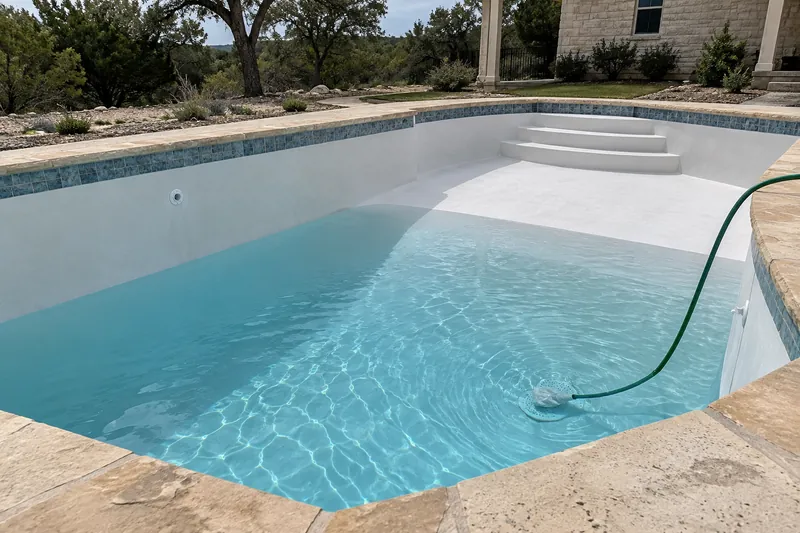
Leander fill water, drains and refills
Testing Lake Travis fill water
The Council recommends fill water above 200 ppm calcium hardness and says never to fill with softened or reverse-osmosis water. Leander's 2024 report gives total hardness of 194 ppm in Ca/Mg terms, alkalinity of 156 ppm and pH 8.2, but no separate calcium figure, so the start-up begins with a test of the fill water for pH, alkalinity, calcium hardness and metals.
Draining and refilling under Phase 2
As of October 1, 2026, Leander is in Phase 2 Water Conservation. Its pool exception covers water that keeps a pool's purification system running or the pool structurally sound, and the code is silent on a full refill after replastering, so confirm with the City before draining. At the City's in-city rates, 15,000 gallons of refill water billed alone in one cycle comes to $68.25 before the monthly charge (our arithmetic), and refill water billed from March through November doesn't enter the single-family sewer charge, which runs on a winter average. The same rules apply to draining and refilling a pool in Leander for a pool drain and acid wash.
Beyond Leander, Leander Pool Resurfacing also handles pool replastering in Round Rock and pool replastering in Northwest Austin.
Call or request a free estimate any time, 24/7.
(737) 212-9378Pool replastering cost in the Austin area
Typical Austin-metro prices for 2026 run $4,500 to $6,500 for standard white plaster on a residential gunite pool and $6,000 to $8,500 for colored or upgraded plaster. National averages for 2025 put a standard-plaster replaster at $6,000 to $8,000, depending on pool size. One national guide counts a 16 by 32 foot pool, 4 to 8 feet deep, as 1,088 square feet of surface.
Pool size, finish type, custom touches such as pigmented plaster, and repairs found once the pool is drained move the price, and a Dallas–Fort Worth builder adds 10 to 20 percent when a tanning ledge enlarges the surface. These are published figures, not prices from Leander Pool Resurfacing, and pool resurfacing cost in Leander for any finish needs a look at the pool.
- White plaster, Austin metro
- $4,500–$6,500
- Colored or upgraded plaster, Austin metro
- $6,000–$8,500
- Replastering per 1,000 sq ft, Austin
- $5,395
- 16 × 32 ft pool, national
- $3,328
- 20 × 40 ft pool, national
- $5,200
Typical Austin-area prices (2026) and national averages (2025). Not a quote.
Call or request a free estimate any time, 24/7.
(737) 212-9378Pool replastering questions
How much to replaster a 10,000 gallon pool?
Published prices go by pool size or surface area rather than gallons. National 2025 averages put a 16 by 32 foot pool at $3,328 and an 18 by 36 foot pool at $4,212, and Austin-area replastering runs about $5,395 per 1,000 square feet of surface. Shape, steps and the old plaster's condition move it from there, so a firm number needs a look at the pool, and Leander Pool Resurfacing gives that estimate free.
How long should a pool replaster last?
Sources disagree. The National Plasterers Council's finish comparison calls white plaster a 5 to 8 year surface, while its FAQ page says plaster can last up to 20 years with proper care, and Universal White Cement expects 15 to 20 years from good materials, sound application and decent water care. The Council's conclusion: materials, workmanship and balanced water must all be right.
What color pool plaster is best?
The color sets the water's tone more than its quality. Premix-Marbletite says white, blue or gray bases give a true blue look and green, tan, black or brown bases a blue-green one, with darker colors holding warmth. The Council-endorsed owner disclosure warns that pigmented finishes vary in shade and fade over time, and that crazing can be quite pronounced in colored plaster without being a defect.
Can pool plaster be repaired?
Sometimes. Universal White Cement says a few small, isolated hollow spots can be chipped out and patched when the rest of the surface is sound, but spreading or patterned hollow areas point to a bond problem across the pool, and widespread separation calls for a full replaster. Spalling, chalky etching and surface scale are different problems that can look like it.
Does the old plaster have to be chipped off before replastering?
Not always. Makers such as SGM and Premix-Marbletite bond new plaster over sound old plaster with a bond coat, while Pebble Technology International strips the old surface for its finishes. The limits are thickness and soundness: the Council caps a finish's average thickness at 3/4 inch, and Universal White Cement warns that stacking thin layers over a marginal finish leads to separation. No maker or industry body states how many coats a shell can carry.
Get a free pool replastering estimate
Leander Pool Resurfacing answers calls and estimate requests 24/7 for replastering in Leander and nearby towns. Tell us the pool's size, its plaster now and the color you have in mind.