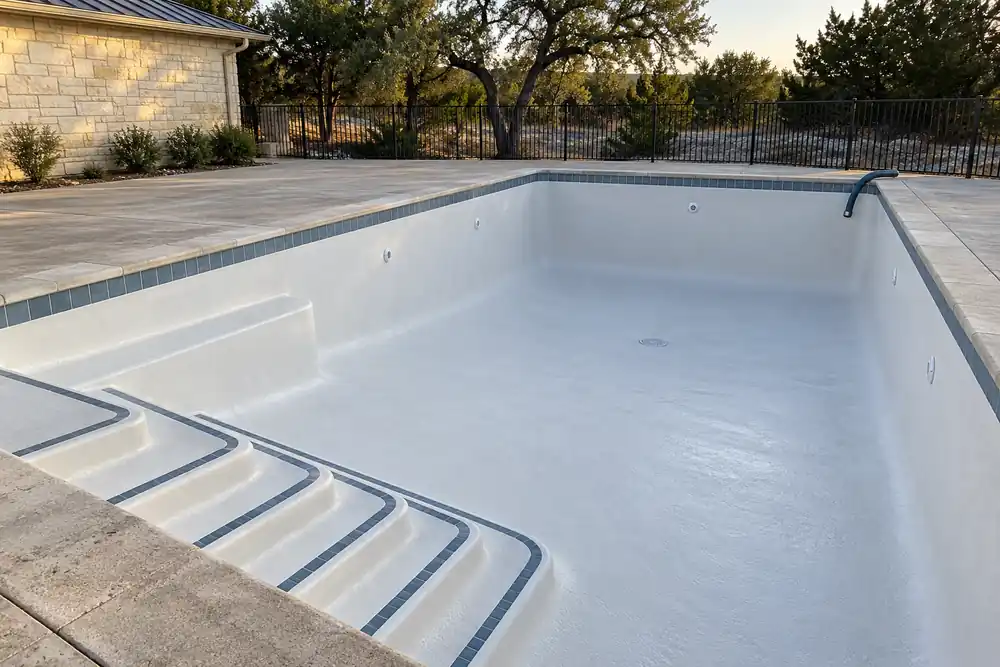
Fiberglass Pool Resurfacing in Leander, TX
Leander Pool Resurfacing handles fiberglass pool resurfacing in Leander, Texas: refinishing a faded, chalky or rough gelcoat with a polymer powder coating, new gelcoat or epoxy pool paint. River Pools, a fiberglass pool maker, describes gelcoat as the smooth, glossy surface you see, touch and walk on, a colored resin sprayed onto the shell when the pool is made.
Call or send the form for a free estimate. We'll talk through which refinish suits your shell, what its maker says about draining it, and the water balance that keeps the new surface looking right.
Call or request a free estimate any time, 24/7
No charge · answered 24/7
Get free estimates
When a fiberglass pool needs resurfacing
Gelcoat, the layer that wears
River Pools applies its gelcoat in three passes to a total of 25 to 30 mils: too thin and it can blister from an improper cure, too thick and it can crack. Latham's use and care manual says the finish is seven to eight times thicker than a normal coat of paint, so scratches are unlikely to go deeper than the surface.
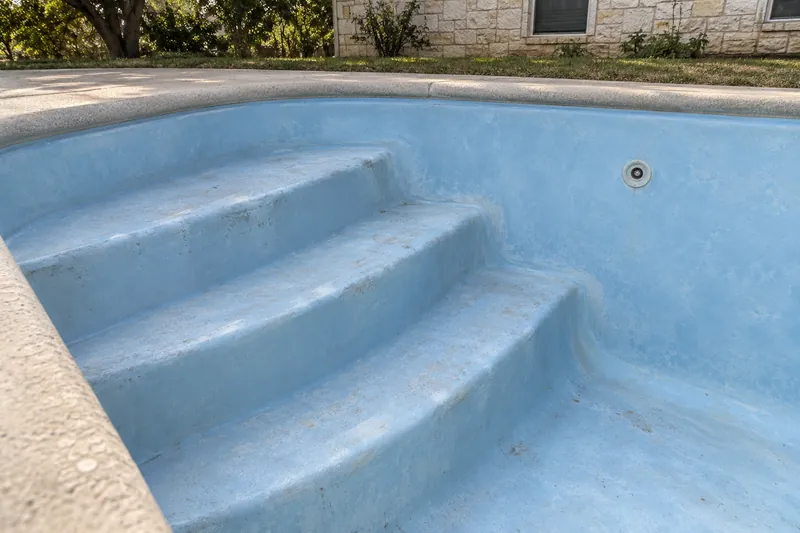
Fading, chalking and roughness
Some change is normal. River Pools says a fiberglass pool's color may fade in the sun, but evenly and gradually enough that you probably won't notice. Tallman Pools, another maker, says incorrect water chemistry can cause discoloration, chalking, fading, etching or scale, and ecoFINISH, which makes a refinishing coating, describes worn shells turning chalky, discolored and rough to the touch as the gelcoat breaks down.
Cracks and blisters are usually repairs
River Pools calls spider cracks, the fine hairline cracks in the gelcoat, typically cosmetic rather than structural, and says the same of osmotic blisters, where water works through the gelcoat and pushes it out from the layer behind. Gelcoat itself suits smaller patches, so isolated cracks and blisters usually call for fiberglass pool repair rather than a full refinish.
Call or request a free estimate any time, 24/7.
(737) 212-9378Three ways to refinish a fiberglass pool
Polymer powder coating
River Pools' standard recommendation for refinishing a fiberglass pool is ecoFINISH, a polyethylene powder sprayed with a compressed-air gun and set with heat. Its steps: sandblast if paint or residue is stuck to the surface, clean and inspect, coat the whole pool in epoxy, spray the powder onto the tacky epoxy, cure it with heat, and build it up in a few layers. ecoFINISH calls its fiberglass coating, polyFIBRO, a thermo-polymer that doesn't chip, peel or crack like gel-coat and paint finishes.
New gelcoat
River Pools says gelcoat is meant to be applied in a factory, because it takes time to dry, must cure at a consistent temperature and needs a precision that can't be matched outdoors; it suits smaller repairs, not resurfacing a whole pool in the ground. Some gelcoat sellers do show pools re-gelcoated in place, and ecoFINISH adds that a re-gelcoat limits the color to light shades such as white, baby blue, tan and light grey.
Epoxy pool paint
Paint makers that allow fiberglass specify epoxy: Insl-x recommends only its epoxy pool paint for fiberglass shells, Ramuc its Hi Build or HB31 epoxy, and Olympic two coats of POXOLON 2 or one coat of ZERON over its GUNZITE primer; Insl-x doesn't recommend its waterborne acrylic on bare fiberglass. They differ on prep. Insl-x scuff-sands bare fiberglass with 150 to 180 grit and Ramuc abrades it to a #80 grit profile; Olympic says no acid wash is needed, while Ramuc's Hi Build guide acid-washes with a 15 to 20 percent solution to remove mineral deposits. ecoFINISH argues paint bonds poorly to smooth, non-porous gelcoat. We handle pool painting as well.
For a free estimate on refinishing a fiberglass pool, call Leander Pool Resurfacing or send the form.
Call or request a free estimate any time, 24/7.
(737) 212-9378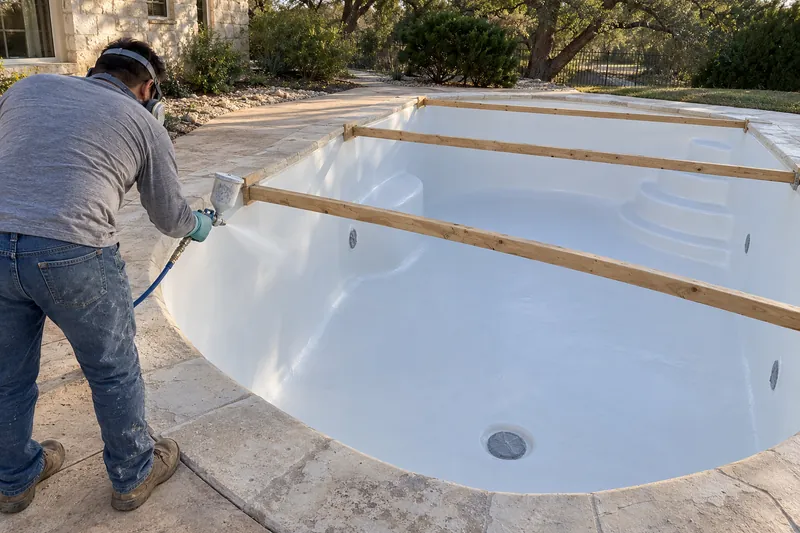
Draining a fiberglass pool for resurfacing
Latham's manual warns that a fiberglass pool drained without first relieving hydrostatic pressure will buckle and crack, and Tallman Pools lists floating or shifting and gelcoat blistering or cracking among the risks of draining without its written authorization.
Bracing and groundwater
River Pools' steps for a necessary drain are to check that the weather will stay dry for the whole job, inspect for and remove groundwater, brace the pool, then take the water out while making sure the floor doesn't lift. It typically uses three braces across the width, 18 to 24 inches down the side walls, because the walls can push in as the water comes out. Tallman Pools tells owners to check the groundwater inspection port before any service that lowers the water, and to pump slowly, stopping if sediment appears.
Rain and the drought rules
NOAA's precipitation normals for its Leander 1.6 NW station average 34.27 inches of rain a year, with May the wettest month at 4.23 inches, and the National Weather Service puts the area in Flash Flood Alley, with severe weather mainly from March through May. As of October 1, 2026, Leander is in Phase 2 Water Conservation, and its code doesn't say whether a refill after resurfacing is allowed, so confirm with the City before the pool is drained. Leander Pool Resurfacing will talk through the drain-down with you once the maker's rules are known.
Beyond Leander, we also handle fiberglass pool resurfacing in Weir.
Call or request a free estimate any time, 24/7.
(737) 212-9378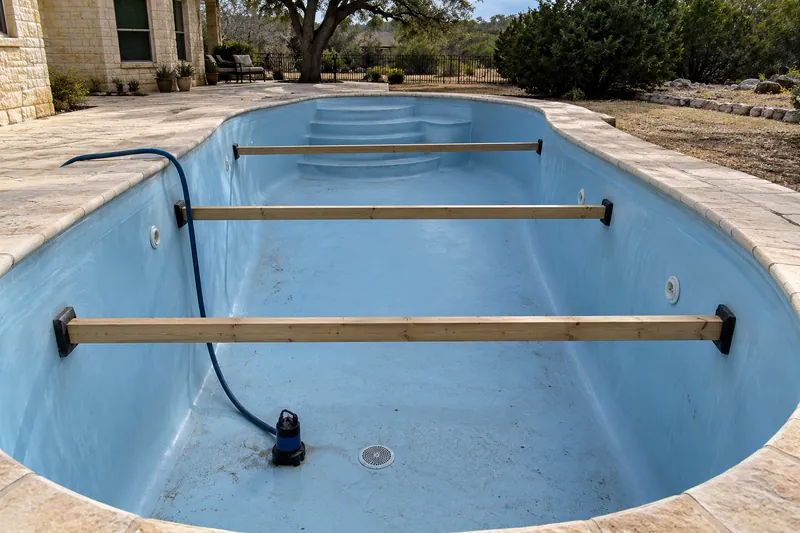
Water balance for fiberglass in Leander's hard water
The makers' ranges
Fiberglass makers disagree sharply on calcium. River Pools says to keep calcium hardness below 120 ppm and pH at 7.2 to 7.4, warning that high pH plus high calcium damages the surface, and calls calcium the root cause of most discoloration on fiberglass. Tallman Pools sets calcium at 80 to 120 ppm and pH at 7.2 to 7.4, and says scale needs only a pH above 7.4 with calcium above 120. Latham's warranty, by contrast, lists calcium hardness of 250 to 350 ppm.
The City's fill water
Leander's 2024 water report gives hardness of 194 ppm, listed in calcium and magnesium terms, alkalinity of 156 ppm and pH 8.2. The pH is above the 7.2 to 7.4 range both River Pools and Tallman ask for, and the report has no separate calcium figure, so a refilled fiberglass pool starts with a water test against its own maker's numbers.
A coated pool needs less waiting: ecoFINISH says pools and spas with its coatings need no start-up process and can be heated as soon as they're filled. We handle spa resurfacing as well.
Call or request a free estimate any time, 24/7.
(737) 212-9378Fiberglass pool resurfacing cost
National 2026 figures put fiberglass resurfacing or recoating at $6,000 to $15,000, and fully resurfacing a fiberglass pool at an average of $6,500 per 1,000 square feet. A Houston fiberglass pool company's 2025 ranges break it down by method: basic gel coat resurfacing $5,000 to $8,000 and a full fiberglass layer replacement $12,000 to $20,000, with refill water and chemicals adding $300 to $700.
In the Austin area, repainting a fiberglass pool runs $1 to $2 per square foot in 2026. These are published figures, not prices from Leander Pool Resurfacing, and the method your shell needs decides the number, so the estimate starts with a look at the pool.
- Resurfacing or recoating, national (2026)
- $6,000–$15,000
- Full resurfacing, per 1,000 sq ft, national (2026)
- $6,500
- Basic gel coat resurfacing, Houston company (2025)
- $5,000–$8,000
- Full fiberglass layer replacement, Houston company (2025)
- $12,000–$20,000
- Repainting, per sq ft, Austin (2026)
- $1–$2
National averages, a Houston company's published ranges and an Austin figure. Not a quote.
Call or request a free estimate any time, 24/7.
(737) 212-9378Fiberglass pool resurfacing questions
How often do fiberglass pools need to be resurfaced?
Rarely, by the makers' own account. River Pools says a fiberglass pool is usually 20 or 30 years old before it shows a need for refinishing, and that in most cases one never needs resurfacing unless its water chemistry or cleaning is neglected. ecoFINISH, which sells a refinishing coating, puts first wear much earlier, at 10 to 15 years of regular use. No maker states how long a refinish done in the ground lasts.
How much does it cost to recoat a fiberglass pool?
It depends on the coating. National 2025 figures put an ecoFINISH thermoplastic polymer coating at $10,000 to $15,000 for a medium-sized pool, and a Houston fiberglass pool company prices an epoxy or polymer coating at $7,000 to $12,000. For minor scratches and dings, a new gel coat with a painted topcoat runs around $1,000 to $1,200, according to national 2026 figures.
Does draining a fiberglass pool void the warranty?
It can. Latham's manual says in capital letters that draining the pool voids the warranty, River Pools says that for most manufacturers an authorized dealer must drain the pool or the warranty may be voided, and Tallman Pools requires its written authorization first. Latham's warranty also leaves draining, bracing and removing groundwater to the owner when a repair is made. Check the maker and the warranty papers before a resurface is booked.
How long does it take to resurface a fiberglass pool?
A Houston fiberglass pool company puts the whole process at 5 to 10 days, depending on the pool's size and condition. The coating sets part of it: River Pools says a powder coating dries almost at once, so the pool can be refilled the same day, while epoxy paint waits before filling, 5 to 7 dry days outdoors for Ramuc's EP epoxy and at least 7 days after the final coat for Insl-x. ecoFINISH puts a gel-coat cure at over a week.
Which chlorine is safe for a fiberglass pool?
Liquid chlorine, by most makers' rules. Tallman Pools bans calcium hypochlorite, dichlor granular chlorine and trichlor tablets in its fiberglass pools and says to shock only with liquid chlorine or a non-chlorine oxidizer, and River Pools also says to avoid calcium hypochlorite. Latham's older manual allows calcium hypochlorite, but only pre-dissolved, to keep it from bleaching or staining the surface.
Get a free fiberglass pool resurfacing estimate
Leander Pool Resurfacing answers calls and estimate requests 24/7 for fiberglass pools in Leander and nearby towns. Tell us who made the pool, roughly how old it is and what the surface looks like now.