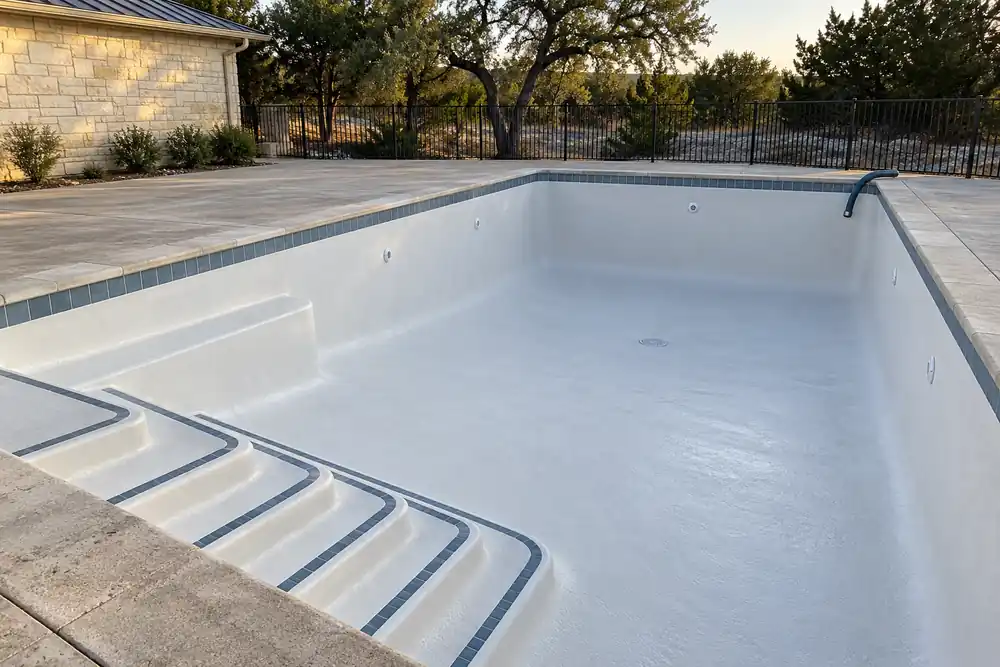
Pool Plaster Repair in Leander, TX
Leander Pool Resurfacing handles pool plaster repair in Leander, Texas: hollow and delaminated spots, spalling and etched patches, scale, stains and rust, and the cracks and leaks that work on a plaster finish from behind. The National Plasterers Council separates delamination, a material separating from itself or from its substrate, from debonding, one material separating from another.
Call or send the form for a free estimate. We'll talk through what the damage points to, whether a patch, a stain treatment or a replaster suits your pool, and what draining involves under Leander's water rules.
Call or request a free estimate any time, 24/7
No charge · answered 24/7
Get free estimates
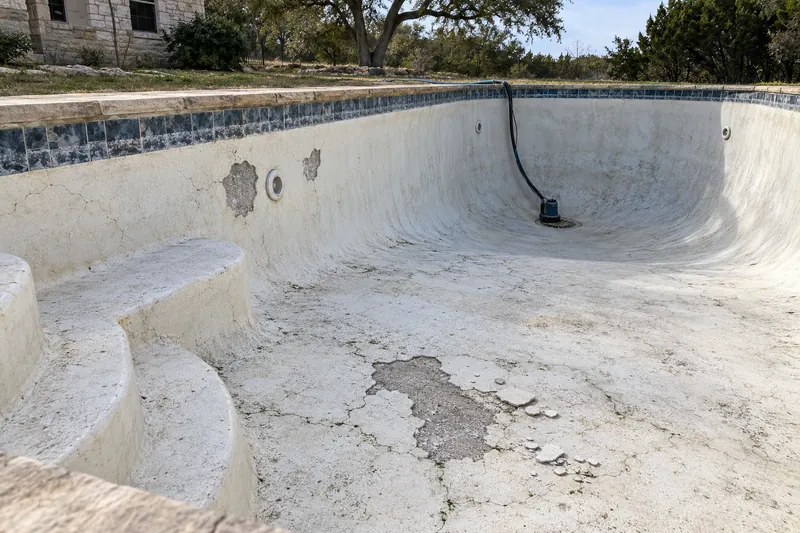
Hollow, peeling and delaminated plaster
Signs to look for
Universal White Cement, a white cement maker, lists the usual signs: raised, blister-like or volcano-shaped areas; patches around lights, returns, tile lines, steps and benches; and circular or spider cracks gathered around one patch. Its field check is to tap the surface in a grid with a screwdriver's plastic handle or a rubber mallet and listen for the dull, drum-like sound of plaster that has let go.
Why plaster lets go
The same maker calls delamination a bond failure, not a cosmetic issue, and usually a process problem rather than a cement problem. Its list of causes: dust, paint, loose old plaster, algae or scale left on the shell; a poor bond coat; cold joints where work stopped and restarted; over-troweling; and thin layers stacked over a marginal old finish.
Patch or replaster
Universal White Cement sorts the damage into three tiers: a few small, isolated hollow spots can sometimes be chipped out and patched when the rest of the surface is in good condition; spreading or patterned hollow areas point to a bond problem across the pool, where patching may only put off the inevitable; and widespread separation calls for a full replaster. Before a resurface, SGM's manual saws 3 inches outside each hollow spot and fills the hole with patching cement. Once the hollow areas have spread, the job becomes pool replastering.
For a free estimate on hollow or peeling plaster, call Leander Pool Resurfacing or send the form.
Call or request a free estimate any time, 24/7.
(737) 212-9378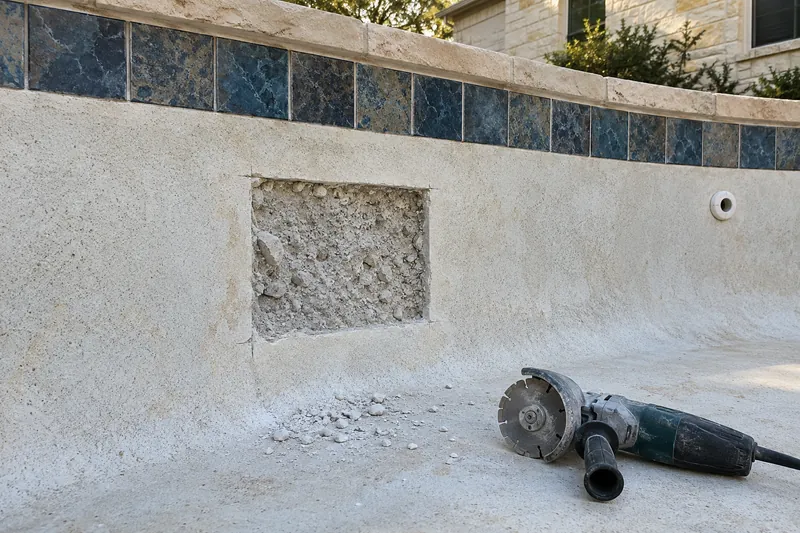
Stains, scale and acid washing
Discoloration and torching
Torching, which the National Plasterers Council developed for abnormal discoloration, heats a drained plaster surface with a propane torch, slowly over a number of days, after a light acid wash. Its targets run from inlet-water and sprinkler stains to rings where a fill stopped, drip marks and hardened plaster dust. Flat plaster and white quartz are the best candidates, pebble can be torched only very delicately, and glass bead not safely at all. Some color loss can't be undone: the Council says aggressive water can leach pigment from a colored finish up to 1/8 inch deep, and that loss is irreversible.
Scale
The Council defines scale as minerals or metals that come out of the water and stick to tile, finishes and other surfaces, with calcium carbonate a major component. On plaster it shows as a white or light-colored film that can dull the finish's color or hide it completely.
Acid washing
Makers warn against overdoing acid washes. Universal White Cement says frequent drain-and-acid washes may make a pool look whiter for a while but strip years off the plaster, and SGM found that on traditional limestone-based plaster, acid washing brought only temporary relief and sped up erosion. The full process is covered under pool drain and acid wash.
Call or request a free estimate any time, 24/7.
(737) 212-9378Rust, cracks and water behind the plaster
Rust stains coming through
Rust spots bleeding through plaster can start in the shell. The American Shotcrete Association says rust stains come through when shotcrete was shot with too little cover over the reinforcing steel, leaving a section much less durable than its designer intended, and an article it published adds that water reaching the steel can start corrosion that may spall the concrete off.
Cracks in the plaster or the shell
Not every crack is structural. The National Plasterers Council says all cement-based finishes develop some shrinkage or check cracking before the pool is filled, and that these cracks typically reseal underwater. The American Shotcrete Association says small holes and shrinkage cracks can often be plugged or patched, its normal repair for a small hole being a pressure wash of at least 3,000 psi and a nonshrink hydraulic cement rated at least 4,000 psi at 28 days; structural movement cracks need a closer look at cause and remedy, which is pool crack repair.
Water pushing from behind
SGM requires water seeping through the shell under pressure, which it calls weepers, to be stopped with hydraulic cement before new plaster goes on, and the Council warns that water collecting against the outside of the shell, from rain, irrigation or a leaking irrigation pipe, can build back pressure that debonds a finish. When water is getting through the shell or its fittings, pool leak repair comes before any plaster patch.
Call or request a free estimate any time, 24/7.
(737) 212-9378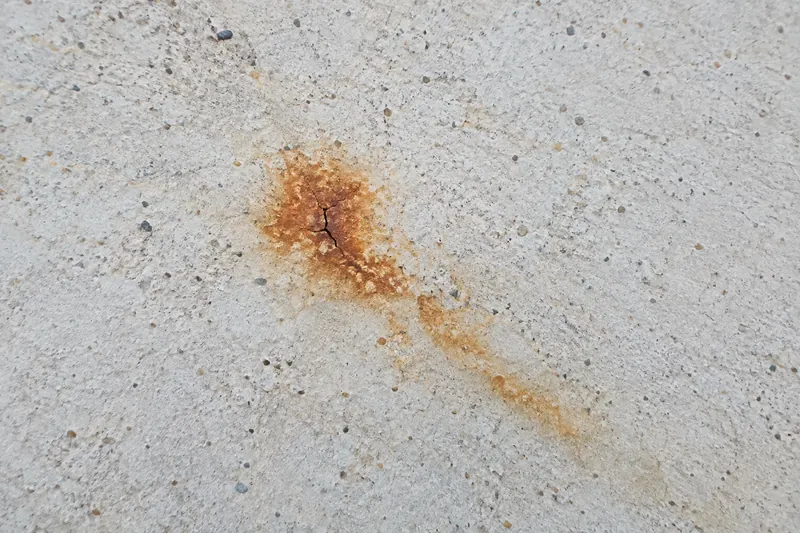
Leander water, freezes and draining for a repair
Fill water
The City of Leander's 2024 water report lists hardness of 194 ppm, alkalinity of 156 ppm and pH 8.2 but no calcium figure, so balancing a repaired pool starts with a test. Softening isn't the answer: the Council warns that filling with soft water damages a cement finish, from severe discoloration to a weakened binder.
Freeze-thaw at the waterline
Freeze-thaw damage shows in stages, the Council explains: white efflorescence just above the waterline, then a rough surface losing aggregate, then thin layers that crack, lift or peel, with steps, benches and sun ledges most at risk. In the January 24–25, 2026 winter storm, parts of the Austin area and Hill Country spent more than 48 hours below freezing.
Draining for a repair
Universal White Cement gets the clearest tap test from a drained pool, so a repair may mean draining. As of October 1, 2026, Leander is in Phase 2 Water Conservation, but since mid-2023 the City has gone above Phase 2 at least four times for work or failures at the regional treatment plant, and during its Phase 4 periods City water couldn't be used to refill a pool. Drained pool water may enter the storm drains only once it is dechlorinated to less than 1 ppm.
Beyond Leander, Leander Pool Resurfacing also handles pool plaster repair in Hutto.
Call or request a free estimate any time, 24/7.
(737) 212-9378Pool plaster repair cost in the Austin area
Typical Austin-area figures for 2026 put general swimming pool repair at $449 on average, within $246 to $673, and in-ground pool repairs at $345 to $2,650. National averages for 2025 put plaster surface repair at $200 to $1,200 or more, depending on the pool's size and type and how far the damage goes.
On a concrete or gunite pool, national 2025 figures run $100 to $200 for small cracks and $700 to $1,000 for large or spider-web cracks, bulges or divots, and a repair that needs draining adds $180 to $230 in drain and refill fees nationally (2026). They are published figures, not prices from Leander Pool Resurfacing, which estimates your repair for free.
- Swimming pool repair, Austin average (2026)
- $449
- In-ground pool repair, Austin (2026)
- $345–$2,650
- Plaster surface repair, national (2025)
- $200–$1,200+
- Small cracks, concrete or gunite, national (2025)
- $100–$200
- Large or spider-web cracks, national (2025)
- $700–$1,000
- Drain and refill fees, national (2026)
- $180–$230
Published Austin-area and national figures, for planning only. Not a quote.
Call or request a free estimate any time, 24/7.
(737) 212-9378Pool plaster repair questions
Is a hollow spot in pool plaster urgent?
It depends on what the spot is doing and how old the finish is. Universal White Cement treats areas that are actively popping off, leaving sharp edges or dropping debris as higher priority, and says delamination in a new or fairly young finish points to more serious problems than in an old one. It also warns that voids behind loose plaster can let water in, with structural or rust problems possible later. Leander Pool Resurfacing gives free estimates on hollow spots of any size.
When does pool plaster need replacing instead of repairing?
Universal White Cement lists the signs that plaster has reached the end of its life: roughness and pitting underfoot with aggregate exposed across large areas, widespread etching or soft areas, large hollow or debonding sections, and deep stains that no longer respond to treatment. Mild mottling and color variation, and light surface roughening in high-traffic areas, it counts as normal aging rather than a reason to replaster.
Why is pool plaster rough or pitted?
Etching is the usual reason. The National Plasterers Council defines it as material removed from within the finish surface, seen as visible pitting, and ties it to the water: low calcium hardness dissolves calcium compounds, low pH dissolves materials generally, and high cyanuric acid causes dissolving, leaching and fading. Spalling is different, Universal White Cement explains: the top cream layer breaks away from chemistry or freeze-thaw while the plaster underneath stays bonded.
What are the white bumps on pool plaster?
Often calcium nodules: small mounds or 'volcanoes' that exude calcium, usually on floors or in micro-cracked areas, which Universal White Cement says may or may not sit over a true hollow spot. Efflorescence is related; the National Plasterers Council defines it as soluble compounds, mainly calcium hydroxide, carried to the surface by moisture and hardening there. Orenda, a pool chemical maker, offers a quick check: real scale lands on every surface in the water, so white calcium that shows only on the cement isn't scale.
Where do metal stains in pool plaster come from?
Mostly from the water. The National Plasterers Council says copper and manganese can stain a finish blue, green or black, and iron red, orange or black, and LATICRETE notes that iron and copper in the source water drop out of solution at normal pool pH. Chelating or sequestering chemicals can hold the metals back, but once started, the Council says, they have to be used continuously, because new fill water keeps bringing metals in.
Get a free pool plaster repair estimate
Leander Pool Resurfacing answers calls and estimate requests 24/7 for plaster repair in Leander and nearby towns. Tell us where the damage is, how big it looks and roughly how old the plaster is.