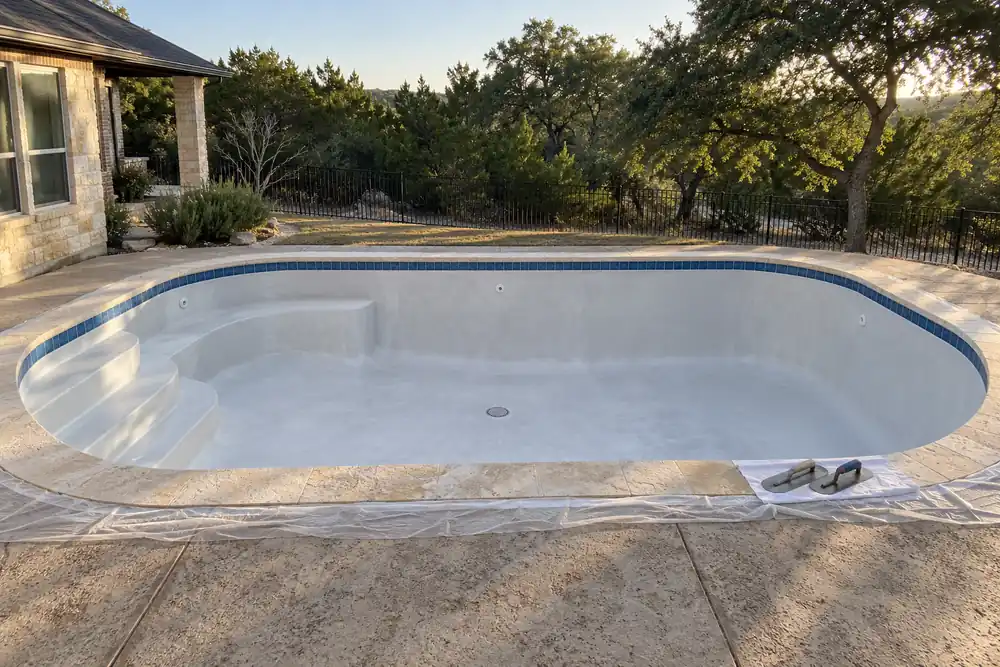
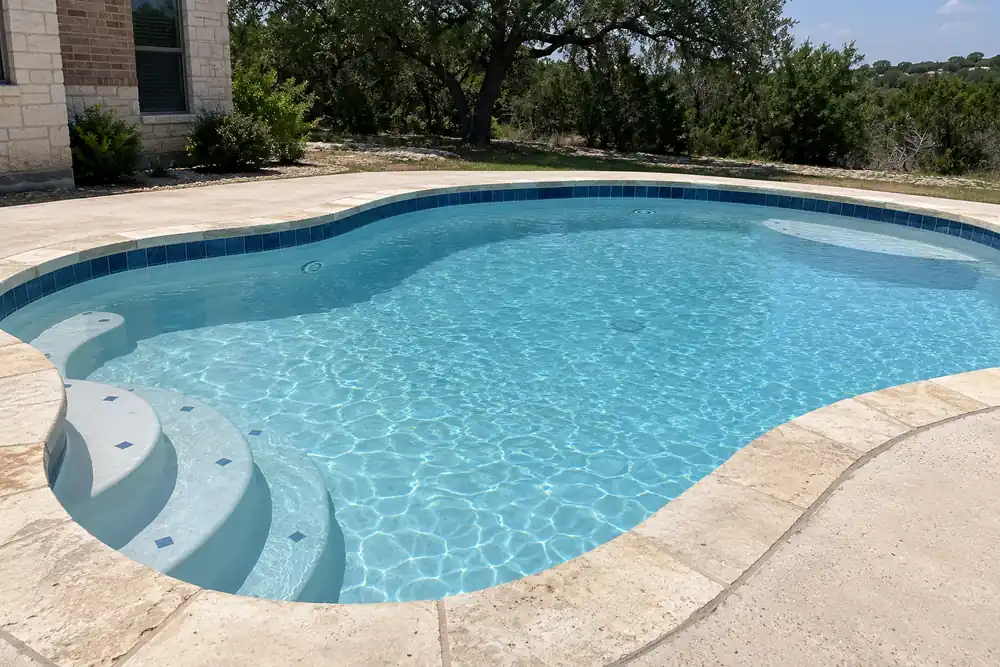
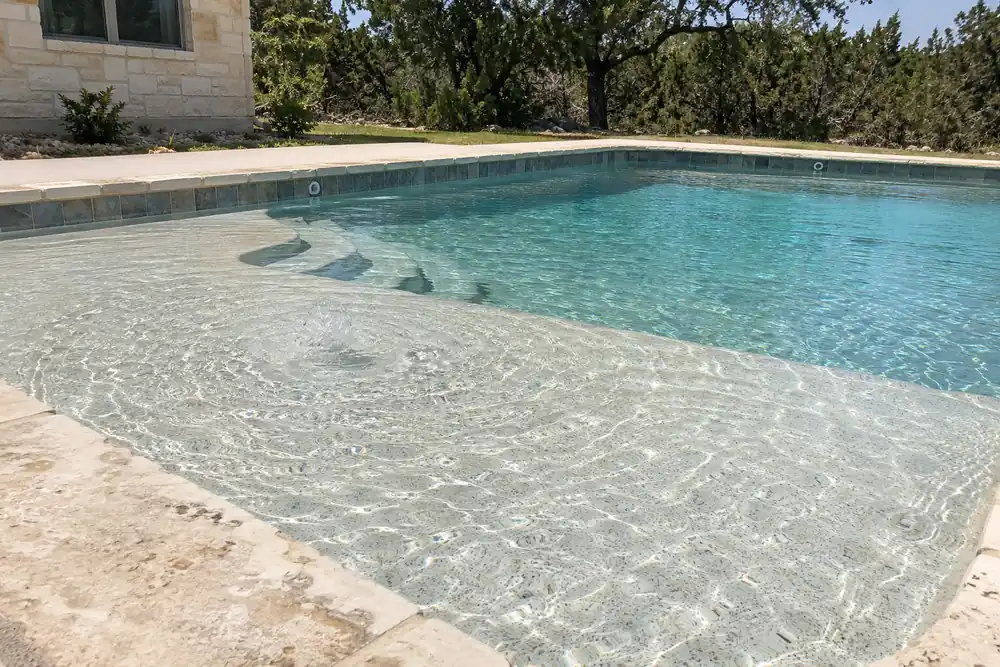
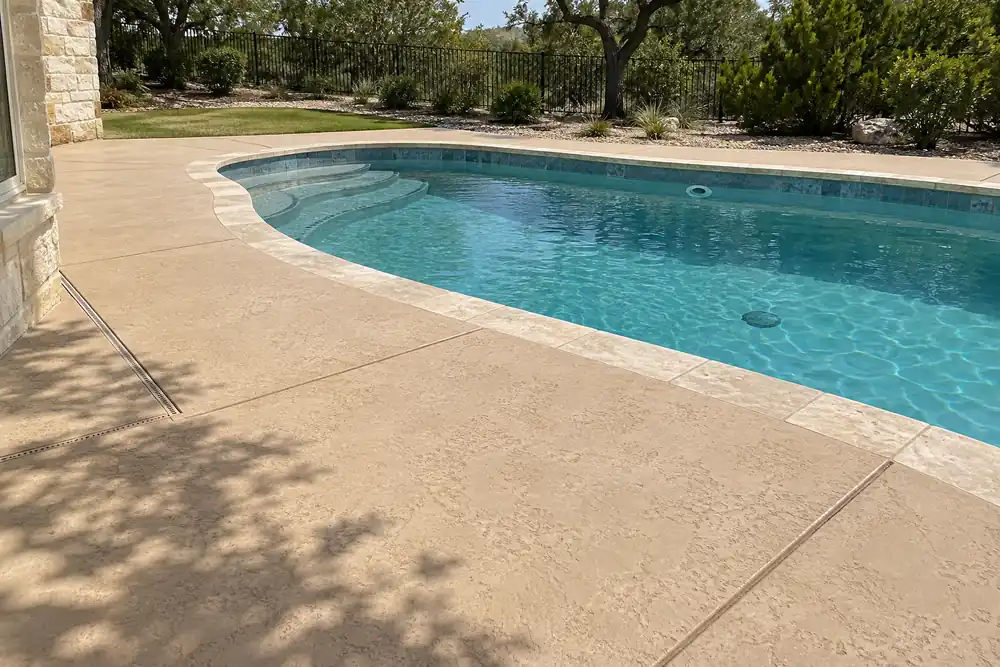
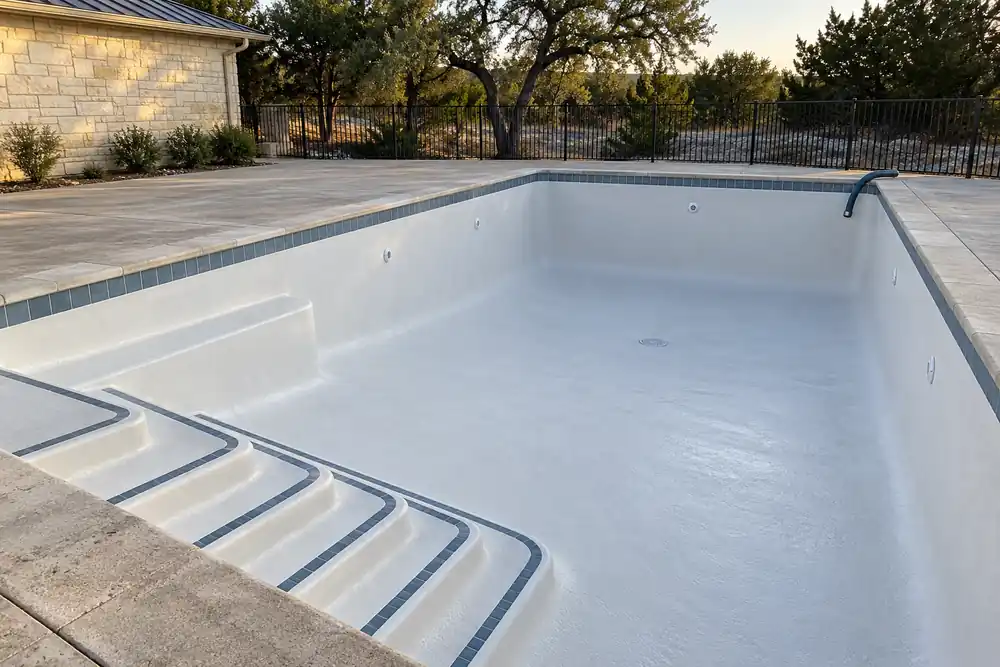
Pool Deck Resurfacing in Leander, TX
Leander Pool Resurfacing handles pool deck resurfacing in Leander, Texas: acrylic spray-texture and knockdown coatings, cement-based toppings and thin resurfacers, laid over a sound concrete deck once its cracks, joints and low spots are dealt with. The International Swimming Pool and Spa Code, adopted by the City of Leander, requires pool decks and coping to be slip resistant and cleanable.
Call or send the form for a free estimate. We'll talk through the systems that suit your deck, the repairs it needs first, and how soon it can take bare feet and furniture again.
Call or request a free estimate any time, 24/7
No charge · answered 24/7
Get free estimates
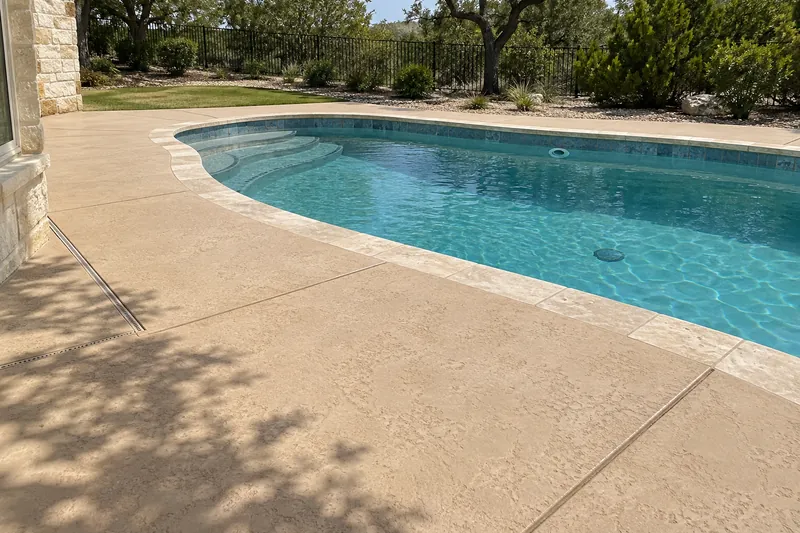
Pool deck coatings: acrylic, cement-based and rubber
Acrylic spray texture and knockdown
SUNDEK's acrylic coating is about as thick as two stacked quarters, just under a quarter inch, and can feather uneven surfaces up to 2 inches deep. Its knockdown texture is sprayed on and flattened with a trowel's edge into a slip-resistant surface, then given two acrylic finish coats for color; in all, SUNDEK applies 4 to 8 layers.
Cement-based toppings and resurfacers
Sider-Crete's Sider-Deck is a cement-based, polymer-modified texture, sprayed from a hopper gun and knocked down to cover 70 to 80 percent of the concrete, then sealed with an acrylic, silicone-enhanced sealer that supplies the color. QUIKRETE's Re-Cap is a polymer-modified portland cement resurfacer applied from a feather edge of 1/16 inch up to 1/2 inch, and Mortex says its three-step Systex system resists oil and grease stains better than plain concrete.
Rubber, cool deck and pavers
Tuff Coat's roll-on coating binds recycled rubber granules into a flexible, non-skid surface 30 to 35 mils thick. Mortex invented Kool Deck in 1962 and says it significantly lowers the surface temperature of concrete; an existing Kool Deck surface is covered under cool deck repair. Travertine and paver pool decks replace the surface instead of coating it, and the Interlocking Concrete Pavement Institute says pavers around pools typically sit on a concrete base at least 4 inches thick where the soil can't be compacted well enough.
For a free estimate on a deck coating, call Leander Pool Resurfacing or send the form.
Call or request a free estimate any time, 24/7.
(737) 212-9378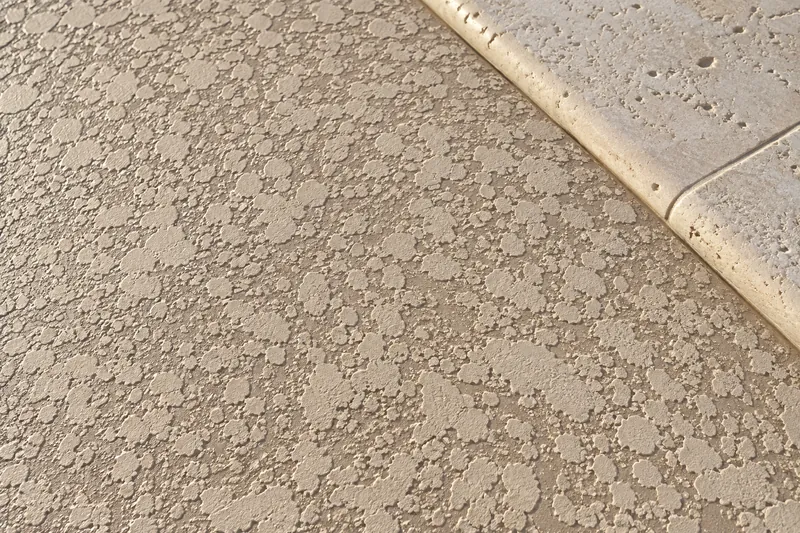
Preparing an old pool deck for a new surface
Cleaning and removing old coatings
Every system starts on clean concrete. SUNDEK power-washes the deck, removes grease, oil and curing compounds, may need old coatings mechanically removed, and won't go over paint. QUIKRETE calls a 2,500 PSI pressure wash essential for its resurfacer to bond, on bare concrete only, and Sider-Crete lays a thin plastic tarp on the pool water so nothing falls in. The makers even disagree on neutralizing after an acid etch: Sider-Crete recommends TSP, while Mortex says TSP leaves a film that breaks the Kool Deck bond, so each maker's instructions apply to its own product.
Joints and the coping edge
SUNDEK keeps existing control joints open and replaces worn expansion joints. Where the deck meets the coping, the pool code calls for a watertight isolation joint that protects the coping and its mortar bed from the deck's movement, and W. R. Meadows' DECK-O-SEAL, a polysulfide sealant made for pool decks, stretches or compresses up to 25 percent once cured. Settled slabs, wide cracks and failed joints are pool deck repair work that comes before any coating.
Slope and low spots
The code limits a concrete pool deck's slope to 1/2 inch per foot and wants no more than 1/8 inch of water standing 20 minutes after the water stops. SUNDEK asks for at least 1/4 inch per foot under its coating and says a coating doesn't guarantee a drainage correction, though a low spot can sometimes be moved, or made wider and shallower, if the installer is told beforehand.
Call or request a free estimate any time, 24/7.
(737) 212-9378Coating day and the cure
Layer by layer
SUNDEK's specified order is a primer, a base coat at least 1/8 inch thick, a stipple coat and a splatter coat knocked down with a flexible pool trowel, caulking at joints, then two finish coats, each drying completely; a typical installation takes about 2 to 8 clear, dry days. Sider-Crete seals its texture 24 to 48 hours after it goes on, in two thin coats laid at right angles.
When the deck can be used again
SUNDEK protects a new deck from moisture, freezing and foot traffic for 24 hours and from vehicles for 72. Sider-Crete allows light foot traffic after 24 hours and keeps patio furniture, hard-soled shoes and heavy use off for at least a week, while QUIKRETE's resurfacer takes foot traffic after 8 hours.
Call or request a free estimate any time, 24/7.
(737) 212-9378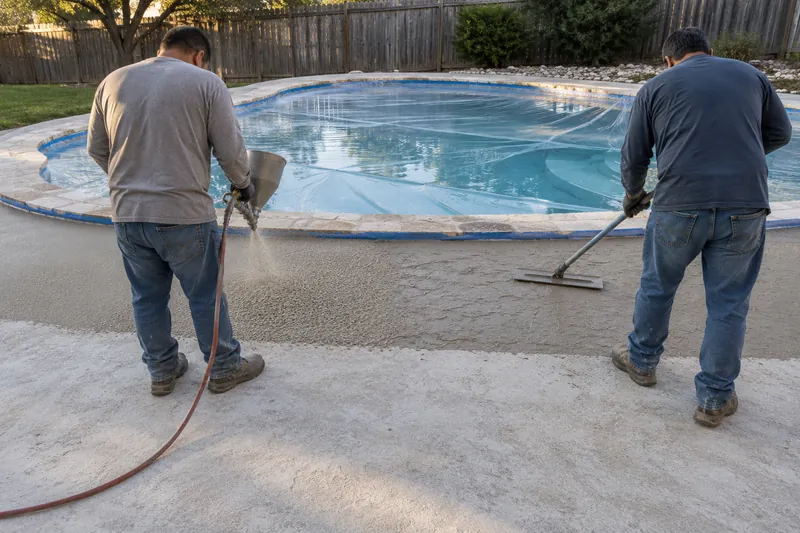
Pool decks in Leander heat and clay
Coating in Texas heat
Sider-Crete warns that hot concrete may force its material to set too quickly and recommends working in cooler temperatures; QUIKRETE keeps air and concrete between 50°F and 90°F, and Tuff Coat paints between 9 a.m. and 4 p.m. at 40°F to 90°F. Camp Mabry, Austin's official climate station, normally tops 90°F from May 26 to September 23, and NOAA's records put its 2026 high, through September 28, at 107°F.
Clay and limestone under the slab
Leander's ground moves. At the city's center point, the USDA soil map shows Denton silty clay over limestone about 3 feet down, a soil whose severe shrink-swell potential, the 1983 county soil survey says, affects foundations, streets and buried utility lines; at the Block House Municipal Utility District office it is Fairlie clay, which opens wide cracks when dry. Prime Resins, a maker of slab-lifting foam, says polyurethane foam injected under settling slabs can stabilize them and lift them back without excavation.
Apartment and HOA pool decks
Under Texas health rules, a pool run for an apartment complex, condominium or property owners association is a Class C public pool, and public pool decks must have no standing water. The CDC's Model Aquatic Health Code, a model rather than Texas law, also caps open deck joints at 3/16 inch. Those jobs fall under commercial pool deck resurfacing.
Outside the city, Leander Pool Resurfacing also handles pool deck resurfacing in Bee Cave.
Call or request a free estimate any time, 24/7.
(737) 212-9378Pool deck resurfacing cost in the Austin area
In the Austin area, typical 2026 prices per square foot installed are $3 to $6 for a spray texture coating, $5 to $8 for a textured coating with a color coat and $8 to $15 or more for a stamped or decorative overlay, so a 300 to 600 square foot residential pool deck usually comes to $1,500 to $5,000. National averages for 2025 run $3 to $12 per square foot, and sealing concrete adds $1 to $3.
Size and shape move the price, freeform and multi-level decks taking more labor, along with the coating system, the deck's condition, the number of colors and whether coping is included; crack and joint repairs are priced on their own. Treat these as published averages rather than prices from Leander Pool Resurfacing; the figure for your own deck comes with a free estimate.
- Spray texture coating, per sq ft, Austin (2026)
- $3–$6
- Textured coating with color coat, per sq ft, Austin (2026)
- $5–$8
- Stamped or decorative overlay, per sq ft, Austin (2026)
- $8–$15+
- 300–600 sq ft residential deck, Austin (2026)
- $1,500–$5,000
- Deck resurfacing, per sq ft, national (2025)
- $3–$12
- Concrete sealing, per sq ft, national (2025)
- $1–$3
Published Austin-area figures and national averages; not a quote.
Call or request a free estimate any time, 24/7.
(737) 212-9378Pool deck resurfacing questions
What is the best coating for pool decks?
No industry body ranks them; the right one depends on the deck underneath and how hot it gets underfoot. Mortex says Kool Deck significantly lowers concrete's surface temperature, though its darker Designer Colors run warmer, and that its bonder sticks only to solid concrete, not brick, tile or natural stone. Sider-Crete's coating can go over an existing cement-based deck coating that is unpainted and unsealed. Leander Pool Resurfacing will talk through the options for your deck.
What is the best non-slip coating for pool decks?
A textured one. Sider-Crete always recommends a knockdown texture for maximum slip resistance and says even its system isn't slip-proof. Leander's adopted code requires decks to be slip resistant and cleanable; a measurable figure comes from another model code, the 2021 Uniform Swimming Pool, Spa & Hot Tub Code, which the Tile Council of North America reports set a wet dynamic coefficient of friction of at least 0.42 for level walkways meant to be walked on wet.
Can a cracked pool deck be resurfaced?
Usually, with the cracks treated first and some chance they show again. SUNDEK fills most cracks with urethane and says they may come back as hairlines largely hidden in the texture, and QUIKRETE says cracks in the old slab can't be completely kept from reflecting into a new cement surface, especially where the slab settles. The National Ready Mixed Concrete Association adds that most early random cracks rarely affect concrete's structural integrity.
Does an HOA have to approve a new pool deck surface?
Often. The Crystal Falls HOA lists decks and hardscaping among the exterior changes that need its Architectural Control Committee's approval, exempts repairs done the same way with the same materials, and has the homeowner, not the contractor, apply. Block House Creek's deed restrictions count patios and decks as improvements needing the Architectural Committee's prior written approval.
Is it cheaper to resurface or replace a pool deck?
Resurfacing, usually by a wide margin. An Austin deck-coating contractor says resurfacing is consistently less expensive than replacing a pool deck, often by a factor of three or more. National 2026 figures put basic resurfacing at $4 to $8 per square foot, against $2 to $6 to remove the old surface plus $6 to $18 or more for new concrete.
Get a free pool deck resurfacing estimate
Leander Pool Resurfacing answers calls and estimate requests 24/7 for deck resurfacing in Leander and nearby towns. Tell us roughly how big the deck is, what surface it has now and where it has cracked or holds water.