Pool Tile Repair and Replacement in Leander, TX
Leander Pool Resurfacing handles pool tile repair in Leander, Texas: loose, cracked or hollow waterline tile replaced piece by piece or as a full band, failed grout renewed, and flexible joints restored where the tile meets the coping. The National Plasterers Council's glossary defines the perimeter tile simply as the water line tile. It is the one surface in a pool that lives both in and out of the water.
Call or send the form for a free estimate. We'll talk through whether your band needs a few tiles reset, a regrout or full replacement, and how long new work cures before the water goes back up.
Call or request a free estimate any time, 24/7
No charge · answered 24/7
Get free estimates
Waterline tile and the materials that hold it
Ceramic, porcelain and stone
LATICRETE's pool guide allows only impervious tile, absorbing under 0.5 percent water, or vitreous tile, under 3.0 percent, because tile absorbing more than 3 percent may permanently expand from moisture. It recommends paper face-mounted mosaics over sheets held by PVC dots or mesh on the back, whose bond can be very low once soaked in pool water.
Glass tile
Interstyle requires face-mounted or dot-mounted glass under water, since mesh backing can interfere with the bond, though LATICRETE is warier of dot-mounted sheets. Interstyle makes back-buttering mandatory so no water collects behind the tile, and LATICRETE calls for at least 95 percent mortar coverage. Oceanside Glass & Tile specifies bright-white thin-sets made for translucent glass, and because glass chips more readily than porcelain, spare tiles from the same run are worth keeping.
Mortar and grout rated for submersion
LATICRETE sets pool tile only in mortars suited to continuous submersion and recommends epoxy adhesives to eliminate deterioration from chemical attack. MAPEI's pool specification, published with Daltile, follows the Tile Council of North America's pool method P602 and calls for a flexible sealant meeting ASTM C920, and the International Swimming Pool and Spa Code, adopted by the City of Leander, names the ANSI A108, A118 and A136.1 standards for tile in a pool shell.
For a free estimate on waterline tile, call Leander Pool Resurfacing or send the form.
Call or request a free estimate any time, 24/7.
(737) 212-9378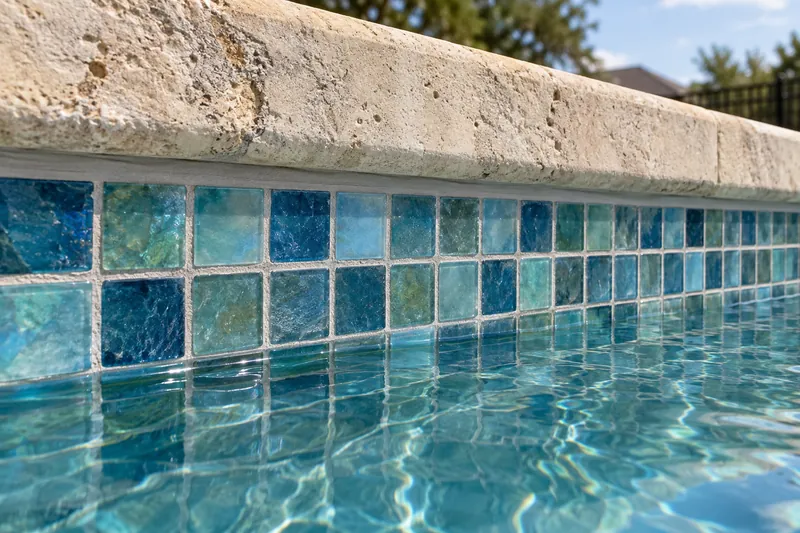
How pool tile is repaired and replaced
Finding why the tile failed
LATICRETE advises working out why a repair is needed before making it. The cause often sits behind the band: without a working flexible joint between the deck and the coping, the deck's seasonal movement can dislodge coping and tile and crack the waterline tile horizontally. The pool code wants that coping-to-deck joint watertight and built to shield the coping and its mortar bed, so a tile job that starts there goes hand in hand with pool coping repair and replacement.
Cutting out loose or cracked tile
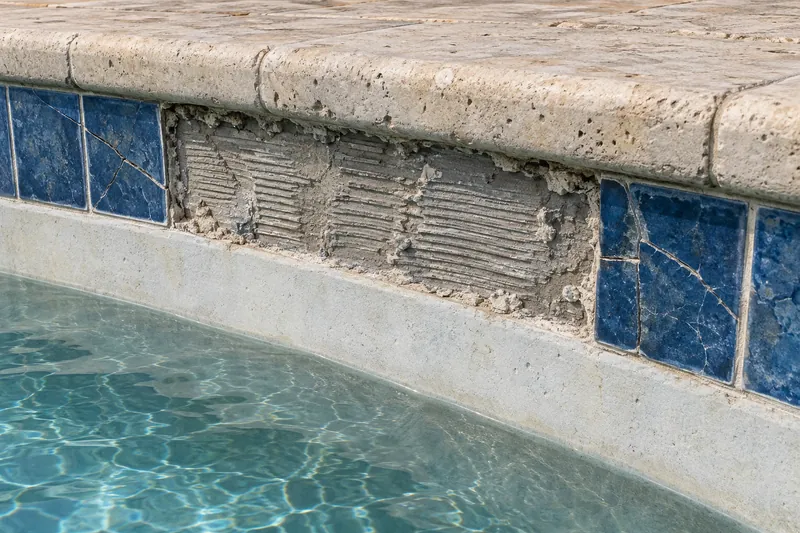
LATICRETE's repair sheet cuts around each loose or cracked tile with an angle grinder or circular saw fitted with a dust attachment, grinds the old thin-set down to the concrete and sets new tile in an adhesive rated for submersion. The surface must be free of dust, sealers and anything that could act as a bond breaker, and Oceanside Glass & Tile wants cracks, active leaks and unsound concrete repaired before tile work starts.
Regrouting a sound band
Where only the grout has failed, LATICRETE clears it with a pressure washer or saw-cuts the joints with diamond blades, down to sound grout or bedding mortar, then lets the joints dry completely before regrouting.
New tile over old tile
LATICRETE allows a new band over the old one only on a pool in good condition with the existing tile well bonded: the old tile is scrubbed and rinsed, damaged pieces are repaired, a thin skim coat goes on, and each new tile is beaten into fresh mortar.
Movement joints
Oceanside Glass & Tile requires a flexible sealant rated for submerged use, not grout, where the tile meets the coping or deck, at inside corners and over shell joints, with field joints at most every 8 feet for glass and 12 feet for porcelain or ceramic. Interstyle calls for 100 percent silicone meeting ASTM C920 in them, never hard grout, because glass moves so much with temperature. Leander Pool Resurfacing will talk through which of these your band needs.
Call or request a free estimate any time, 24/7.
(737) 212-9378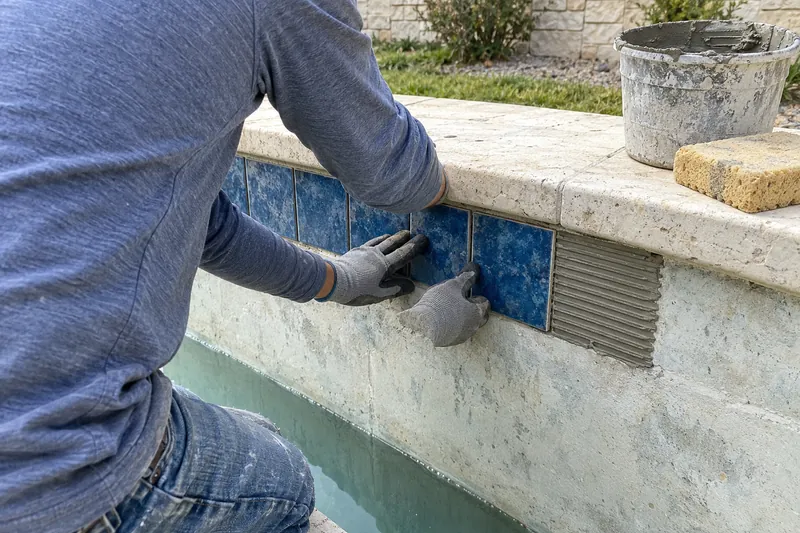
Heat, freezes and hard water at the Leander tile line
Working temperatures, summer and winter
MAPEI keeps the surface and air between 50°F and 95°F while tile is set and for at least 7 days after, and Oceanside Glass & Tile wants outdoor tile shielded from direct sun, heat, wind and rain while it cures. At Camp Mabry, Austin's official climate station, normal highs reach 90°F by May 26 and stay above it until September 23; the average first freeze there is December 1 and the last February 15. LATICRETE also keeps fill water within 10°F of the shell, so cold water doesn't go into a pool baked by days of sun.
Hard water and the white line
Leander's 2024 water report lists hardness of 194 ppm, alkalinity of 156 ppm and pH 8.2, and the Texas Water Development Board recorded 47.76 inches of lake evaporation in 2025 across the one-degree block that contains the city. Orenda, a pool chemical maker, explains the white line that follows: water evaporates off the tile and leaves its calcium behind. LATICRETE warns that calcium below 200 to 250 ppm lets chlorine draw calcium out of cement grout, and Oceanside Glass & Tile keeps products containing hydrofluoric, hydrochloric, muriatic or phosphoric acid off tile entirely. Scale on the band is a job for pool tile cleaning and calcium removal.
Vanishing edges and overflow features
The American Shotcrete Association warns that salt building up behind tile can break down the binder and debond it, and names vanishing edges as especially vulnerable. Lunada Bay Tile says overflow features should run at least from sunrise to sunset, since minerals are left behind each time the water dries. An overflow wall's tile is part of infinity edge pool repair.
Beyond Leander, Leander Pool Resurfacing also handles pool tile repair in Hudson Bend.
Call or request a free estimate any time, 24/7.
(737) 212-9378Pool tile repair cost in the Austin area
Typical Austin-area prices for 2026 put pool tile replacement at $20 to $30 per tile. A whole band goes by the foot: typical Dallas–Fort Worth figures for 2026 run $15 to $30 per linear foot, and with about 80 to 120 linear feet of waterline on a typical pool, a full replacement comes to $1,200 to $3,600. National figures for 2026 put waterline tile at $25 per linear foot.
A Dallas–Fort Worth tile contractor lists what moves the price: size and shape, with curves, raised walls, spillovers and spas adding time; fixing bad adhesive or a damaged surface underneath, which can add $500 to $2,000; tight access; and damage to the concrete lip under the tile. It adds that tile and coping done together cost less than two separate jobs, and a new band often comes as one part of pool remodeling.
None of these is a quote from Leander Pool Resurfacing, and the estimate for your band is free.
- Tile replacement, per tile, Austin (2026)
- $20–$30
- Waterline tile, per linear ft, Dallas–Fort Worth (2026)
- $15–$30
- Full waterline band, 80–120 ft, Dallas–Fort Worth (2026)
- $1,200–$3,600
- Full residential retile, Dallas–Fort Worth (2026)
- $3,000–$8,000
- Waterline tile, per linear ft, national (2026)
- $25
Published Austin-area, Dallas–Fort Worth and national figures. Not a quote.
Call or request a free estimate any time, 24/7.
(737) 212-9378Pool tile repair questions
How much does it cost to repair pool tiles?
Small repairs cost far less than a new band. National 2026 figures put re-adhering loose tiles at as little as $250 and section repairs at $2,000 to $5,000 for most homeowners, and national 2025 figures put regrouting at about $3 per square foot. Leander Pool Resurfacing gives free estimates on any size of tile repair.
Can you replace pool tile without draining the pool?
Often, for a few tiles or a run of grout. The repair commonly described lowers the water just below the tile line, replaces the grout or tile and lets it cure before the water comes back up. LATICRETE adds that a full pool protects the tile bond from water pressure in the ground behind the shell, and that when a tiled pool is emptied, it drains at about 2 feet per 24 hours so that pressure can't push tiles loose.
What are the common problems with pool tile?
LATICRETE lists six reasons cement grout fails in pools: poor water chemistry, filling the pool too soon, no allowance for movement, the wrong grout, poor surface preparation and poor installation. Water too high in pH leaves deposits that can form behind a tile and push it loose; water too low in pH etches the grout until it turns rough or falls apart. Iron and copper in the source water can also drop out at normal pool pH and stain tile and grout.
What grout is best for pool tile?
The makers differ. LATICRETE says epoxy grouts contain no portland cement and aren't affected by pool water treatment, while cement grouts break down under water more often. For glass, Oceanside Glass & Tile says sanded cement grout won't scratch its tile, but LATICRETE and Interstyle say sand may scratch glass and point to unsanded or epoxy grout. Oceanside also warns that blue, green and red grouts may not suit submerged use.
How long does new pool tile cure before the pool is refilled?
It depends on the grout and whose instructions apply. LATICRETE's minimum is 14 days at 70°F for latex-fortified cement grout and 10 days at 70°F for epoxy, with heat and humidity moving it either way, while Oceanside Glass & Tile asks for at least 21 days unless the thin-set and grout maker says otherwise. LATICRETE then refills at about 2 feet per 24 hours; MAPEI's specification gives 24 to 30 inches a day.
Get a free pool tile repair estimate
Leander Pool Resurfacing answers calls and estimate requests 24/7 for tile work in Leander and nearby towns. Tell us how much of the band is loose or cracked, what tile it has now and whether the plaster is due too.