Commercial Pool Tile and Depth Markers in Leander, TX
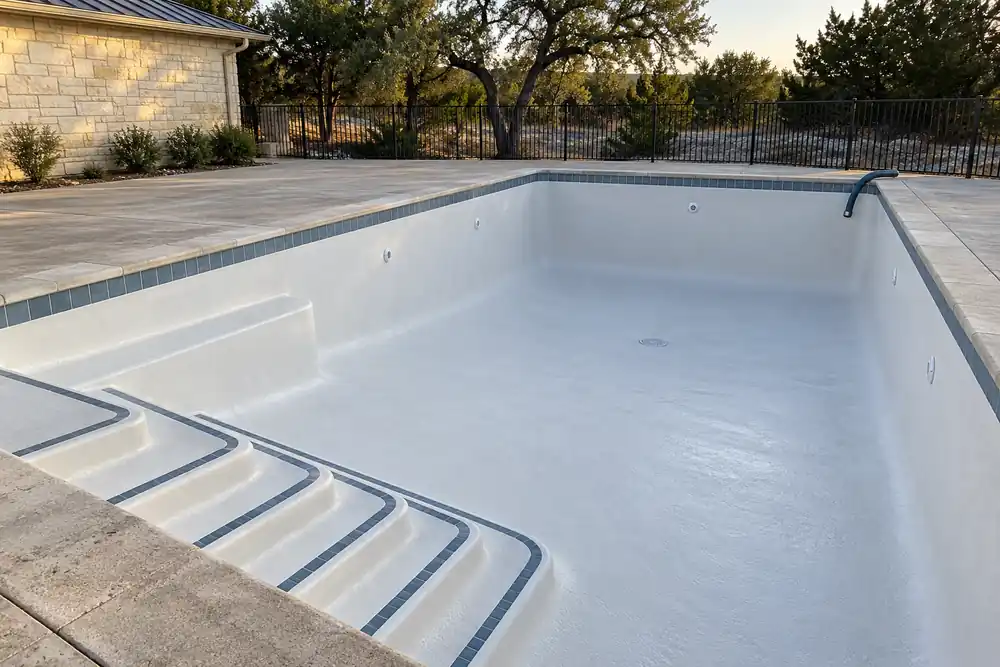
Leander Pool Resurfacing handles commercial pool tile in Leander, Texas: depth markers, no-diving markers, step-edge tile, the line where the floor drops toward the deep end, and the waterline tile at HOA, apartment, hotel and club pools. The state rules and the code set the size, spacing and color of most of these markings, because Texas counts these shared pools as public pools.
Call or send the form for a free estimate. We'll talk through which markings your pool needs, the tile that holds up at the waterline, and how the work fits around a resurfacing or a short closure.
Call or request a free estimate any time, 24/7
No charge · answered 24/7
Get free estimates
Depth markers on HOA and apartment pools
Where they go
Texas puts wall depth markers in the top 4-1/2 inches of the wall, just under the coping, where a swimmer in the water can read them. The 2021 International Swimming Pool and Spa Code puts wall markers at or above the waterline, except on pools with a vanishing edge or rim-flow gutters, and deck markers within 18 inches of the water's edge. The CDC's Model Aquatic Health Code, a model code rather than Texas law, adds markers on both sides and at each end of the pool, on the wall and again on the coping or deck within 18 inches of the wall.
How many, and how far apart
The state wants no fewer than two depth markers on a pool, whatever its size or shape. The code places them at the maximum and minimum depths and at every change in floor slope, at depth steps of no more than 2 feet and no more than 25 feet apart, accurate to within 3 inches. The Model Aquatic Health Code is stricter in shallow water, with a marker for every 1 foot of depth where the water is less than 5 feet deep.
Size, color and wording
Texas markers must be permanent, with numbers and letters at least 4 inches tall in a color that contrasts with both the deck and the wall, and they must spell out feet and inches, abbreviate them as FT and IN, or use fractions of a foot. The Model Aquatic Health Code rules out the ' and " marks for feet and inches. Texas also wants deck depth markers slip resistant and readable while standing on the deck, and the 2021 code gives a public spa at least two permanent markers of its own, on the deck within 18 inches of the design waterline.
Call or request a free estimate any time, 24/7.
(737) 212-9378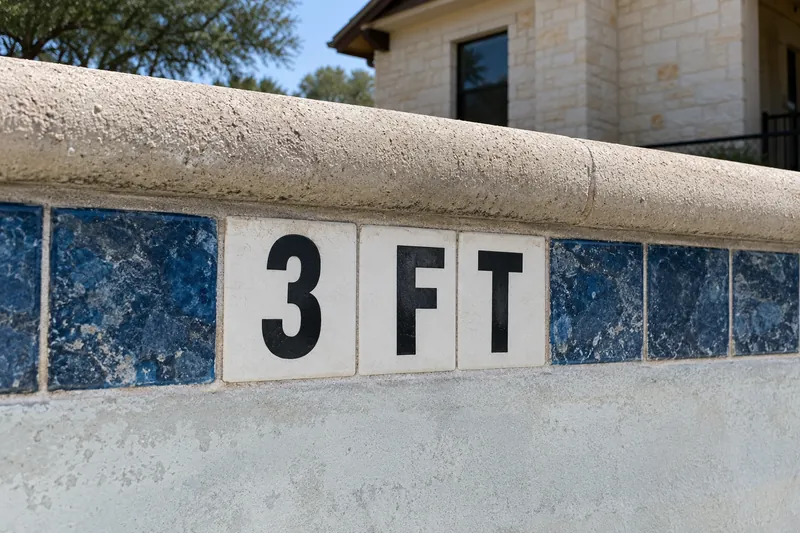
Step edges and the slope-break line
Stair treads
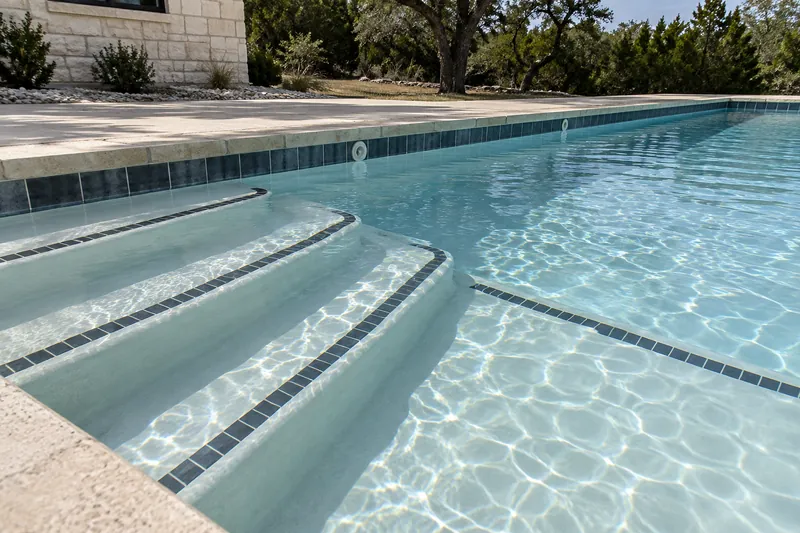
Each stair tread in a public pool gets a contrasting band along its front edge, on both the top and the face. The 2021 code calls for slip-resistant contrasting tile or another permanent marking 1 to 2 inches wide, and the Model Aquatic Health Code adds that the band runs continuously.
Where the floor drops
Texas Class C pools deeper than 5 feet, a group that takes in HOA and apartment pools, need a permanent line in a color that contrasts with the pool bottom where the floor turns from shallow to deep, for example a row of floor tile at least 4 inches wide. The Model Aquatic Health Code asks for a contrasting line 2 to 6 inches wide on the shallow side of the slope break, carried up the walls to the waterline, with a rope and float line one foot toward the shallow end. The floor line sits in the interior finish, so it belongs in the plan whenever the pool is refinished.
Call or request a free estimate any time, 24/7.
(737) 212-9378Waterline tile for a commercial pool
Tile and setting materials
LATICRETE's pool guide allows only impervious tile, under 0.5 percent water absorption, or vitreous tile, under 3.0 percent, because tile that absorbs more than 3 percent can swell permanently from moisture. It calls for mortars rated for continuous submersion and recommends epoxy adhesives to end deterioration from chemical attack. MAPEI's pool specification, published with Daltile, follows the Tile Council of North America's method P602, with a cement bond coat to ANSI A118.4 or better, epoxy grout to ANSI A118.3, cement grout to ANSI A118.6 or better, and a flexible sealant meeting ASTM C920.
Movement joints
Tile held in place by the coping or deck needs room to move. Oceanside Glass & Tile requires a flexible, submersion-rated sealant, never grout, between the tile and the coping or deck, at inside corners and over any joints in the shell, with field joints at most every 8 feet for glass tile and every 12 feet for porcelain or ceramic. LATICRETE calls for joints every 8 to 12 feet in each direction, in part for the shrinkage that comes when a pool is emptied.
Why pool tile fails
LATICRETE names six causes of failing cement grout: poor water chemistry, filling the pool too soon, no allowance for movement, the wrong grout, poor surface preparation and poor installation. Water that runs high in pH leaves mineral deposits at the waterline that can build up behind the tile and loosen it, and water that runs low etches grout until it turns rough and the mortar beneath starts to go. Tile at backyard pools is covered under pool tile repair.
Call or request a free estimate any time, 24/7.
(737) 212-9378Planning commercial tile work in Leander
With the resurfacing and the deck
Waterline tile is one of the items a national HOA reserve-planning guide says to fold into the same funding event as coping repair and light niche work, so the crew's mobilization and the drain and refill are shared; the interior finish itself is commercial pool resurfacing. Deck depth markers and no-diving symbols are set in the deck, so plan them with commercial pool deck resurfacing.
Cure times in summer heat
Grout needs time before the water goes back in. LATICRETE's minimum is 14 days at 70°F for latex-fortified cement grout and 10 days for epoxy grout, while Oceanside Glass & Tile asks for at least 21 days unless the thin-set and grout maker says otherwise, and LATICRETE's rate for refilling a tiled pool is about 2 feet per 24 hours. Heat narrows the working window: MAPEI's specification keeps surface and air between 50°F and 95°F during tiling and for at least 7 days after, and Oceanside wants outdoor tile shielded from direct sun while it cures. At Austin's official climate station, normal highs stay above 90°F from May 26 to September 23 (1991–2020 normals, rounded to the nearest degree).
Community pools around Leander
Leander's shared pools include the Crystal Falls HOA's Junior Olympic pool and 3-foot toddler pool at Quarry Park, and new ones keep arriving, such as Larkspur's second pool and amenity center, registered with the state in 2023, and a pool amenity building at Arista Leander, registered in 2024.
Call or request a free estimate any time, 24/7.
(737) 212-9378Commercial pool tile cost
A 2025 guide for property managers (no area given) puts commercial pool tile at $1 to $5 per square foot for porcelain, $3 to $10 for ceramic and up to $25 for glass, and notes that tile accents such as borders keep costs more reasonable. For depth markers, a maker's 2026 catalog lists a ceramic deck depth-marker tile with an abrasive non-slip finish at $10.49 each, for the tile alone.
No installed price for commercial depth markers, lane lines or safety tile was found, and these are published figures, not prices from Leander Pool Resurfacing. The estimate is free once the pool's markings have been counted.
- Porcelain tile, per sq ft (2025)
- $1–$5
- Ceramic tile, per sq ft (2025)
- $3–$10
- Glass tile, per sq ft (2025)
- up to $25
- Ceramic deck depth-marker tile, each, material only (2026)
- $10.49
A 2025 property-manager guide (no area given) and a 2026 tile maker catalog price; no installed price for depth markers is published. Not a quote.
Call or request a free estimate any time, 24/7.
(737) 212-9378Commercial pool tile questions
Do HOA and apartment pools in Texas need depth markers?
Yes. Texas counts pools run with apartments, condominiums, hotels, property owners associations and clubs as Class C public pools, and its safety rules call for at least two depth markers on every public pool or spa, regardless of size and shape. A pool serving only a single-family home or a duplex, for no more than two resident families and their guests, is residential and sits outside the state's public-pool rules. Leander Pool Resurfacing handles depth markers for HOA boards and property managers around Leander.
Do community pools need no-diving markers?
Where the water is 5 feet deep or less, the 2021 International Swimming Pool and Spa Code requires the No Diving symbol on the deck at intervals of no more than 25 feet, directly beside a depth marker. Where Texas requires a NO DIVING marker, it must be at least 4 inches tall, show a diver's profile in a circle with a 45-degree slash, be permanent, contrasting and slip resistant, and sit within 18 inches of the water's edge; it isn't required on the interior tile line.
Can a commercial pool have dark waterline or accent tile?
In some places. The 2021 code requires the interior colors, patterns and finishes of non-residential pools not to obscure objects or surfaces in the water, with a value of at least 6.5 on the Munsell color scale, but it exempts waterline tiles, competitive lane markings, step and bench edge markings, pools shallower than 24 inches, and features such as rock formations, as approved. A dark band at the waterline or along a step edge is exempt from that color rule; the floor and walls are not.
What is a reference tile in a public pool?
It is a contrasting square at the deepest point, used to check that the water is clear. The CDC's Model Aquatic Health Code calls for a 4-by-4-inch reference tile in a contrasting color, or the main suction outlet, at the deepest part of pools 10 feet deep or less, and an 8-by-8-inch tile in deeper pools, visible from anywhere on the deck up to 30 feet away. Texas uses its own clarity check: an 8-inch black disk on the floor at the deepest point must be clearly and immediately visible from the surface or the nearest deck.
How are depth markers and waterline tile kept clean at a public pool?
Texas requires public pools to remove slime and biofilm from every accessible surface, naming steps and ladders, sidewall tile and depth markers. Lunada Bay Tile, a tile maker, recommends brushing tile weekly with a soft brush or non-abrasive pad, because minerals build up most along the waterline, where evaporation is highest. LATICRETE notes that iron and copper in the fill water drop out of solution at normal pool pH and can stain tile, grout and fittings.
Get a free commercial pool tile estimate
Leander Pool Resurfacing takes calls and estimate requests 24/7 from HOA boards, property managers and owners of apartment and hotel pools around Leander. Tell us the pool's depths, the markings it has now and when it needs to reopen.