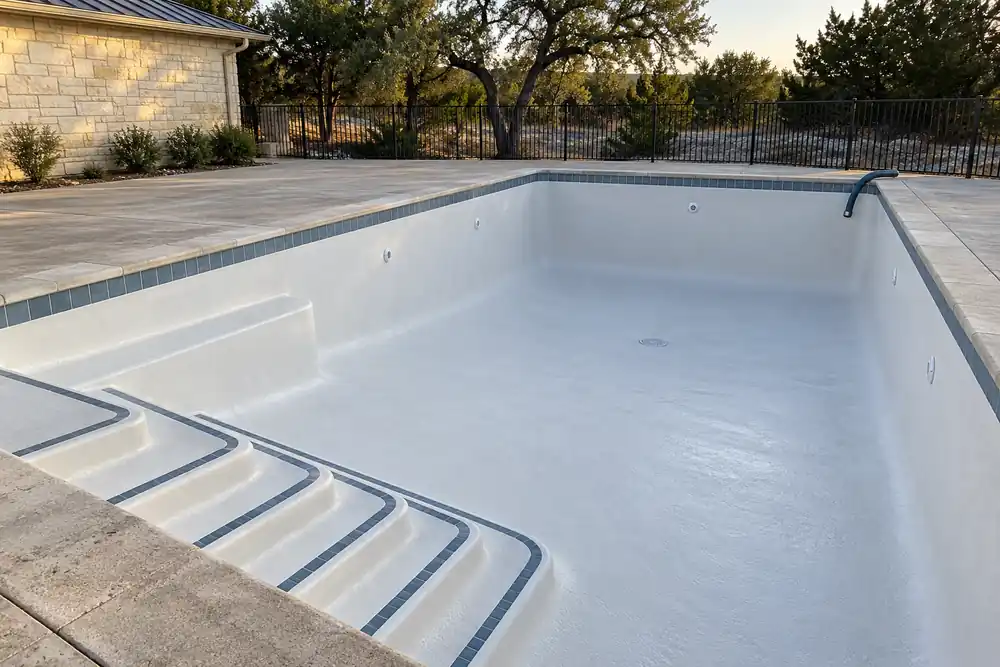
Commercial Pool Deck Resurfacing in Leander, TX
Leander Pool Resurfacing handles commercial pool deck resurfacing in Leander, Texas: the decks around HOA, apartment, condominium, hotel and club pools, which Texas treats as public pools. Those rules reach the deck's width, its texture, its joints and how quickly it sheds water.
Call or send the form for a free estimate. We'll talk through the surface and how it is wearing, the joints and drains, and a schedule that suits the pool's season and your board or property manager.
Call or request a free estimate any time, 24/7
No charge · answered 24/7
Get free estimates
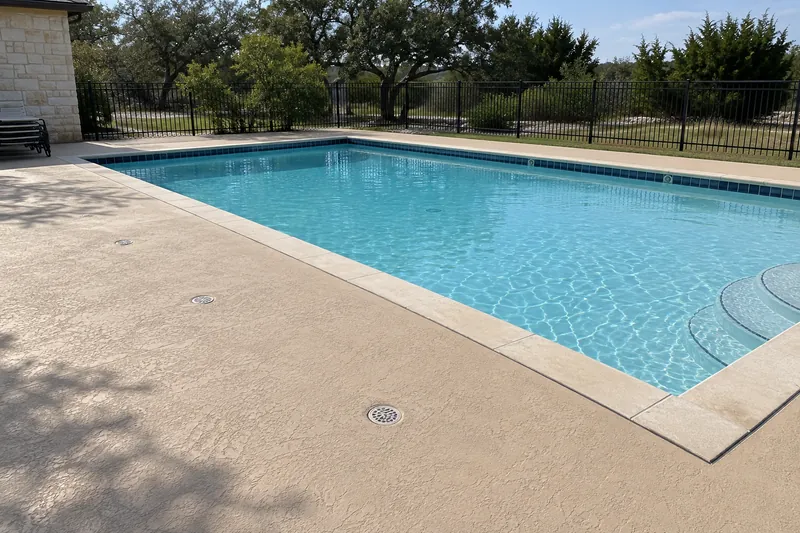
Public-pool rules for a commercial pool deck
Which decks the rules cover
The Texas Department of State Health Services calls a pool that is limited to residents, members or guests a Class C public pool when it is run with apartments, condominiums, hotels, a property owners association or a club, and the state applies the 2021 International Swimming Pool and Spa Code's public-pool chapters when those pools are renovated or repaired. The pool's interior is covered under commercial pool resurfacing.
Width and clearance
The code wants a deck or unobstructed access along at least 90 percent of a public pool's perimeter, at least 6 feet of deck between a pool and a spa, at least 4 feet of decking on the sides and rear of any diving equipment, and 4 feet of clearance around other deck equipment. The CDC's Model Aquatic Health Code, a model code rather than Texas law, asks for perimeter decks at least 4 feet wide, unobstructed and flush with the pool walls or coping.
Steps, edges and deck markers
Deck steps at a public pool need risers of 3-3/4 to 7-1/2 inches and treads of at least 11 inches, with a handrail wherever there are three or more risers. The model code also wants deck edges beveled, rounded or otherwise relieved, and concrete decks built to the latest American Concrete Institute standards. Markers and insignia set into a deck must be slip resistant under the 2021 code, and deck depth markers are part of commercial pool tile and depth markers.
Call or request a free estimate any time, 24/7.
(737) 212-9378Joints and drainage on a commercial pool deck
The joint at the coping
The Model Aquatic Health Code calls for a continuous watertight expansion joint between the perimeter deck and the pool coping, built to protect the coping and its mortar bed from the deck's movement, and watertight expansion joints between neighboring concrete pours. The 2021 code adds a joint wherever a deck meets existing concrete work, so relative movement can't damage the pool, and enough joints to keep visible cracking outside the control joints to a minimum.
Gaps, level changes and sealant
The two codes differ on gaps. The 2021 International Swimming Pool and Spa Code allows up to 3/4 inch, joint material included, between a pool deck and an adjoining walkway, with no more than 1/4 inch of difference in height. The Model Aquatic Health Code caps open joints at public pools at 3/16 inch, treats a change in level of more than 1/4 inch as an edge condition, and allows caulk or sealant in joints for expansion and contraction. W. R. Meadows' DECK-O-SEAL, a pourable polysulfide made for pool decks, stretches or compresses up to 25 percent once cured; it goes in at a 2:1 width-to-depth ratio, 1/4 to 1/2 inch deep over foam backer rod, and isn't used in joints narrower than 1/4 inch. Sika's self-leveling polyurethane sealants list a maximum chlorine exposure of 5 ppm.
Slope and drains
The model code's minimum slopes away from the pool run from 1/8 inch per foot for smooth finishes such as tile and hand-finished or lightly broomed concrete, through 1/4 inch for exposed aggregate or medium broom, to 3/8 inch for heavily textured finishes such as brick. The 2021 code caps deck slope at 1/2 inch per foot and allows no standing water deeper than 1/8 inch 20 minutes after water stops being added. Texas requires public pool decks to be free of standing water, with the deck drains kept clean.
Call or request a free estimate any time, 24/7.
(737) 212-9378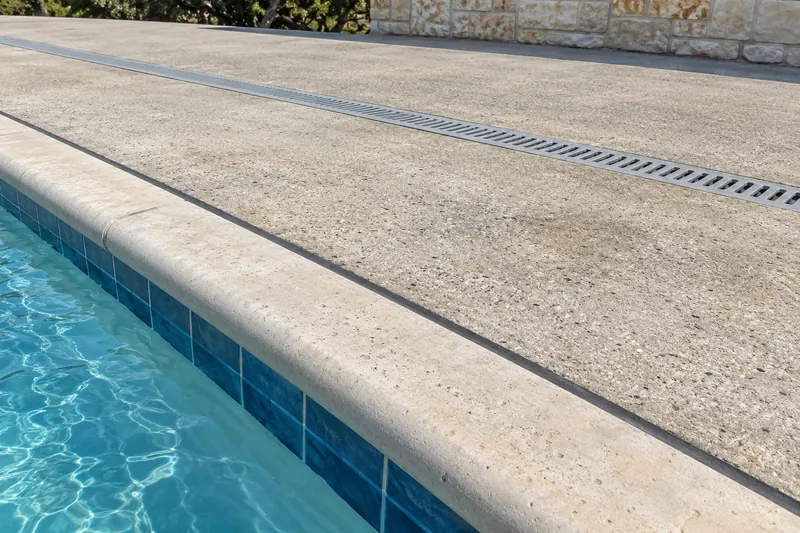
Resurfacing systems for a busy pool deck
Acrylic spray-knockdown coatings
SUNDEK describes its coating as an acrylic about as thick as two stacked quarters, put down in 4 to 8 layers over roughly 2 to 8 clear, dry days, depending on size, condition and weather. Its specification starts with a high-pressure wash, the removal of grease, oil, curing compounds and any old coating that would block the bond, and crack repair; then come a primer, a base coat at least 1/8 inch thick, a stipple coat and a splatter coat knocked down with a flexible pool trowel, caulked joints and two finish coats. SUNDEK keeps existing control joints open, replaces worn-out expansion joints and won't coat over paint.
Cement-based coatings and resurfacers
Sider-Crete's Sider-Deck is a cement-based, polymer-modified texture sprayed from a hand-held hopper gun and knocked down with a stainless steel trowel to cover 70 to 80 percent of the concrete, with an acrylic sealer supplying the final color; an existing cement-based deck coating that is unpainted and unsealed can be recoated. QUIKRETE's Re-Cap resurfacer restores worn or scaled concrete from a feather edge up to 1/2 inch, worked in sections no larger than about 144 square feet with the control and expansion joints kept open, though QUIKRETE says cracks in the old slab can still reflect through. Decks around backyard pools, cool deck toppings included, are covered under pool deck resurfacing.
Call or request a free estimate any time, 24/7.
(737) 212-9378Scheduling deck work at a community pool in Leander
Cure times before the deck reopens
Each system has its own wait. SUNDEK's specification keeps foot traffic off its coating for 24 hours and vehicles off for 72; Sider-Crete allows light foot traffic 24 hours after its sealer, light use for 48 hours, and furniture and hard-soled shoes only after at least a week; QUIKRETE's resurfacer takes foot traffic after 8 hours but is moist-cured for 24 to 48 hours before use. While the work is under way, Texas allows a pool-yard gate to be propped open only when the owner's contractor is there doing work that needs it open.
Heat, rain and wind
Austin's official climate station at Camp Mabry records normal highs of 96.6°F in July and 97.8°F in August, and normal highs stay above 90°F from May 26 to September 23 (all 1991–2020 normals; the two dates rounded to the nearest degree). The makers set limits for that. Sider-Crete wants air and surface at 45°F or above, no application to overheated or very dry concrete or in high winds, and warns that hot concrete can make its material set too quickly; QUIKRETE applies its resurfacer with air and concrete between 50°F and 90°F; and SUNDEK doesn't coat exterior decks in wet weather.
Run-off, noise and permits
Leander's stormwater ordinance bans putting pool water with 1 ppm or more of chlorine, or harmful amounts of muriatic acid or other pool chemicals, into the storm drains, along with concrete, mortar and the wash from equipment used to place them; a violation can bring a fine of up to $2,000 for each day it continues. Under the noise ordinance, construction or repair equipment that causes a disturbance between 9:00 p.m. and 7:00 a.m. counts as a noise disturbance on its face. The City posts a 10-business-day first review for a commercial pool or spa permit and requires every contractor to be registered before a permit is issued, so confirm with Development Services whether deck work needs one.
Community pool decks around Leander
Leander's shared pools range from the Crystal Falls HOA's two pools to the Block House Creek pools that the local utility district runs, and state architectural-barrier records list an amenity center with a gated pool and deck area at 2129 Fairway Rd., registered in 2023. Beyond Leander, Leander Pool Resurfacing also handles commercial pool deck resurfacing in Wells Branch.
Call or request a free estimate any time, 24/7.
(737) 212-9378Commercial pool deck resurfacing cost
The only commercial-facing figure found comes from a national HOA reserve-planning guide that draws its per-square-foot range from a residential cost guide. It puts 2026 pool deck resurfacing at $3 to $12 per square foot, or $9,000 to $36,000 for a typical small-HOA deck of 3,000 square feet, and says hot-climate markets trend toward $5 to $14 because heat-reflective, slip-resistant systems are standard there. For comparison, one Austin contractor's 2026 residential deck-coating prices start at $3 to $6 a square foot for spray texture and $5 to $8 with a color coat, with $8 to $15 or more for stamped or decorative overlays.
No commercial deck contractor's own price was found, and these are published figures, not prices from Leander Pool Resurfacing. A firm number needs a walk around the deck, and the estimate is free.
- HOA pool deck, per sq ft, national (2026)
- $3–$12
- Typical small-HOA deck, 3,000 sq ft, national (2026)
- $9,000–$36,000
- Hot-climate markets, per sq ft, national (2026)
- $5–$14
- Residential spray texture, per sq ft, Austin (2026)
- from $3–$6
- Residential stamped overlay, per sq ft, Austin (2026)
- $8–$15+
National HOA figures and Austin-area residential figures, for planning only. Not a quote.
Call or request a free estimate any time, 24/7.
(737) 212-9378Commercial pool deck questions
What is the best material for resurfacing a commercial pool deck?
No code or industry body names one. What the codes set are conditions: the Model Aquatic Health Code wants every deck slip resistant and textured so bare feet don't slip, wet or dry, and lists carpet, artificial turf and wood as prohibited perimeter-deck materials, while the 2021 International Swimming Pool and Spa Code wants decks, coping and similar step surfaces slip resistant and cleanable. Within those limits, acrylic knockdown coatings, cement-based textures and cement resurfacers each come with the maker's own preparation, weather and cure rules, set out above. Leander Pool Resurfacing will talk through the choices for your deck during a free estimate.
Does Texas require a slip-resistance rating for a commercial pool deck?
Not a number, in the code sections read for this page. The 2021 International Swimming Pool and Spa Code, which the state adopts for commercial pools, requires deck walking surfaces within 4 feet of a public pool or spa to be slip resistant but sets no test value. The Tile Council of North America reports that the 2021 Uniform Swimming Pool, Spa & Hot Tub Code set a wet dynamic coefficient of friction of at least 0.42 for level walkways meant to be walked on wet, tested under ANSI A326.3, but Texas cities haven't been shown to adopt that code. The makers are careful too: Sider-Crete says its knockdown deck is not presented as slip-proof, and the tile maker Crossville says no tile is.
Can resurfacing fix standing water on a community pool deck?
Only partly. SUNDEK's specification asks for drainage of at least 1/4 inch per foot under its coating and says a drainage correction isn't guaranteed; told ahead of time, it says it will try to move a low spot or make it twice as wide and half as deep so the sun dries it faster. The Model Aquatic Health Code keeps public deck surfaces at their original design slope, and the state rules don't allow standing water on them.
How much does rubber surfacing for a pool deck cost?
National figures for 2026 put a rubber pool deck surface at $12 to $20 or more per square foot, rising with design detail and irregular pool shapes. One rubber-based option, Tuff Coat, is a water-based non-skid coating that cross-links urethanes, acrylics and co-polymers with recycled rubber granules and dries to 30 to 35 mils; its maker says two coats are required for best results, applied between 9:00 a.m. and 4:00 p.m. at 40°F to 90°F so dew or condensation doesn't spoil them. Any surface on a public pool deck still has to meet the slip-resistance rules above.
How long does a resurfaced HOA pool deck last?
A national HOA reserve-planning guide gives pool deck resurfacing a useful life of 10 to 15 years. The deck-coating makers read for this page publish no recoat interval; the nearest is Mortex's claim of 5 to 10 years of water repellency for its Protect-A-Deck sealer on Kool Deck, which covers the sealer only. The Model Aquatic Health Code adds daily crack checks on public pool decks, with repairs once a crack changes enough to raise the risk of trips, falls or cuts, or to make the deck hard to clean.
Get a free commercial pool deck estimate
Leander Pool Resurfacing takes calls and estimate requests 24/7 from HOA boards, property managers and owners of apartment and hotel pools around Leander. Tell us the deck's size and surface, any cracks or standing water, and when the pool needs to reopen.