Glass Tile Pool Finishes in Leander, TX
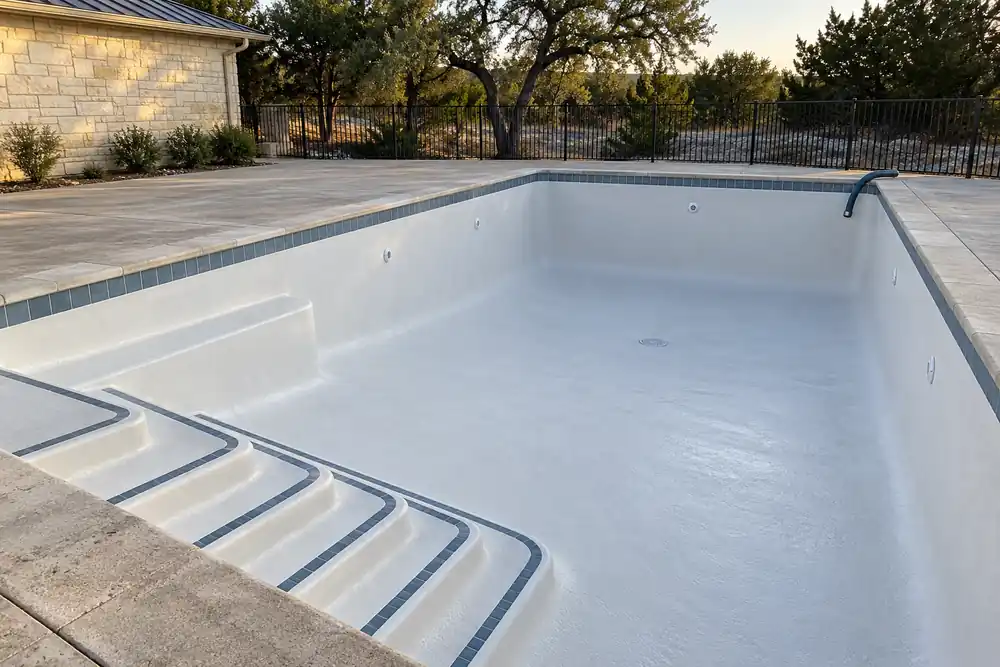
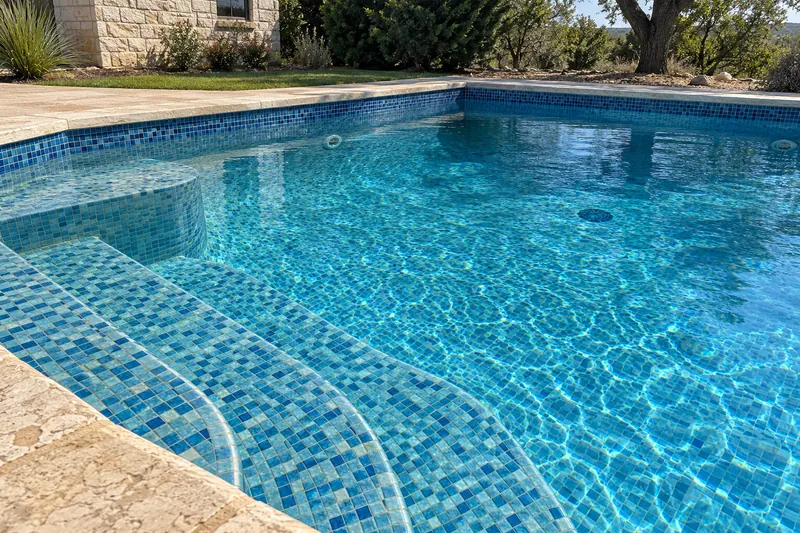
Leander Pool Resurfacing handles glass tile pool finishes in Leander, Texas: all-tile interiors in which sheets of glass mosaic cover the whole shell rather than only the waterline band, set over a waterproof membrane and broken up by flexible movement joints. Lightstreams, a glass tile maker, requires ANSI and Tile Council of North America standards on every installation and says only experienced professional tile installers who know the procedures should do the work.
Call or send the form for a free estimate. We'll talk through whether your shell is ready for tile, which glass and setting materials suit it, and how the long cure and the refill fit Leander's water rules.
Call or request a free estimate any time, 24/7
No charge · answered 24/7
Get free estimates
What an all-tile glass interior is built from
All-tile interiors and the waterline band
Tiling the whole interior is a bigger job than the band of tile at the waterline, which is covered under pool tile repair and replacement. Lightstreams asks to be consulted before tile is ordered or installed for any all-tile pool, spa or fountain, and it tells buyers that variation in surface, color, tone and shading is normal in its cast glass, with slight bubbles or depressions common. When the tile is one part of wider changes to the shell, steps or features, the work is planned as pool remodeling.
The standards behind the system
MAPEI's pool specification, hosted by tile maker Daltile and based on the Tile Council of North America's pool method P602, names a standard for each layer: the waterproof membrane to ANSI A118.10, the crack isolation membrane to ANSI A118.12, the cement bond coat to ANSI A118.4 or better, epoxy grout to ANSI A118.3 and movement joints to the Council's EJ171 detail. The same specification lists ANSI A137.2 as the American National Standard for glass tile. Lightstreams cautions that not every ANSI A118.4 polymer thin-set suits glass, and some can discolor over time.
Face-mounted sheets
LATICRETE, a maker of tile-setting materials, recommends face-mounted glass for submerged work, with the paper or clear plastic on the face of the sheet, to head off problems from poor mortar coverage or a failing backing material. Glass can also go into a cement-based finish: NPT's JewelScapes Classic series is 100% glass beads in white cement with colored pigment, one of the glass bead finishes covered with polished pool finishes.
Call or request a free estimate any time, 24/7.
(737) 212-9378How a glass tile pool finish is installed
A membrane over the whole shell
Lightstreams requires a waterproof membrane system under any partly or fully submerged tile, because thin-set mortar and grout are not waterproof, and it adds a movement-joint and tile-fracture system for glass. LATICRETE says the membrane must form a continuous waterproof pan with no voids or breaks, and it doesn't recommend waterproofing only part of a submerged shell, such as the waterline alone. It names poor preparation and cleaning as a primary cause of membrane failure, and it doesn't recommend acid cleaning where other methods are available.
Setting the sheets
Lightstreams keys a bond coat into the surface with the flat of the trowel, combs thin-set with a 3/16 by 1/4 inch V-notch trowel, then flattens the ridges into a smooth bed about 3/32 to 1/8 inch deep, since gaps, bubbles and trowel lines show through translucent glass. It recommends back-buttering every sheet in fully submerged or translucent work, because some thin-sets shrink as they cure and leave voids that discolor and can lead to delamination and mold. LATICRETE treats 95 to 100 percent adhesive coverage as essential under water.
Shade, face tape and grout
Clear glass lets sunlight straight through, and Lightstreams says that can significantly heat the thin-set while it cures, so every area being tiled is shielded from sun and wind with tarps, screens or umbrellas. The face tape comes off after 6 to 12 hours, and grouting waits at least 24 hours. Lightstreams strongly recommends building a test panel first, to confirm the materials and procedures before the whole pool is tiled.
Movement joints
Lightstreams follows the Tile Council of North America's joint design, with flexible, pool-grade neutral-cure silicone between the waterline tile and the coping or deck and a joint at every inside corner where the surface changes plane. LATICRETE adds joints every 8 to 12 feet in each direction across a tiled pool, on top of any carried up from the shell, to allow for long-term moisture expansion and for shrinkage when the pool is emptied.
For a free estimate on an all-tile interior, call Leander Pool Resurfacing or send the form.
Call or request a free estimate any time, 24/7.
(737) 212-9378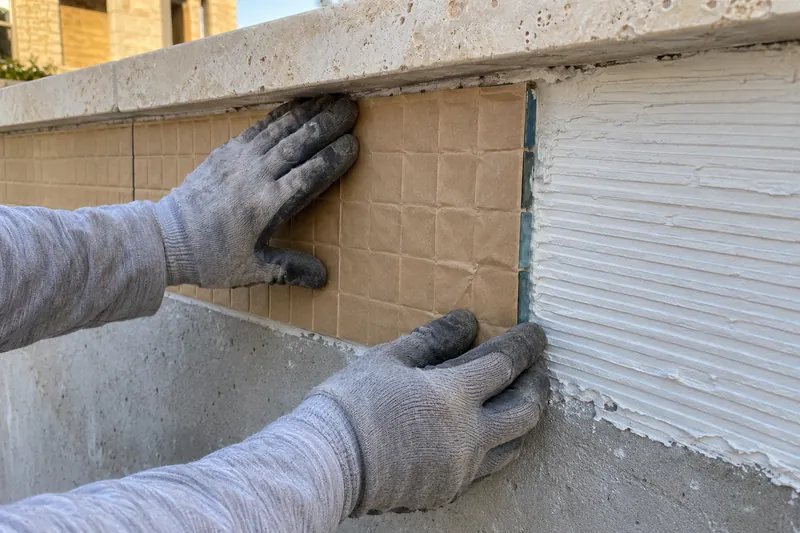
Curing and filling a newly tiled pool
An all-tile interior runs on cure times, because each layer cures before the next goes on. Lightstreams lists the industry minimums: 28 days for a shotcrete or gunite shell, 1 to 7 days for the primary waterproofing depending on the product, 7 days for a mortar bed, 1 day for the secondary waterproofing that glass requires, and 21 days after grouting before the pool is filled. LATICRETE likewise wants a concrete shell cured for at least 28 days, with time allowed between each stage of the project.
The setting material changes the wait. MAPEI's cure before filling is three days for its Ultraflex LFT Rapid mortar, 14 days for Kerapoxy CQ epoxy, 21 days for Adesilex P10 mortar mixed with its Keraply admixture and 28 days for Ultraflex LFT. When the water does go in, LATICRETE fills a tiled pool at 2 feet per 24 hours, so the tile meets water pressure, temperature and moisture changes gradually, and holds off when very cold water would go into a sun-heated pool.
Leander's heat and fill water
Shade matters here. Austin's official climate station at Camp Mabry, about 18.5 miles from Leander, averages 28.7 days a year at 100°F or above on its 1991–2020 normals, with normal highs of 96.6°F in July and 97.8°F in August, and by September 28, 2026 it had logged 49 such days that year.
The fill water needs watching as well. Leander's 2024 water report, the newest that lists pH, gives 8.2 with a range of 7.8 to 8.5, while LATICRETE asks for tiled-pool water between pH 7.2 and 8.0: too high and mineral deposits can form on and even behind the tile and weaken its bond, too low and cement grout and mortar etch. Under the Phase 2 Water Conservation rules in force on October 1, 2026, water may go into a pool only where needed to keep its purification system running or the pool structurally sound, and neither the City's page nor its code says whether a full refill after resurfacing counts, so ask the City before work starts.
Call or request a free estimate any time, 24/7.
(737) 212-9378Glass tile pool finish cost
Published prices for tiling a whole pool run wide. Typical Austin-area figures for 2026 put pool tile at around $24 a square foot on average and $34 or more for high-end tile, list glass tile at $1 to $34 a square foot, and price refinishing a pool with tile at $29,430 per 1,000 square feet. The tile's look moves the price too: typical Dallas–Fort Worth figures for 2026 put glass mosaic at $10 to $50 a square foot, with basic solid colors at the low end and custom blends and iridescent finishes costing more.
National averages for 2026 put finishing a pool in tile at $4 to $30 a square foot, with glass usually the most expensive tile and ceramic and porcelain the most affordable. Glass alone runs $7 to $50 a square foot nationally, and a full pool tile installation can pass $80,000 with high-end glass and complex patterns. These are published figures, not prices from Leander Pool Resurfacing, and the estimate for your pool is free.
- Pool tile, average per sq ft, Austin (2026)
- about $24
- Glass tile, per sq ft, Austin (2026)
- $1–$34
- Refinishing with tile, per 1,000 sq ft, Austin (2026)
- $29,430
- Glass mosaic, per sq ft, Dallas–Fort Worth (2026)
- $10–$50
- Finishing a pool in tile, per sq ft, national (2026)
- $4–$30
- Glass tile, per sq ft, national (2026)
- $7–$50
Published Austin-area, Dallas–Fort Worth and national figures, for planning only. Not a quote.
Call or request a free estimate any time, 24/7.
(737) 212-9378Glass tile pool finish questions
Are glass tiles good for pools?
They can be, when the tile and everything behind it is made for life under water. LATICRETE calls submerged-rated glass very pleasing in appearance, and also typically more expensive and more demanding of the installer's experience and expertise. It recommends epoxy adhesives in pools to eliminate deterioration from chemical attack, and says its epoxy grouts contain no portland cement, so water treatment doesn't affect them. Lightstreams makes a waterproof membrane a condition of any submerged glass job, since thin-set and grout alone let water through.
How long does an all-tile glass interior last?
Tile, mortar and grout makers don't put a figure in years on it. What they describe is how the bond fails. LATICRETE warns that some glues used to back-mount glass sheets soften and swell under water and lose adhesion, anywhere from several weeks to several years after filling. It also says calcium hardness below 200 to 250 ppm lets the chlorine in the water use the calcium in cement-based grout and mortar, leading to deterioration and etching, while a pH that runs too high leaves deposits that can press on the tile from behind.
How do you clean glass pool tile?
Gently. Lightstreams says to clean the glass faces only with a nylon vegetable brush, a blue nylon scrub pad, a soft sponge and warm water. LATICRETE says acid-based cleaners must not touch its grouts at any point during installation, during the cure or before the pool is filled, and points owners to neutral-pH cleaners for routine maintenance. White scale at the waterline is a separate job from everyday cleaning, and the tile maker's care rules decide which method is safe.
Can a tiled pool be drained?
Yes, slowly. LATICRETE empties a tiled pool no faster than 2 feet per 24 hours, so water pressure from behind the shell can't delaminate the tile or the leveling mortar, and it keeps a seasonally closed tiled pool partly filled, because the water in the pool protects the tile and waterproofing bond from that pressure and from drying shrinkage. In Leander, the drained water may go to a storm drain only once it is dechlorinated to less than 1 ppm of chlorine, and the refill falls under whatever water phase the City has in force that week.
Can a spa be tiled in glass?
Yes, with a few extra rules. Lightstreams' request to be consulted before tile is ordered covers all-tile spas as well, and the Tile Council of North America joint design it follows spaces movement joints no more than 8 feet apart on spa overflows and vanishing edges. Heat is the other factor: MAPEI's pool specification says heated water should be raised slowly, at no more than about 2°F an hour, once a tiled pool is filled.
Get a free glass tile pool finish estimate
Leander Pool Resurfacing answers calls and estimate requests 24/7 for tiled pool interiors in Leander and nearby towns. Tell us what finish the pool has now, roughly how big it is and whether it has a spa or vanishing edge.