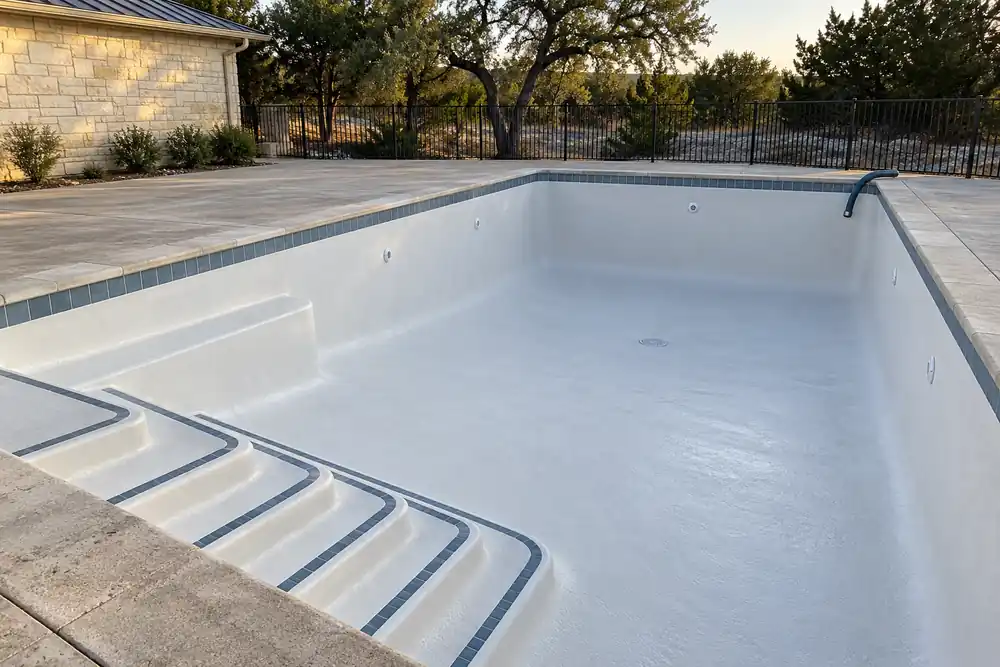
Draining and Refilling a Pool Under Leander's Water Rules
Leander Pool Resurfacing explains how to drain and refill a pool in Leander, Texas, under the City's water rules: how to get the water out without harming the shell, where the drained water may go, when City water may refill the pool and what the refill costs.
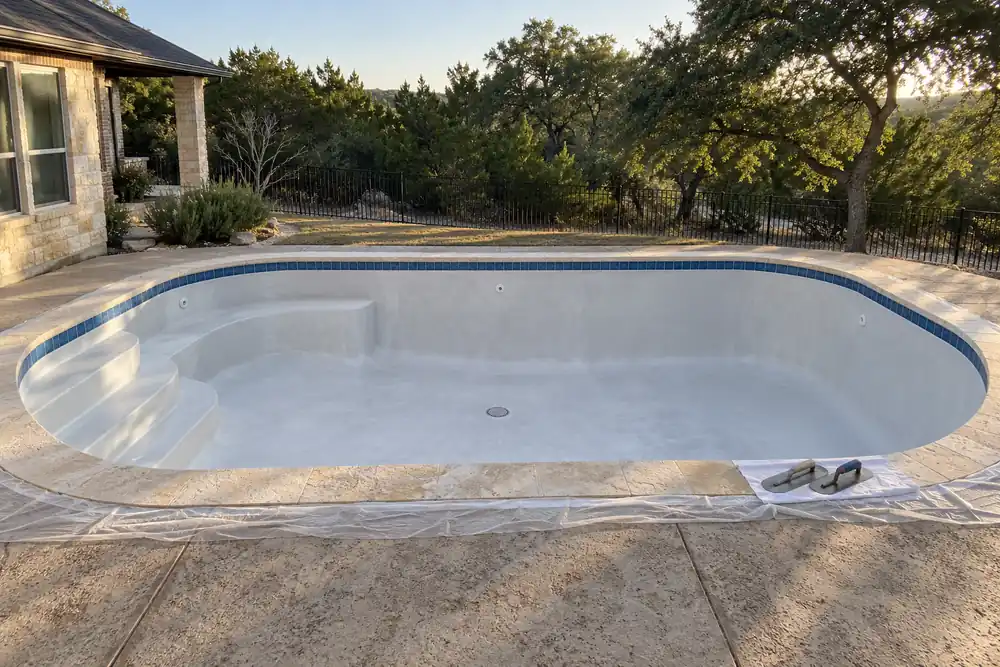
A pool finish is meant to stay wet. The National Plasterers Council wants it fully underwater for its service life, apart from limited servicing or repair, so a drain-down belongs to a planned job such as a replaster or an acid wash. As of October 1, 2026 Leander is in Phase 2 Water Conservation, and since mid-2023 the phase has changed several times, so check it with the City before any water comes out.
Call or request a free estimate any time, 24/7
Draining a pool without harming the shell
An empty pool is under pressure from below. River Pools, a fiberglass pool maker, explains that groundwater around a pool pushes up on the shell, and that without enough water inside, the shell can bulge, crack or even float; it says the same principles apply to every type of pool, and that concrete pools will float with enough uplift. It advises owners not to drain a pool themselves and to have a professional do it when draining is truly needed.
Relief valves and drain covers
Many main drains carry a hydrostatic relief valve. Pentair's drain guide says at least one in a set of suction outlets lets groundwater pressure under the pool relieve into it, with a collector tube keeping the path to the valve clear, and Hayward's valve threads into the 1½- or 2-inch pipe opening inside the main drain sump. With the water out, the drain covers are easy to check: Pentair says to replace any that are cracked, broken or older than the design lifetime marked on them, and Custom Molded Products rates its Galaxy cover at 7 years.
Fiberglass pools and young finishes
Fiberglass shells need more care still. Latham warns that a fiberglass pool drained without first relieving hydrostatic pressure will buckle and crack, and that draining voids its warranty unless a dealer handles it. River Pools braces the walls, typically with three braces across the width set 18 to 24 inches down the side walls, and starts only when the weather will stay dry for the whole job. SGM tells owners of its Diamond Brite finish to drain only when they absolutely must, not at all in the first year, and to have the water back in within 24 hours, since sun and air on the exposed finish can crack it or make it delaminate.
Call or request a free estimate any time, 24/7.
(737) 212-9378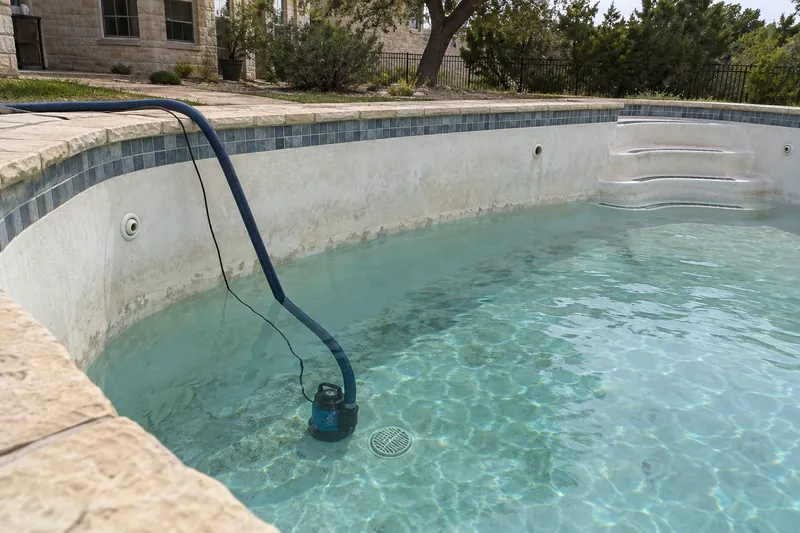
Where drained pool water can go in Leander
Leander's stormwater program treats dechlorinated pool water as an allowed discharge and chlorinated pool water as a prohibited one, and storm drains there run to waterways such as Brushy Creek untreated. The ordinance draws the line at chlorine: pool, fountain or spa water, filter backwash included, may reach a storm drain only below 1 ppm, and never with any harmful amount of chlorine, muriatic acid or other pool treatment or cleaning chemical.
Acid washes and plaster wash-out
That rule reaches the run-off from a pool acid wash, which SGM says should be diluted and neutralized before it is pumped out and disposed of under local requirements. The same ordinance keeps ready-mix concrete, mortar and ceramic material out of the storm drains, along with the rinse from equipment used to carry or apply them. A violation can cost up to $2,000 for each day it continues, plus a civil penalty of up to $5,000 a day under state law, and the property owner and any contractor involved can each be charged.
Reusing the water on the property
The other route is the yard. The EPA suggests letting the water sit 48 to 72 hours without chemicals to make it safer for landscape use. Under Texas Commission on Environmental Quality rules, pool drain water counts as alternative onsite water that a homeowner can reuse, on landscaping for instance, without TCEQ authorization, but not within five days of adding shock or acid, not so that it ponds or runs off across property lines or onto paving, and never through a system connected to a sewer or septic tank.
The sanitary sewer
The International Swimming Pool and Spa Code lets drain water go to a sanitary or storm sewer or an approved disposal system, always through an air gap rather than a direct connection. Leander's own sewer rules, though, bar unpolluted drainage from the public sanitary sewer without naming pool water, and the City hasn't said whether a pool may be drained into a house clean-out, so ask before using one.
Call or request a free estimate any time, 24/7.
(737) 212-9378Leander's drought phases and the refill
Leander calls its drought levels phases, and on October 1, 2026 the City was in Phase 2 Water Conservation. Phase 2 bans nonessential water use with three exceptions, one of them adding water to a pool where needed to keep its purification system running or the pool structurally sound. The code's list of nonessential water uses includes using water to fill, refill or add to a pool "only to the extent to preserve the structural integrity and/or functionality of the pool", and neither the code nor the City's page says whether a full refill after replastering counts. Ask the City's Water Conservation office before the pool is drained.
When the City goes above Phase 2
Phase 3 keeps every Phase 2 rule, the pool rule included. Phase 4 lets the City stop approving permits for new or expanded pools, shut off bulk water meters and restrict any water use the emergency calls for. Low lakes aren't the only trigger: since mid-2023 Leander has moved above Phase 2 at least four times for treatment-plant or pipeline work, among them Phase 4 from February 12, 2024, when the City restricted pool filling unless the water came from outside its system, and Phase 4 from December 30, 2024 into January 2025, when local news reported that City water couldn't fill, refill or top up any pool. In both of those Phase 4 periods, a pool drained just before couldn't legally be refilled with City water.
Variances, fines and other water systems
The city manager can grant a temporary written variance for a banned use, but only where refusing it would cause an emergency affecting health, sanitation or fire protection, and the petition must be filed within five working days after the phase is invoked. Residential customers who break the rules get a courtesy warning, then fines of $50, $100 and $200 plus disconnection, and the City may prosecute instead, at up to $2,000 a day. The rules cover only City water, so homes served by another system, such as Block House MUD in Block House Creek, should check that utility's own rules. Leander Pool Resurfacing will talk through the current phase and the refill plan at the free estimate.
Call or request a free estimate any time, 24/7.
(737) 212-9378Refilling: City water, hydrant water and delivery
After pool replastering, the refill is part of the job: the National Plasterers Council wants the fill to run without stopping to the middle of the skimmer, because a pause can leave a ring on the new finish. Where the water comes from sets the price and, in Phase 4, whether it is allowed at all.
City water. Leander's single-family rates add a $37.35 monthly customer charge to usage at $4.55 per 1,000 gallons up to 15,000 gallons, $5.80 per 1,000 from 15,001 to 25,000 and $7.00 per 1,000 above that, with 10 percent more outside the city limits. By our arithmetic, a 20,000-gallon refill billed as the home's only water that month costs $97.25 in usage, but $140.00 if the home's other use had already passed 25,000 gallons. Sewer is billed on a winter average, so refill water billed from March through November stays out of it, while water billed in December, January or February can count.
Hydrant water. Water from a City fire hydrant needs a permit and a temporary construction hydrant meter, requested from the Utilities office in person or by email, never by phone, with a $1,040 refundable deposit and a $20 connection fee. It bills at the commercial two-inch-meter rate, a $344.88 monthly customer charge plus $5.65 per 1,000 gallons, so 20,000 gallons carries $113.00 in usage charges by our arithmetic, plus a $200 bulk meter testing fee. Phase 2 allows hydrant water for construction; Phase 4 shuts bulk meters off.
Delivery and labor. Typical Austin-area figures for 2026 put draining a pool at $180 to $230 and refilling at $55 per 5,000 gallons. National 2026 figures put a refill by garden hose at $40 to $400 and by delivery truck at $400 to $2,000, and the Council asks for at least 24 inches of water in the deepest area as a cushion before a truck fills a new finish. A pool with an automatic filler also needs a backflow test every 12 months under Leander's rules, by a licensed tester the owner hires once the City sends notice.
- Draining, Austin (2026)
- $180–$230
- Refilling, per 5,000 gallons, Austin (2026)
- $55
- Refill by garden hose, national (2026)
- $40–$400
- Refill by delivery truck, national (2026)
- $400–$2,000
- 20,000 gallons of City water, in-city rates
- $97.25–$140.00
- 20,000 gallons of hydrant water, usage only
- $113.00
Typical Austin-area and national figures, and our arithmetic on the City of Leander's rates. Not a quote.
Call or request a free estimate any time, 24/7.
(737) 212-9378Pool drain and refill questions
How do I know if my pool needs to be drained?
Usually the water or the finish tells you. The EPA says a well-maintained pool should only need draining every 3 to 7 years, to keep total dissolved solids down. The National Plasterers Council flags two readings: dissolved solids above about 1,500 ppm, which may bring cloudy water and balance that is hard to hold, and stabilizer at 100 ppm or more, which may permanently damage the surface. Its answer to the first is to drain part of the water and refill with fresh, and to the second, draining the pool or treating the water. A worn-out finish is the other reason, because resurfacing means draining the pool.
How long can a pool sit empty during a resurface?
As briefly as the work allows. The National Plasterers Council wants a new finish fully underwater as soon as practical, to limit shrinkage cracking and the risk of the finish debonding from the shell. The work in between has its own clock: SGM says its Bond Kote bond coat must cure at least 6 hours before plastering, and may need to be put on again if it is rained on or left for more than a few days. For fiberglass, River Pools' advice is to start only when the weather will stay dry for the whole job.
Plan a drain, acid wash or replaster with a free estimate
Leander Pool Resurfacing answers calls and estimate requests 24/7. Tell us what the pool needs and roughly how big it is, and we'll talk through the drain-down, where the water goes and the refill.