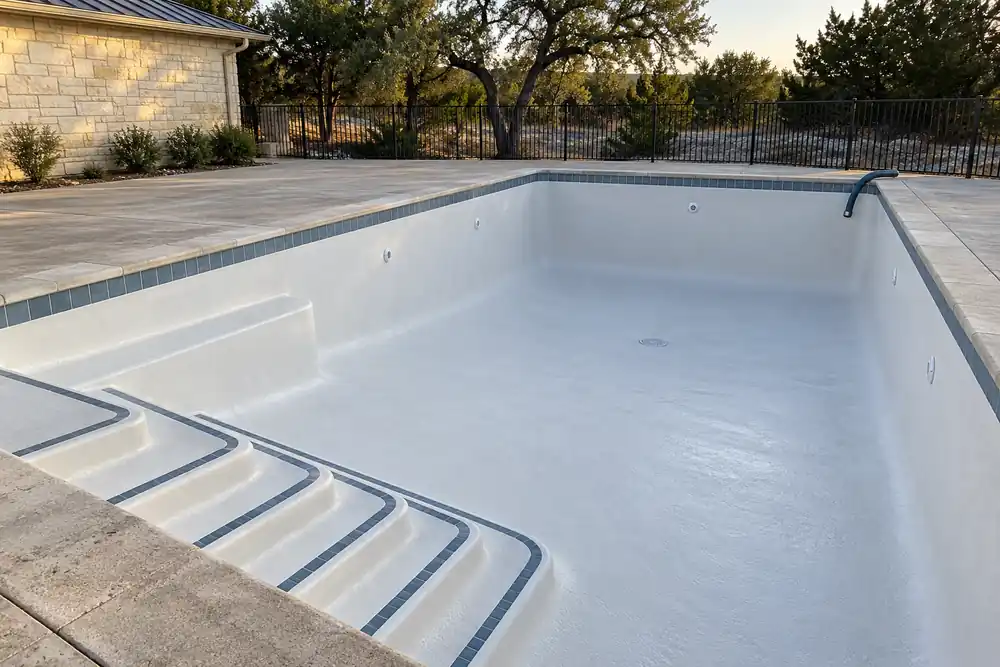
Pool Drain and Acid Wash in Leander, TX
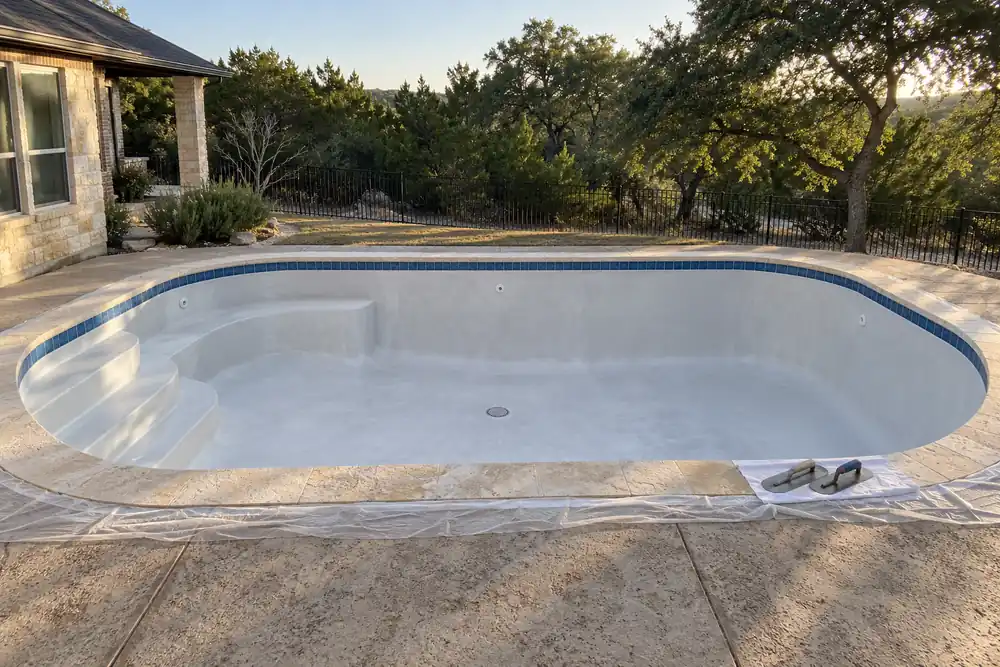
Leander Pool Resurfacing handles pool drain and acid wash work in Leander, Texas: the pool is drained, its cement-based finish washed with a diluted acid solution to lift stains, dirt and efflorescence, then neutralized, rinsed and refilled under the City's water rules. The National Plasterers Council's glossary treats an acid wash as cleaning, so plaster that is hollow, cracked or worn through needs a different fix.
Call or send the form for a free estimate. We'll talk through whether your stains call for an acid wash, a chlorine wash, tile cleaning or something more, and how a drain-down fits Leander's current water phase.
Call or request a free estimate any time, 24/7
No charge · answered 24/7
Get free estimates
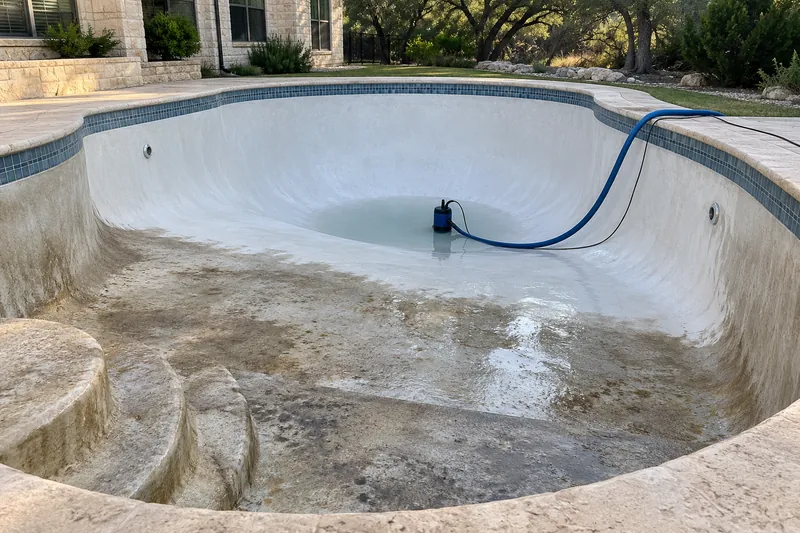
When a pool acid wash helps, and when it won't
Scale that acid won't shift
White scale along the waterline is its own problem. Orenda, a pool chemical maker, doesn't recommend putting acid directly on scale; it lists grinding and bead blasting as the physical ways to clear a tile line, and warns that scale usually comes back unless the water's saturation index is corrected. It also describes calcium silica scale, which sometimes forms on cement surfaces, often looks rounded like kernels of rice, appears to be immune to muriatic acid and has no known chemical remover. Tile-line deposits are covered under pool tile cleaning and calcium removal.
Algae calls for chlorine
Algae, mold and mildew are a chlorine job rather than an acid one. SGM's surface preparation kills them with a chlorine wash before any new plaster goes on, because whatever is left behind leads to discoloration and bond failure, and it takes off oil and grease with trisodium phosphate and water.
Hollow or worn-out plaster
A wash cleans the surface; it doesn't reattach plaster that has let go. The quick check is a tap with a screwdriver's plastic handle or a rubber mallet, and Universal White Cement says a dull, hollow sound means the plaster has separated, which calls for pool plaster repair. Once a finish is rough and worn through, the fix is pool replastering, and before new plaster goes on, SGM etches the bare shell with muriatic acid to clean and roughen it.
For a free estimate on a stained or tired finish, call Leander Pool Resurfacing or send the form.
Call or request a free estimate any time, 24/7.
(737) 212-9378How a drain and acid wash runs
Each maker writes instructions for its own finish. The steps below draw on the EPA, River Pools and SGM.
Let the chemicals fade
The EPA suggests letting the water sit 48 to 72 hours without added chemicals before draining, to make it safer for landscape use, and checking local rules on where pool water may go.
Drain with care
River Pools, a fiberglass pool maker, explains that groundwater pushes up on a pool holding too little water and can bulge, crack or even float a shell, concrete pools included, so it leaves draining to a professional.
Wash from the deep end up
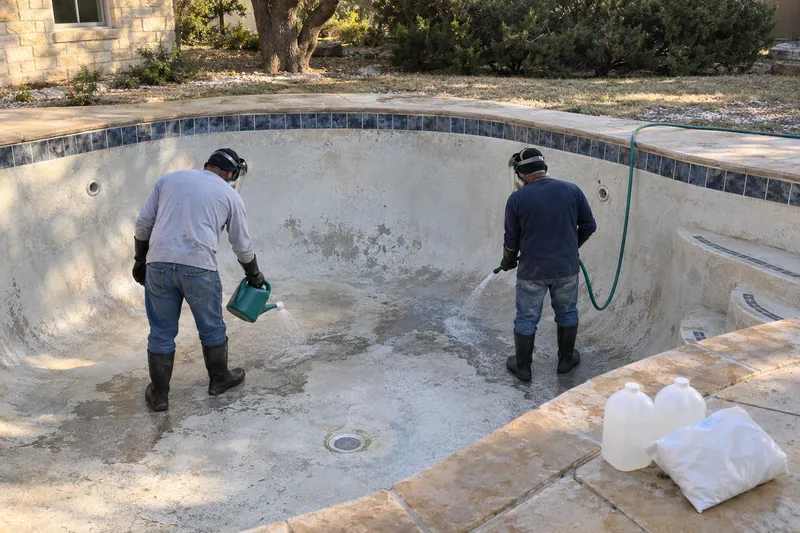
SGM's procedure for its own finish: proper safety equipment at all times, the deep bowl washed first and the work carried up to the shallow end to avoid streaks, walls and steps last, no solution left to puddle in the bowl, and an additive to cut the fumes.
Neutralize the run-off
SGM keeps a sump pump discarding the run-off once it is diluted and neutralized, disposes of the wash under local rules, and neutralizes acid left on the finish with soda ash and water so it doesn't discolor.
Rinse and refill
Once the surface is rinsed, the pool refills under whatever water phase Leander has in force that week, covered in the next section.
Call or request a free estimate any time, 24/7.
(737) 212-9378Leander's drain and refill rules
As of October 1, 2026, Leander is in Phase 2 Water Conservation. Phase 2 lets water be added to a pool where it is needed to keep the purification system running or the pool structurally sound, and neither the City's page nor its code says whether a full refill after a drain-down counts, so ask the City before the pump goes in. Higher phases have come for plant and pipeline work rather than low lakes: the City has moved above Phase 2 at least four times since mid-2023, and in its Phase 4 periods no City water could go into filling or refilling a pool.
The run-off needs as much care as the refill. Leander's stormwater ordinance names muriatic acid among the pool chemicals that may not reach a storm drain in any harmful amount, admits drained pool water only once it is dechlorinated to below 1 ppm, and carries fines of up to $2,000 for each day a violation goes on. The City points out that storm drains empty into waterways such as Brushy Creek without treatment.
The refill water itself is a small line. At the City's in-city rates, 15,000 gallons billed as a home's only water use that month comes to $68.25, and 20,000 gallons to $97.25, before the fixed monthly charge (our arithmetic on the City's rate table). The guide to draining and refilling a pool under Leander's water rules goes through the drain and refill in more detail.
Outside the city, Leander Pool Resurfacing also handles pool acid wash in Bertram.
Call or request a free estimate any time, 24/7.
(737) 212-9378Pool acid wash cost
National averages for 2026 put an acid wash at $250 to $600, about $450 on average, with most homeowners paying $120 to $1,500 depending on the pool's size and condition; refilling is extra. Priced by surface, the 2026 national figure is $0.40 to $0.60 a square foot, so a pool 10 feet wide, 20 feet long and 6 feet deep, with 560 square feet of surface, comes to about $280. National 2025 figures run $300 to $700 for most residential in-ground pools.
Surface area, how heavy the staining or algae is and the surface material drive the price, and national 2026 figures put the wash itself at about four hours of work. Draining is often priced apart: typical Austin-area figures for 2026 put draining at $170 to $220 and refilling at about $54 per 5,000 gallons. These are published figures, not prices from Leander Pool Resurfacing, which estimates a drain and acid wash for free.
- Acid wash, national average range (2026)
- $250–$600
- Acid wash, per sq ft of surface, national (2026)
- $0.40–$0.60
- Acid wash, residential in-ground, national (2025)
- $300–$700
- Draining a pool, Austin (2026)
- $170–$220
- Refill, per 5,000 gallons, Austin (2026)
- about $54
Published national and Austin-area figures, for planning only. Not a quote.
Call or request a free estimate any time, 24/7.
(737) 212-9378Pool acid wash questions
What does an acid wash do to a pool?
It dissolves material at the surface of a cement-based finish. The National Plasterers Council's glossary gives the term three uses: cleaning a finish to remove efflorescence, dirt or other unwanted stains; etching a brand-new exposed-aggregate finish to bring out its stones or sand; and a low-strength, diluted wash that lifts certain stains with little, if any, of the surface compromised. Efflorescence, in the same glossary, is soluble compounds, mainly calcium hydroxide, that moisture carries out of the finish and leaves to harden on its surface.
Is it good to acid wash a pool?
In moderation, on a finish that can take it. Makers counsel restraint: Universal White Cement says frequent washes buy a whiter pool for a while at the cost of years of plaster life, and SGM saw acid give traditional limestone-based plaster only short-lived relief and faster wear. A finish that is hollow, cracked or worn through needs repair or a new surface rather than another wash, and Leander Pool Resurfacing can talk through which your pool needs.
Can I acid wash my pool without draining the water?
Not in the usual sense; the washes makers describe are done on an empty pool, with the run-off pumped out as the work goes. The one "no-drain acid wash" SGM describes is a start-up method for new plaster, used where fill water is high in alkalinity or hardness: after filling, enough acid goes in to drop total alkalinity to zero, and the pool is brushed twice a day for three days before a sequestering agent goes in and soda ash brings the pH back up. SGM says that used alone, without water washing, it gives the least desirable result and a streaked look, and research funded by the Independent Pool & Spa Service Association ranked the acid start-up last of four start-ups because it etched the plaster microscopically.
Can a pebble or quartz finish be acid washed?
Within each maker's limits. SGM says its quartz-based Diamond Brite can be acid washed several times over its life without permanent damage. Pebble Technology International uses an acid solution itself on a new pebble finish, pressure washing and detailing it once it has hardened to remove residue or film before the fill. Polished finishes have their own rules: CL Industries allows its polished Hydrazzo to be acid washed and polished again after a poor start-up. The finish maker's care guidance decides.
Will an acid wash hurt pool tile or stone coping?
It can if the acid reaches them. Oceanside Glass & Tile warns that some acids damage tile glaze and iridescent glass tile, says hydrofluoric, hydrochloric, muriatic and phosphoric acids must not touch its tile, even while a pool is being finished, and neutralizes any accidental contact at once with baking soda and water. Lunada Bay Tile says never to put muriatic acid directly on glass or ceramic tile. Stone needs the same care: the Natural Stone Institute says travertine and limestone are calcium-carbonate stones vulnerable to mild acids.
Get a free pool drain and acid wash estimate
Leander Pool Resurfacing answers calls and estimate requests 24/7 for drain and acid wash work in Leander and nearby towns. Tell us what the finish is, what the stains look like and when the pool was last drained.