Starting Up New Pool Plaster in Leander's Hard Water
Leander Pool Resurfacing explains the pool plaster startup for Leander, Texas: the first 28 days after a new plaster finish is filled, when the National Plasterers Council says the surface is especially susceptible to staining, scaling and discoloration, and when frequent brushing and daily testing of the water do most of the work.
Leander's City water, drawn from Lake Travis, runs higher in pH and alkalinity than the Council's start-up card works toward. This guide follows that card day by day after pool replastering or any new cement-based finish, then covers what the local water changes and where the makers differ. It is general industry practice; on a branded finish, the maker's own start-up comes first.
Call or request a free estimate any time, 24/7
Fill day for new pool plaster
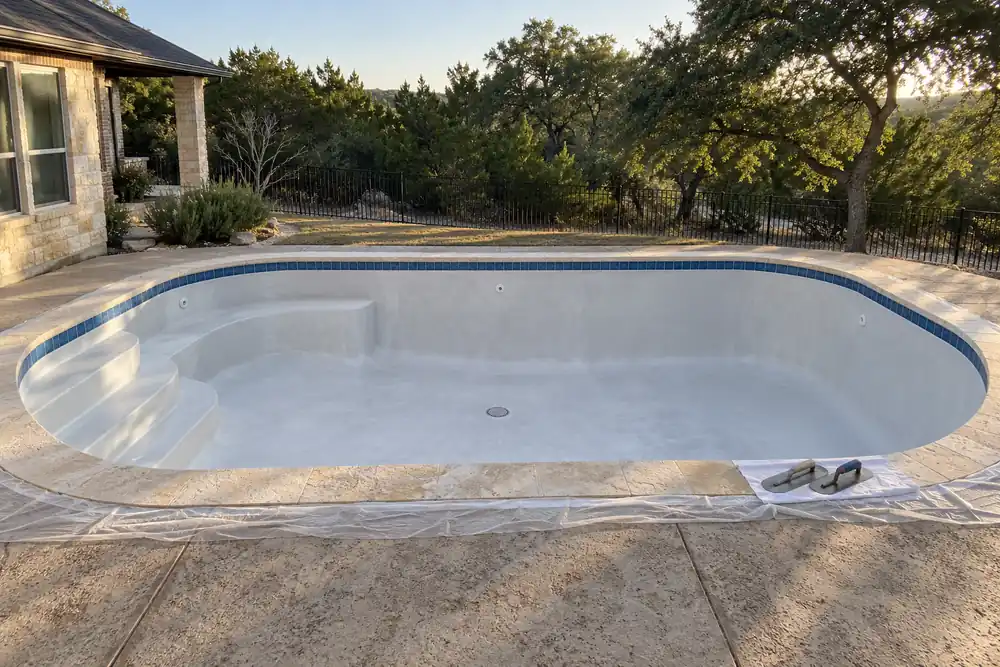
The start-up begins before the water does. The National Plasterers Council wants the pool's filtration working before the finish goes on, with a portable filter brought in if the pool's own system can't clear the plaster dust. Traditional hard-troweled white plaster should be filled as soon as possible after final set, while polymer-modified, quartz and pebble finishes may need extra time to cure, or to be cleaned, exposed or polished first, usually the same day or the next.
Filling without stopping
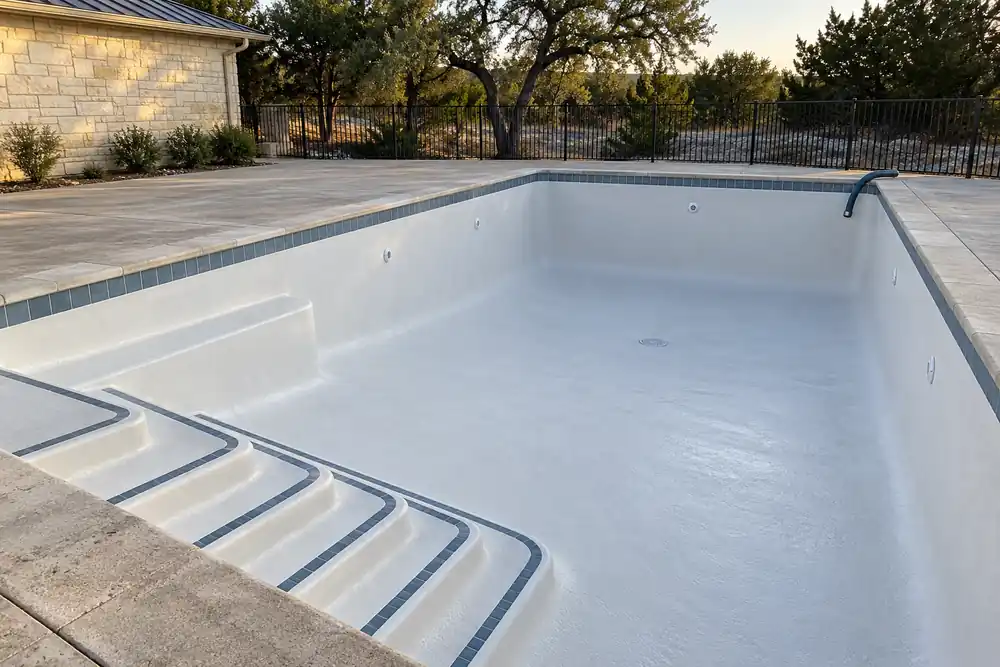
The Council's fill-day rules are simple and strict: clean potable water, never softened or reverse-osmosis water; a clean cloth tied to the end of the hose, which lies at the deepest point; and a fill that runs continuously and as fast as possible to the middle of the skimmer. A stop can leave a discolored "bowl ring" at that level, and a long one can increase shrinkage cracking above it. If a water truck is used, the Pool & Hot Tub Alliance says to test the water from each truck, and NPT, the maker of StoneScapes, says to turn a hose down overnight rather than off.
Keeping other water off the finish
Nothing else should wet the new surface until the pool is full: no sprinklers and no rain runoff, which leave streaks or spots, and no people or pets in the pool. In Leander, Phase 2 limits sprinklers to one day a week, from midnight to 7 a.m. or 7 p.m. to midnight on a day set by the address's last digit (as of October 1, 2026), so it pays to know that day before the fill. Once the pool is full, the Council's card says to test the fill water for pH, total alkalinity, calcium hardness and metals, record the results and start the filtration straight away.
Call or request a free estimate any time, 24/7.
(737) 212-9378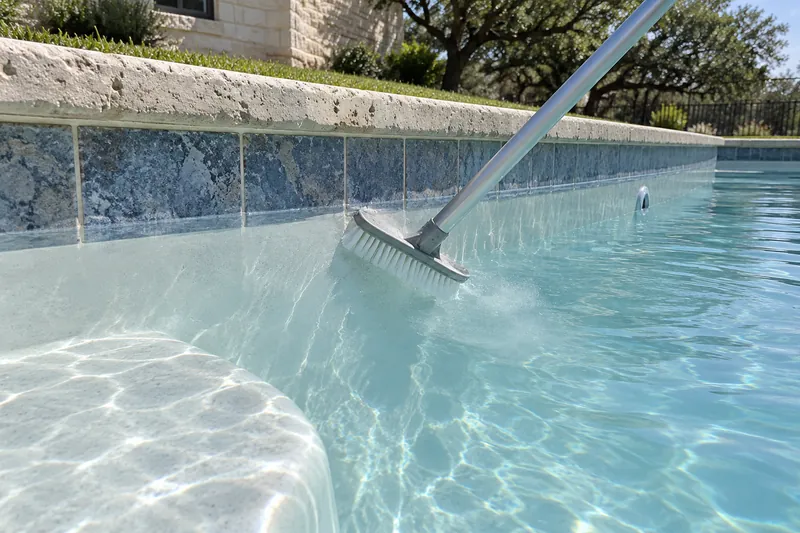
The 28-day plaster startup, day by day
The National Plasterers Council's start-up card (revised 03-2021) asks for each step in the recommended order before moving on to the next, and notes that unusual fill water may call for changes. Its traditional sequence runs like this:
Day 1: alkalinity first, then pH
High total alkalinity comes down to 80–100 ppm with muriatic acid pre-diluted in a 5-gallon bucket of water, or low alkalinity goes up to 80 ppm with baking soda; pH then goes to 7.2–7.6. Low calcium hardness rises to 80–100 ppm in dissolved 10-lb doses of calcium chloride, several hours apart, never at the same time as baking soda. The pumps run without stopping, the whole pool is brushed at least twice a day, and no chlorine goes in for 48 hours.
Day 2: calcium hardness
With alkalinity at 80–100 ppm and pH at 7.2–7.6, calcium hardness goes up to 100–150 ppm, again in dissolved 10-lb doses several hours apart.
Day 3: chlorine
Pre-diluted or liquid chlorine brings the level to 1.5–3.0 ppm. Salt-water pools get no salt in the first 30 days.
Day 4 onward: calcium and stabilizer
Calcium hardness rises slowly, if needed, to at least 200 ppm. Cyanuric acid goes in through the skimmer with the pumps running, over at least three days, to 30–50 ppm, with a brushing after each addition, because concentrated stabilizer can discolor pigmented finishes. Floor return heads and directional eyeballs can go back in once the water is balanced.
Day 7: the last of the dust
Any plaster dust left comes out with a brush pool vacuum. By now the pumps have run continuously for seven days, the card's requirement, unless the dust was gone and the water clear sooner, with 72 hours as the minimum.
Days 7 to 28: testing every day
With the dust gone and a good cleaning system in place, brushing can drop to removing leaves and dirt or spreading chemicals, but the water is still tested and adjusted daily until day 28.
Two habits run through every step: add chemicals to water, never water to chemicals, and pre-dilute them and pour them into the deep end with the pumps running, away from benches, steps and suction lines, then brush the area. The Pool & Hot Tub Alliance applies the same basic 28-day process to marble, quartz, pebble and glass-bead finishes, and says there is no one-day start-up that safely and properly balances the water.
Call or request a free estimate any time, 24/7.
(737) 212-9378What Leander's hard water means for the startup
The City of Leander's 2024 water report, the newest that lists these figures, gives hardness of 194 ppm, total alkalinity of 156 ppm within a range of 144 to 171, a pH of 8.2 within 7.8 to 8.5 and total dissolved solids of 305 ppm. The City's 2025 report carries no hardness, alkalinity or pH figures at all.
Alkalinity and pH: the acid steps come first
Against the card's Day 1 targets, an alkalinity of 156 ppm sits above the 80–100 ppm range and a pH of 8.2 above 7.2–7.6, so on the City's reported figures Day 1 means bringing both down with acid rather than raising them. The Council warns that fill water high in pH, calcium hardness or total alkalinity can leave mineral scale on a finish, and that dissolved metals, usually copper, iron and sometimes manganese, can stain it; it says testing fill water should no longer be optional. A sequestering agent, a metal and mineral stain preventer, is optional on the card but recommended by many, and once started it carries on at the maintenance dose.
Calcium: test it at the hose
The Council recommends fill water above 200 ppm of calcium hardness, or above 150 ppm for some high-performance finishes. Leander's report gives total hardness only and doesn't break out calcium, so whether the fill clears that mark is something only a test at the pool can show. Homes in Block House Creek get their water from Block House MUD rather than the City, so the City's report doesn't describe it. Softened or reverse-osmosis water is a risk too: the Council says soft fill water leaches calcium from the top of a new finish, with damage from severe discoloration to a weakened surface, and it suggests bypassing the softener, using hydrant or trucked water, or dosing calcium chloride during the fill.
Acid and bicarb start-ups
SGM describes an acid start-up, used where fill water is high in alkalinity or hardness: muriatic acid takes total alkalinity to zero, the pool is brushed twice a day for 3 days, then a sequestering agent goes in and soda ash brings the pH back up. Used alone, SGM says, it gives the least desirable result and a streaked look. A bicarb start-up instead adds baking soda to the fill water, so that, its promoters say, virtually no plaster dust forms. Research funded by the Independent Pool & Spa Service Association rated bicarb ideal, the Council's traditional start-up a close second and the acid start lowest, because it etched the plaster; the Council kept its card as the method simple enough for homeowners and technicians to follow.
A common sign of scale is the white evaporation line on the waterline tile. The pool chemical maker Orenda calls it a common type of scale, and Lunada Bay Tile notes that the waterline is where evaporation is highest. Taking it off is a job for pool tile calcium removal.
Call or request a free estimate any time, 24/7.
(737) 212-9378Quartz, pebble and other finishes: the maker's start-up
The Council says proprietary finishes should always follow the maker's fill and start-up instructions, and the makers don't all agree with its card or with each other.
Quartz
For its Diamond Brite quartz pool finish, SGM's product sheet adds a sequestering agent on the first fill, keeps calcium hardness at least 125 ppm for three days and then at 200–400 ppm, brushes twice a day for the first three days and daily for two weeks, and holds off the wheeled vacuum for 14 days and the automatic cleaner and salt for 28. Its online maintenance guide gives a different brushing schedule and says to add no metal sequestering agent unless the installer directs.
Pebble
In its start-up procedure for saltwater pools, Pebble Technology International's 28-day range for its high-performance finishes is a pH of 7.0–7.4, total alkalinity of 80–90 ppm, calcium hardness of 200–250 ppm and a saturation index between -0.3 and +0.3. It calls frequent acid additions normal, often daily for the first two weeks, because plaster dust raises pH and calcium hardness. NPT, the maker of StoneScapes, takes alkalinity to 70 ppm on Day 2 and raises calcium slowly over the 28 days to no more than 200 ppm, where the Council's card sets 200 ppm as a minimum from Day 4.
Heaters, salt cells and automatic cleaners
The waits differ by source:
- Heater: 28 days in the Council's white paper; until the water is balanced and the dust is gone on its card; normally 2–4 weeks per the Pool & Hot Tub Alliance; until the dust is gone, typically day 4 to 10, for NPT; at least 14 days for Pebble Technology International.
- Salt: not within the first 30 days on the Council's card; 28 days for NPT, which says waiting up to 6 weeks may help; 28 days for SGM and Pebble Technology International.
- Cleaners and feeders: no wheeled vacuum or wheeled cleaner until after 28 days on the Council's card, and no chemical feeders other than ORP and pH controllers for 28 days per NPT and Premix-Marbletite.
Warranties lean on the start-up too. NPT's limited warranties on QuartzScapes and StoneScapes cover material issues, not installation, water-chemistry deterioration or an improper start-up; Premix-Marbletite's warranty terms say pH should never rise above 7.6 in the first 30 days; and Wet Edge Technologies asks owners to keep start-up and monthly water records. Leander Pool Resurfacing will talk through the start-up your finish's maker calls for at the free estimate.
Call or request a free estimate any time, 24/7.
(737) 212-9378After day 28: keeping new plaster balanced
From day 28 the Council's card moves to ongoing targets: free chlorine 1–3 ppm, pH 7.2–7.6, carbonate alkalinity 80–120 ppm, calcium hardness 200–400 ppm, cyanuric acid 30–50 ppm and total dissolved solids of 300–1,800 ppm in non-salt pools. It holds the Langelier Saturation Index between 0.0 and +0.3, above all in the first six months: below zero the water leaches or etches the surface, and above it the water scales or stains it. The Pool & Hot Tub Alliance suggests testing twice a week after day 28, during the plaster's secondary cure.
In a long drought, the Pool & Hot Tub Alliance says calcium can drift higher; pH and alkalinity can be lowered to offset it, and calcium hypochlorite, which adds calcium, isn't recommended. The Council's verdict is that proper materials, proper workmanship and balanced water chemistry must all be present for a finish to last, with water balance the most critical care item.
Call or request a free estimate any time, 24/7.
(737) 212-9378Pool plaster startup questions
How much does a pool startup cost?
National figures for 2026 put water balancing and start-up chemicals at $100 to $500, and another national 2026 estimate prices start-up chemicals at $150 to $400, depending on the pool's volume and finish type. In one Austin pool company's 2026 breakdown of a mid-range resurface, the refill, chemical start-up and cure monitoring together make up 5 to 10 percent of the budget. These are published figures, not a quote.
Why is new pool plaster cloudy?
Because of plaster dust. The National Plasterers Council explains that it is calcium hydroxide, a by-product of the cement hydrating, released from new plaster underwater, and that losing the excess is normal and not harmful. The cloudiness typically lasts 7 to 10 days after the fill. The Council wants the dust brushed and filtered out within the first 3 to 5 days, because left longer it turns to calcium carbonate and sticks to the surface, which is difficult and expensive to remove.
Get a free estimate for new pool plaster
Leander Pool Resurfacing takes calls and estimate requests 24/7 from Leander and nearby towns. Tell us the finish you are weighing and where your water comes from, and we'll talk through the start-up it needs.