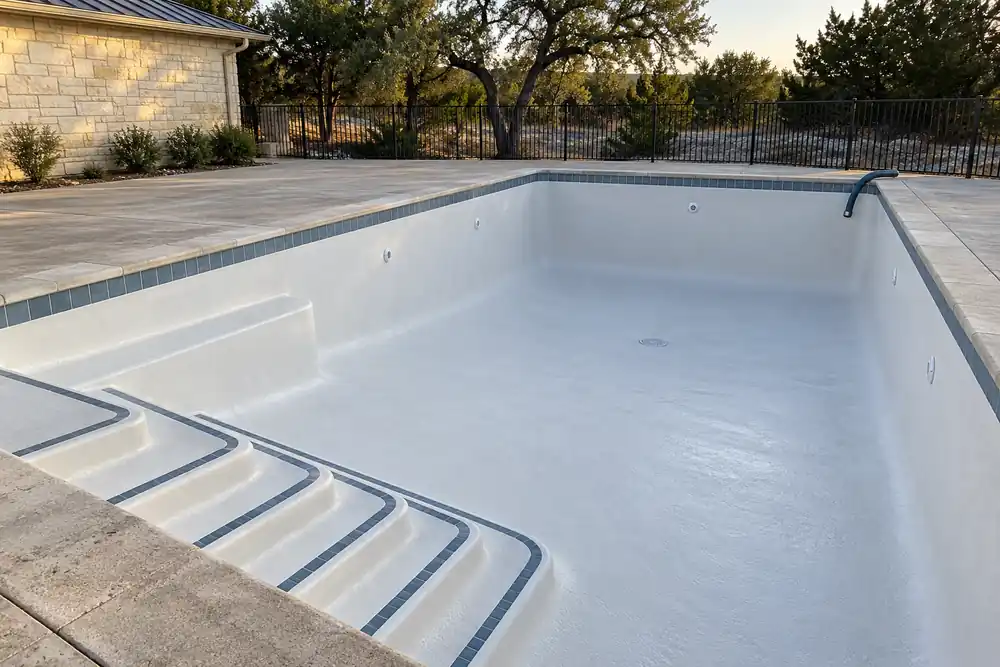
Pool Tile Cleaning and Calcium Removal in Leander, TX
Leander Pool Resurfacing handles pool tile cleaning and calcium removal in Leander, Texas: the white scale line that builds where the water meets the tile, taken off by media blasting or by hand with a method matched to the tile. The National Plasterers Council defines scale as minerals or metals that come out of the pool water and stick to tile and other surfaces, leaving stains and roughness, and names calcium carbonate as a major part of it.
Call or send the form for a free estimate. We'll talk through what tile your pool has, how heavy the scale is, and which cleaning method the tile's maker allows.
Call or request a free estimate any time, 24/7
No charge · answered 24/7
Get free estimates
Why a calcium line forms on pool tile
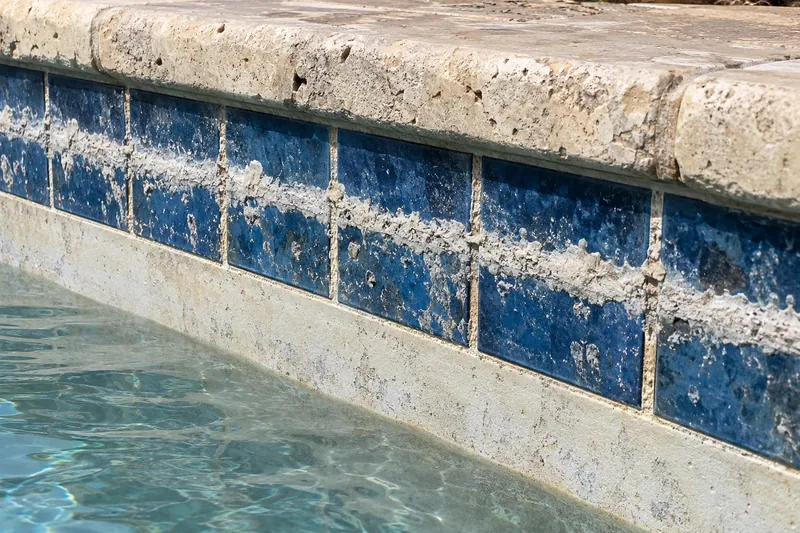
Evaporation leaves the calcium behind
Orenda, a pool chemical maker, calls evaporation lines on tile a common type of scale. As water evaporates off the tile, its calcium stays put, and as the pool loses water, what remains becomes more saturated with calcium. Lunada Bay Tile points to the waterline as the place where evaporation is highest.
Water balance and the saturation index
LATICRETE explains that water oversaturated with minerals gets rid of them by depositing scale, while undersaturated water dissolves whatever it touches, and that balanced water can drift out of balance within 24 hours. The Pool & Hot Tub Alliance's Langelier Saturation Index weighs pH, temperature, total dissolved solids, alkalinity and calcium hardness: above zero the water may form scale, below zero it may attack the calcium in cement, and the range it gives for proper balance is -0.3 to +0.5. Orenda draws the scaling line higher, above +0.30, and says calcium hardness usually needs help from high pH, warm water or carbonate alkalinity before scale forms.
White deposits that aren't scale
Orenda's test is simple: real scale lands on everything in the water, from tile and plastic fittings to metal ladders and lights, so white calcium that shows only on the cement is something else, such as etching, mottling or plaster dust. It also describes calcium silica scale, which forms on cement surfaces, often looks rounded like kernels of rice, appears immune to muriatic acid and has no known chemical remover.
Call or request a free estimate any time, 24/7.
(737) 212-9378How calcium is removed from pool tile
Media blasting at the waterline
Kramer Industries, a maker of blasting media and equipment, describes the usual tile job: the water comes down about 6 inches below the tile, glass beads are shot at the band at low pressure, and the spent beads sink to the pool floor, where the pool's cleaning equipment can pick them up. Some crews work from a machine with a built-in vacuum that pulls the deposits back as they come off, then wipe the tile down by hand and polish it once dry, leaving the water cloudy and low until the filter clears it. Kramer also wants everyone, pets included, out of the pool and off the deck before blasting starts.
Matching the media to the tile
The makers don't agree on media. Kramer says glass beads will not harm tile or its glaze, while Oceanside Glass & Tile rates glass bead as the aggressive end of the range and baking soda as the mild end, and says baking soda or a media of similar hardness, such as kieserite, a mineral salt, removes scale and stays safe for tile, glass tile included. Kieserite pops as it hits the tile, and that force is what frees the calcium. Lunada Bay Tile goes further and advises against blasting or mechanically abrading glass or ceramic tile at all. Oceanside's rule covers every method: test it first on a spot nobody will see.
Cleaning by hand, and what to keep off the tile
For lighter buildup, Oceanside Glass & Tile's care guide calls for an acid-free calcium remover and a nylon bristle brush, and rules out pumice stones, wire brushes and abrasive or acidic cleaners. Summit Brands, the maker of the Pumie scouring stick, says not to use it on glass, fiberglass or other plastics, and warns that some decorative tile and colored porcelain is fragile enough to be damaged by abrasives.
Sealers and grout
Lunada Bay Tile recommends sealing a new tile installation before the pool is filled, to cut later maintenance, and calls the sealer sacrificial, meaning it has to be reapplied from time to time. Oceanside Glass & Tile says sealers benefit cement-based grout, natural stone and masonry such as coping. LATICRETE warns that deposits forming behind a tile can push it loose; once tiles have moved, the band needs pool tile repair as well as cleaning.
For a free estimate on a calcium line, call Leander Pool Resurfacing or send the form.
Call or request a free estimate any time, 24/7.
(737) 212-9378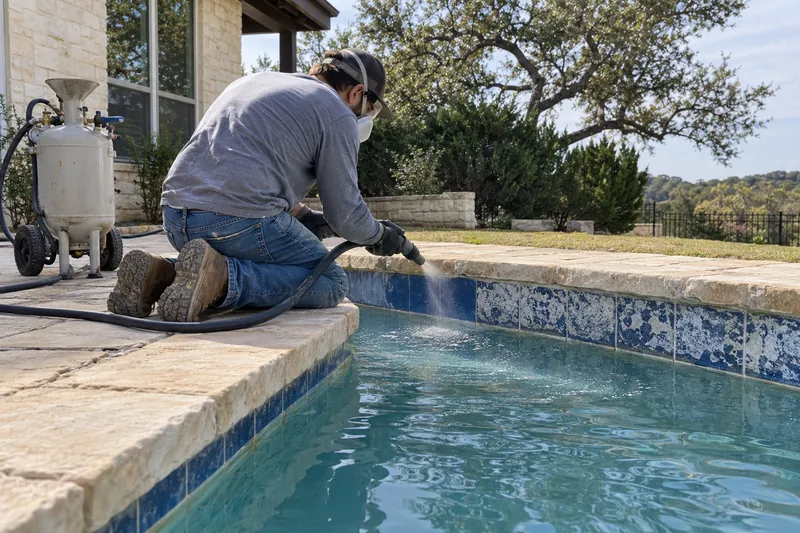
Leander's hard water and the tile line
Leander's City water comes from Lake Travis, and the City's 2024 water report, the newest one that lists hardness, gives 194 ppm of hardness, 156 ppm of total alkalinity and a pH of 8.2. Evaporation does the rest. In the Texas Water Development Board's one-degree block that contains Leander, yearly lake evaporation from 2015 to 2025 ran from 40.68 inches in 2021 to 54.16 inches in 2017, and the single highest month was July 2022, at 11.57 inches.
The tile makers' own water targets differ. Lunada Bay Tile asks for calcium hardness of 200 to 400 ppm and a pH of 7.2 to 7.8, while LATICRETE allows a pH of 7.2 to 8.0 and warns that with calcium below 200 to 250 ppm, chlorine starts taking calcium out of cement-based grout and mortar.
A newly finished pool adds to the load for a few weeks. Pebble Technology International says plaster dust raises pH and calcium hardness during start-up, so acid additions are often needed daily for the first two weeks, one of the steps in starting up new pool plaster in Leander's hard water. Scale on the tile is a waterline job; stains and efflorescence across the plaster itself are cleaned by dissolving surface material, the National Plasterers Council's first meaning of an acid wash, and that work is done as a pool drain and acid wash.
Beyond Leander, Leander Pool Resurfacing also handles pool tile calcium removal in Santa Rita Ranch.
Call or request a free estimate any time, 24/7.
(737) 212-9378Pool tile cleaning cost in Texas and nationally
Published tile cleaning figures come from elsewhere in Texas and from national averages. Typical Houston-area prices for 2026 put bead blasting the waterline tile at $900 to $2,400, with no draining, against $600 to $1,100 for acid washing and $150 to $400 for scrubbing by hand with a pumice stone. National averages for 2025 run by how heavy the scale is: $3 to $6 per linear foot for light scale cleaned chemically or with pumice, $6 to $8 for moderate scale by glass bead or soda blasting, the most common tier, and $8 to $12 for heavy scale by salt or multi-pass media, which may need a partial drain.
The same national figures put job minimums at $400 to $1,000 and optional grout sealing at $2 to $3 per foot. Labor grows with the severity of the scale and with access, as tight decks, raised walls, spas and water features add time. Lowering the water a few inches is usually included; a full drain and refill changes the bill and brings in local discharge rules. These are published averages, not prices from Leander Pool Resurfacing, and the estimate for your pool is free.
- Bead blasting, waterline tile, Houston area (2026)
- $900–$2,400
- Light scale, chemical or pumice, per linear ft, national (2025)
- $3–$6
- Moderate scale, glass bead or soda, per linear ft, national (2025)
- $6–$8
- Heavy scale, salt or multi-pass, per linear ft, national (2025)
- $8–$12
- Job minimum, national (2025)
- $400–$1,000
- Grout sealing, per ft, national (2025)
- $2–$3
Published Houston-area figures and national averages. Not a quote.
Call or request a free estimate any time, 24/7.
(737) 212-9378Pool tile cleaning questions
Will muriatic acid remove calcium deposits from pool tile?
The tile makers say to keep it off the tile. Lunada Bay Tile says never to put muriatic acid directly on glass or ceramic tile, and Oceanside Glass & Tile warns that some acids damage tile glaze and iridescent glass, bars products containing hydrofluoric, hydrochloric, muriatic or phosphoric acid from touching tile, even during pool finishing, and neutralizes accidental contact at once with baking soda and water. Orenda doesn't recommend putting acid directly on scale either, and notes that calcium silica scale appears immune to muriatic acid anyway.
What is the best calcium remover for pool tile?
The one the tile's maker allows. Oceanside Glass & Tile's advice for its tile is an acid-free calcium remover scrubbed in with a nylon brush, and for heavier scale a mild blasting media such as baking soda or kieserite, tested on a hidden spot first. Lunada Bay Tile, which advises against blasting glass or ceramic tile, points owners to a pool professional for persistent buildup. Leander Pool Resurfacing will talk through which method suits your tile.
What dissolves calcium in pools?
Water that is short of minerals. LATICRETE explains that undersaturated water tries to saturate itself by dissolving everything it touches, and the Pool & Hot Tub Alliance says water below zero on the saturation index is potentially aggressive toward the calcium compounds in cement-based materials, which means plaster and grout. The Alliance even says a slightly positive reading may be preferred, because a thin scale layer gives some protection and does less harm than corrosion.
How often should pool tiles be cleaned?
Lunada Bay Tile calls weekly brushing with a soft brush or non-abrasive scrub pad essential to keep mineral buildup from forming, especially along the waterline. For buildup that persists, the same tile maker points owners to a pool professional. Orenda adds that scale usually comes back after removal unless the water's saturation index is corrected.
Does the pool have to be drained to remove calcium from tile?
Usually not. Kramer Industries' method lowers the water about 6 inches below the tile, and national 2025 cost figures treat lowering the water a few inches as part of a normal job, while heavy scale handled by salt or multi-pass media may need a partial drain. Leander has rules for both directions: pool water may go to a storm drain only once it is dechlorinated to less than 1 ppm of chlorine, and putting water back counts as adding water to a pool, which the City's Phase 2 rules, in force on October 1, 2026, allow only where needed to keep the purification system running or the pool structurally sound. Check the City's current phase before the water comes down.
Get a free pool tile cleaning estimate
Leander Pool Resurfacing answers calls and estimate requests 24/7 for tile cleaning and calcium removal in Leander and nearby towns. Tell us what tile your pool has, glass or ceramic, and how thick the white line has grown.