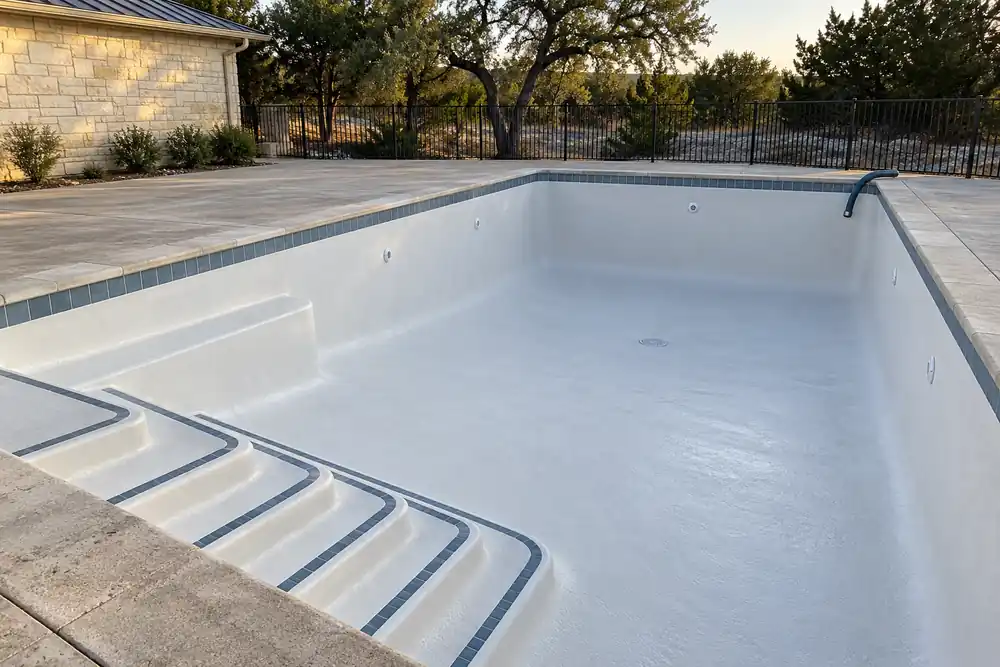
Travertine Pool Decks in Liberty Hill, Texas
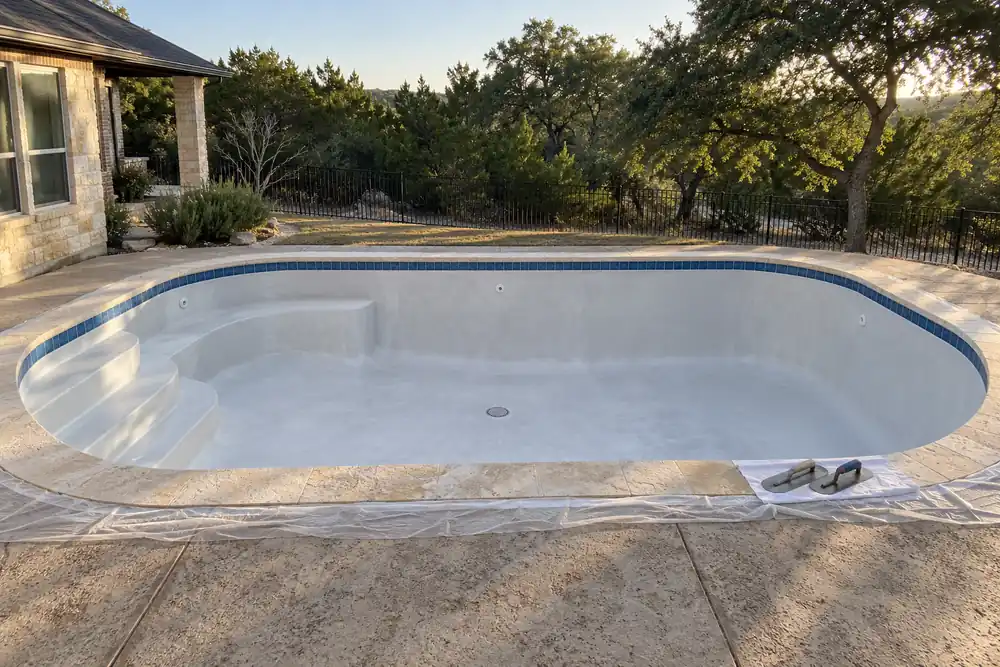
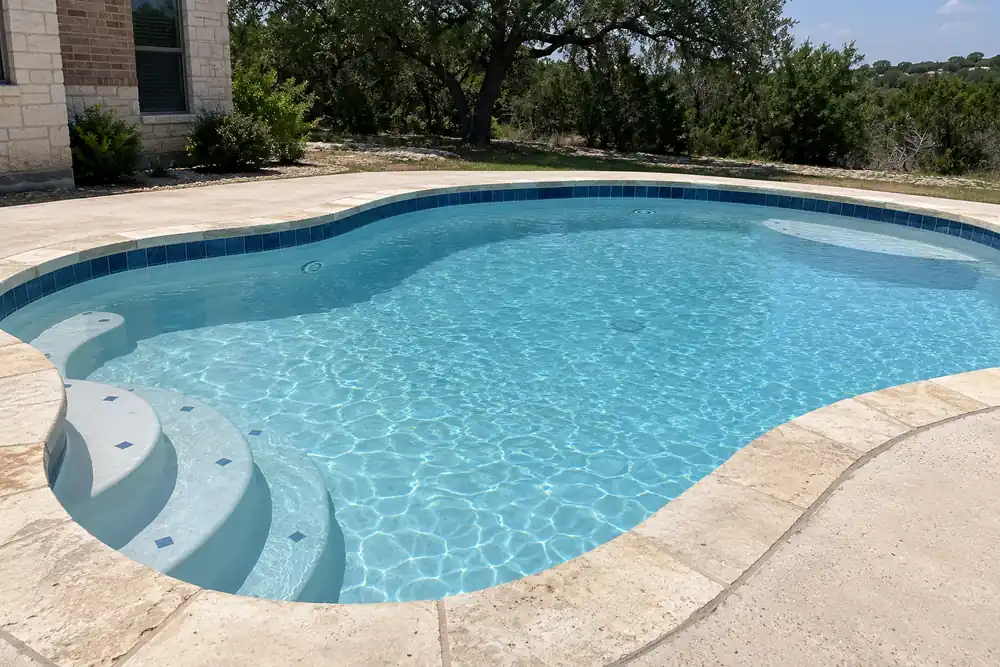
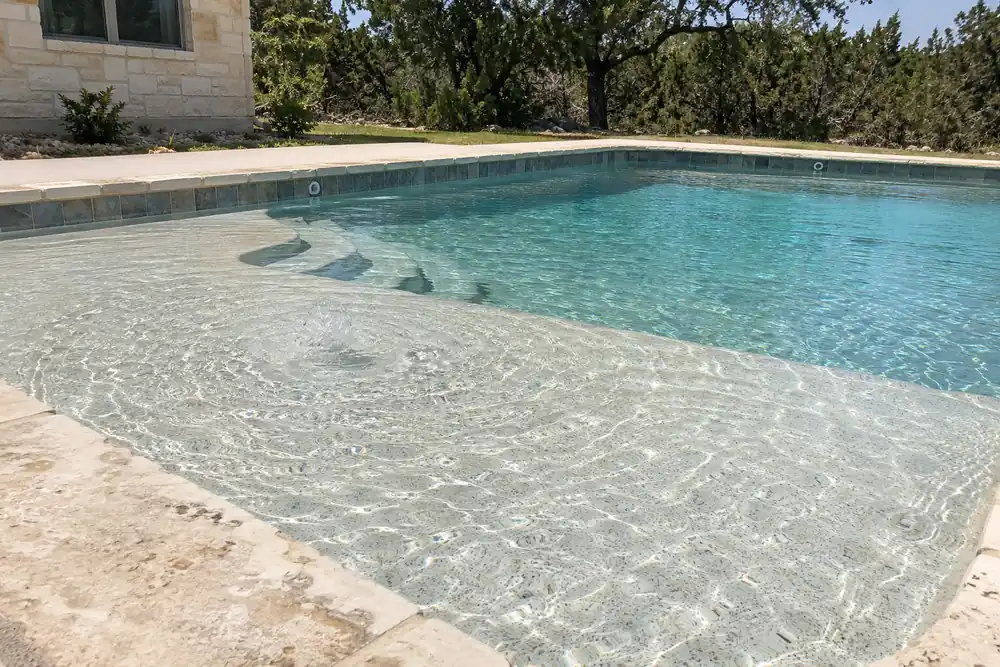
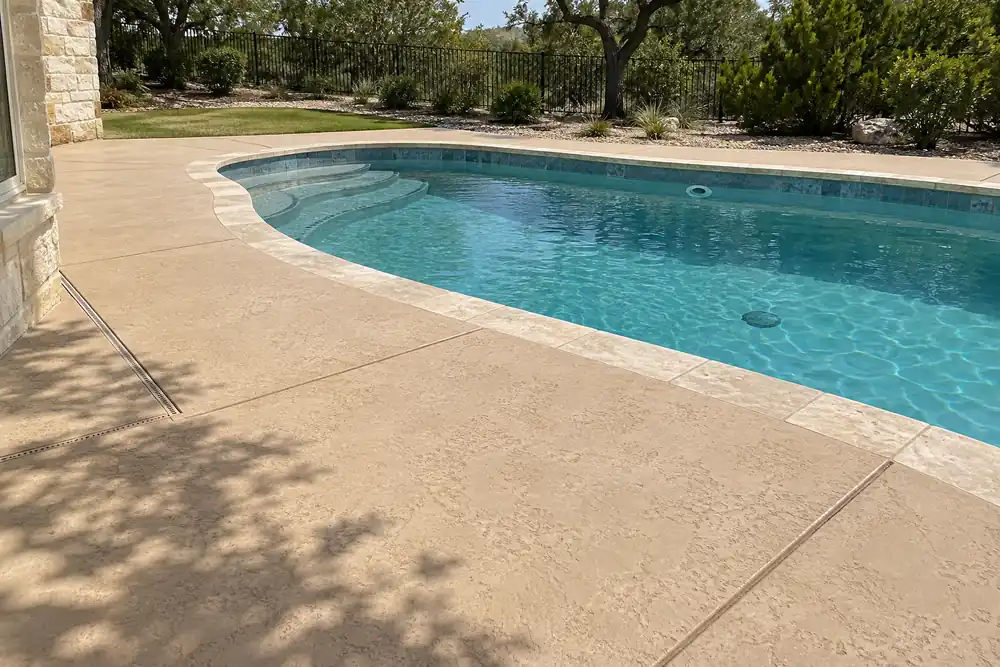
Leander Pool Resurfacing builds travertine pool decks in Liberty Hill, Texas, along with concrete paver decks and the sealed joint where a new deck meets the pool's coping.
Liberty Hill sits on State Highway 29 in the Hill Country, between the north and south forks of the San Gabriel River. Its city limits take in Liberty Parke, Butler Farms, downtown and the land along Highway 29. The International Sculpture Park, made by artists who stayed with local families in the summer of 1976, stands in Lions Foundation Park on Main Street, and the City's Swim Center opened in City Park on Memorial Day 2023.
Call or request a free estimate any time, 24/7
No charge · answered 24/7
Get free estimates
Pool decks in a town mostly built since 2010
Liberty Hill never reported more than 500 people through 1990, the Handbook of Texas records, and it counted 1,409 in 2000. The 2020 Census found 3,646, and the Census Bureau's estimate for July 1, 2025 is 13,317. The homes are young: in the 2020–2024 survey, 2,217 of 2,719 housing units, about 81.5%, were built in 2010 or later, and the median home dates from 2017, though the survey's margins are wide for a place this size.
The town's roots run further back. Settlers arrived in the 1840s, a post office opened three miles west of today's townsite in 1853, when postmaster William Oliver Spencer suggested the name, and the settlement shifted again when the Austin and Northwestern Railroad bypassed it in 1882. The City was founded in 1999 and became a home-rule city on November 18, 2024, after voters approved its charter 1,422 to 643. In a straight line, Liberty Hill's Census center point lies about 6.7 miles north-north-west of Leander's.
Call or request a free estimate any time, 24/7.
(737) 212-9378Travertine and pavers on thin Hill Country ground
The 1983 federal soil survey of Williamson County places the county's west, where Liberty Hill lies, in the Grand Prairie land resource area of thin, stony soils formed in limestone or in limestone and marl, and it notes that surface mining of limestone is significant there. That is a county-wide description rather than a test of any one lot, so the base under a new deck is planned from the yard itself.
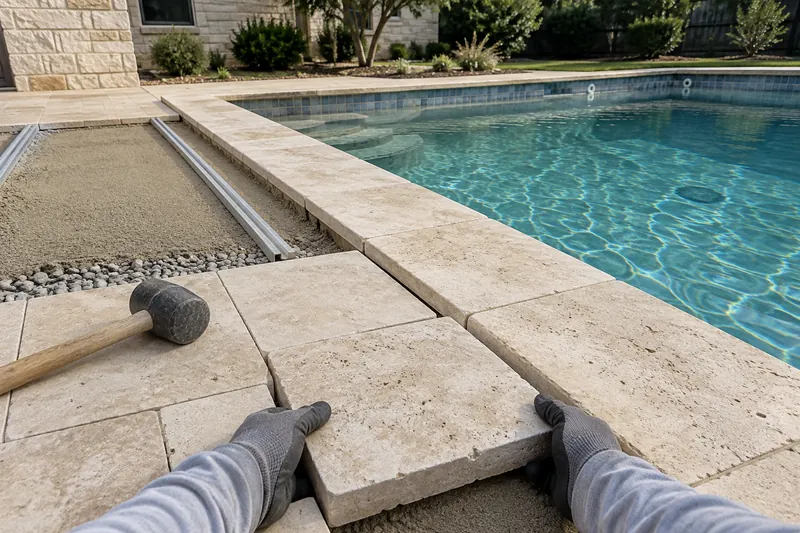
Sand-set, mortar-set or pedestal
The Natural Stone Institute names three ways to lay stone paving: mortar-set where stability matters, sand-set, which is common outdoors, and pedestal systems where drainage leads. For concrete pavers, the Interlocking Concrete Pavement Institute (ICPI) builds up an edge restraint, pavers with sand-filled joints, a nominal 1-inch layer of bedding sand, and a compacted aggregate or stabilized base over compacted soil. Around pools, it typically uses a concrete base at least 4 inches thick where the backfill or aggregate base can't be compacted well enough.
Choosing the stone
Travertine is a calcareous stone, mostly calcium carbonate, which the Institute groups with limestone and marble, and it shows more variation than any other natural stone, even from a single quarry. Its advice is to ask for a range of samples before installation and to mix pieces from every pallet. The holes in travertine come from gases trapped as it formed; most are filled at the factory with a cement or resin filler, and voids hiding just under the face can break through later under a small concentrated load, which the Institute says is normal to fill in place.
Slope, drains and gaps
The 2021 International Swimming Pool and Spa Code, which Liberty Hill has adopted, sets a minimum drainage slope of 1/8 inch per foot for travertine or brick-set pavers at a residential pool, and wants decks to drain so no more than 1/8 inch of water stands 20 minutes after the water stops. It caps the open gap between a pool deck and an adjoining walkway at 3/4 inch, with no more than 1/4 inch of height difference. ICPI slopes paver surfaces toward drains with holes or slots at the bedding-sand level, wrapped in geotextile so the sand doesn't wash out.
Call or request a free estimate any time, 24/7.
(737) 212-9378How a bigger pool deck counts against the lot limits
Inside the city limits, Liberty Hill's lot design table sets a maximum lot cover of 25% in the SF1 low-density district, 45% in SF2 and 50% in SF3, a maximum impervious cover of 45%, 50% and 65% in the same districts, and minimum rear setbacks of 25, 10 and 5 feet. The code counts patios, decks, walkways and swimming pools among a lot's impervious surfaces, and it credits wooden decks and walkways at 50% of their area. By our reading, that credit names only wood, so a stone or paver deck counts in full.
Zoning applies only inside the city; in Liberty Hill's extraterritorial jurisdiction the same lot standards are nonbinding guidelines. Many homes with a Liberty Hill address sit outside the city altogether. The City lists Stonewall, Orchard Ridge, Larkspur, Santa Rita and Wildleaf among the subdivisions on City of Georgetown water, and Rancho Sienna on City of Leander water.
Call or request a free estimate any time, 24/7.
(737) 212-9378Permits and job-site rules for deck work
Liberty Hill requires a building permit for any construction that physically changes or adds structures, and its permit list names swimming pools and spas, and alterations or remodeling. Fencing is on its list of projects that need no permit, though a fence that serves as a pool barrier still has to meet the pool code's 48-inch minimum. The adopted 2021 pool code requires a permit before anyone alters or repairs a pool, and the City's residential code amendments cut the permit-exempt list down to small sheds without electric or plumbing.
No City page says how a new pool deck on its own fits those rules, so that question goes to Liberty Hill Development Services before work is scheduled. The City's fee schedule sets $200 for an in-ground pool plus any required inspections, and $50 plus $50 per trade, up to $200, for a residential remodel, repair or alteration. On permitted jobs, erosion controls stay in working order for the whole permit, and construction debris is kept in dumpsters, roll-offs or a mesh-fenced area.
Outside any city's limits, Williamson County has adopted no residential building code. Its Road & Bridge Division issues a Certification of Compliance, which checks whether the property is in a floodplain, and owners in a city's ETJ are told to check with that city.
Call or request a free estimate any time, 24/7.
(737) 212-9378Coping, coatings and related pool deck work
Alongside travertine and paver decks, we replace pool coping, resurface concrete pool decks with coatings, repair cracked or settled decks, recoat cool deck and repair waterline tile.
Nearby, Leander Pool Resurfacing also handles pool tile calcium removal in Santa Rita Ranch and pool acid wash in Bertram.
Call or request a free estimate any time, 24/7.
(737) 212-9378How a travertine or paver pool deck is built
General practice from Unilock's installation sequence for a paver patio, the Interlocking Concrete Pavement Institute and the Natural Stone Institute. Your estimate covers the details of your own deck.
Samples and layout
A range of stone samples is checked first and pieces are drawn from every pallet, then the deck is marked out around the pool.
Excavate and compact
The area is dug out, loose subsoil is compacted, and the gravel base goes down in 3-inch layers, each compacted with at least three passes.
Screed the bedding
The bedding course is screeded flat and nobody walks on it afterwards; ICPI's bedding sand is a nominal 1 inch.
Lay, cut and restrain
Pavers or stone are laid and cut to fit, and edge restraints go in, which ICPI calls essential to keep the pavers and sand locked together.
Compact and fill the joints
The surface is compacted in three passes and the joints are filled with sand. Finished pavers sit 1/8 to 1/4 inch above the edges to allow for minor settlement.
Seal the coping joint
Urethane or neoprene sealant over a backer rod closes the joint between the last course and the coping, keeping water out while the pool wall and paving move separately. ICPI also recommends sealing the pavers and joints to hold the sand in place.
Call or request a free estimate any time, 24/7.
(737) 212-9378Travertine deck questions
How do you clean a travertine pool deck?
Gently. The Natural Stone Institute says calcium carbonate stones such as travertine are sensitive to acids, so cleaners with lemon, vinegar or other acids can dull or etch them; around pools it recommends flushing with clear water and using a mild bleach solution for algae or moss. High-pressure spray and stiff brushes can knock filler and grout out of the voids, and a sealer makes stone more stain resistant, not stain proof. If Liberty Hill ever reaches Phase 3 of its drought plan, a patio or other paved area may be washed only from a single refillable vessel of water.
Do Liberty Hill's water restrictions affect pool work?
They can. Liberty Hill has been in Phase 1, its base conditions, since January 21, 2025. Its drought plan counts filling, refilling or adding to a pool as a nonessential use, and under Phase 2 nonessential uses are banned except adding water to keep a pool's purification system running or to protect its structure. The City's 2025 water report lists Lake Travis surface water and Trinity Aquifer wells as its two sources, with City of Georgetown and City of Leander supplies both active.
Free travertine pool deck estimates in Liberty Hill
Leander Pool Resurfacing answers calls and estimate requests 24/7 for travertine and paver pool decks in Liberty Hill. Send the deck's rough size, what is there now and the stone you have in mind.