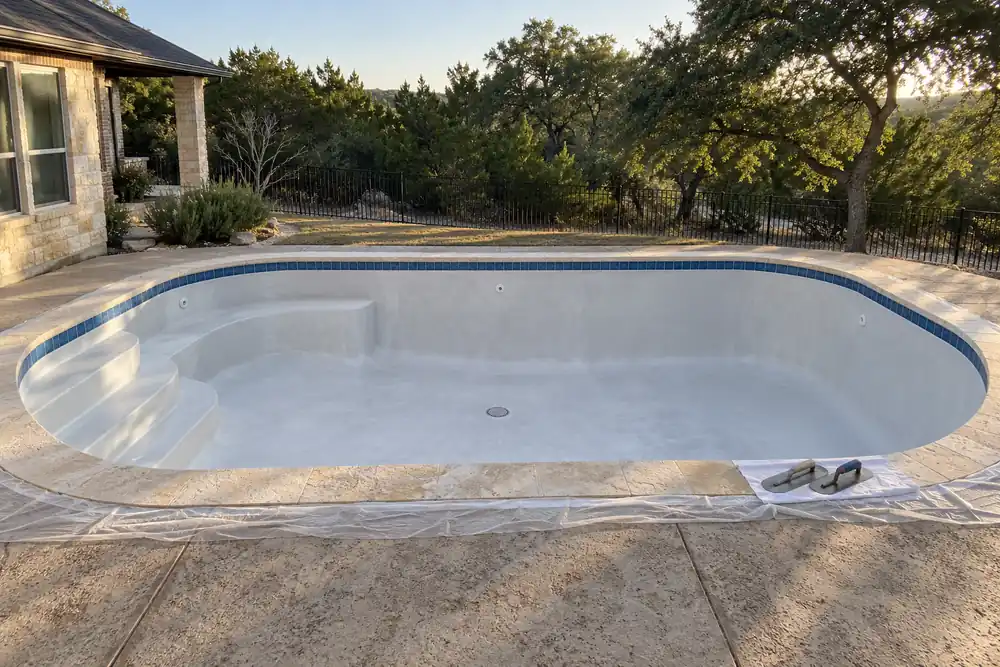
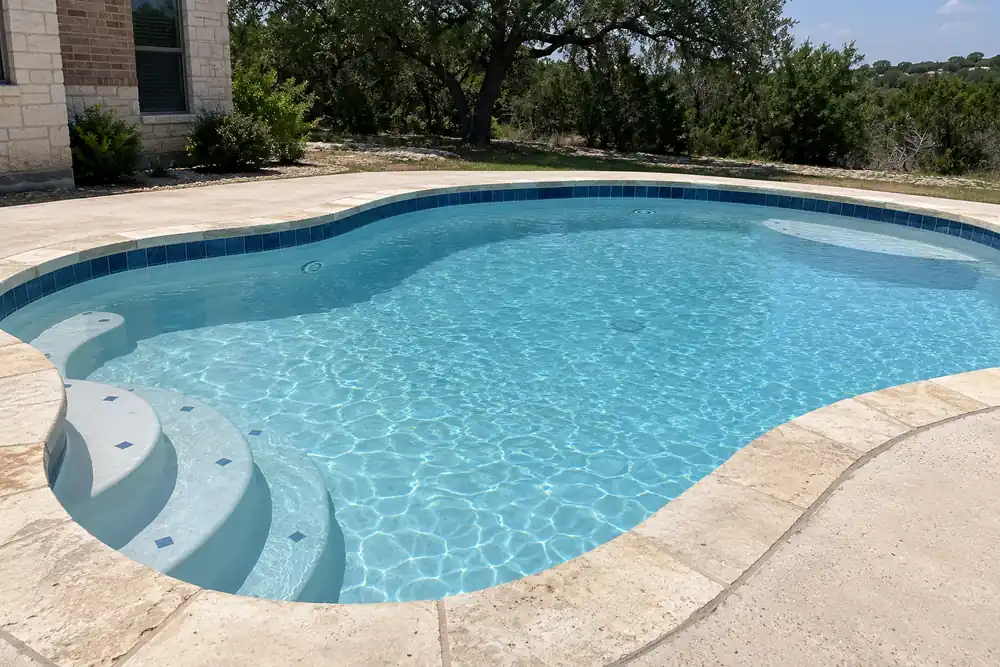
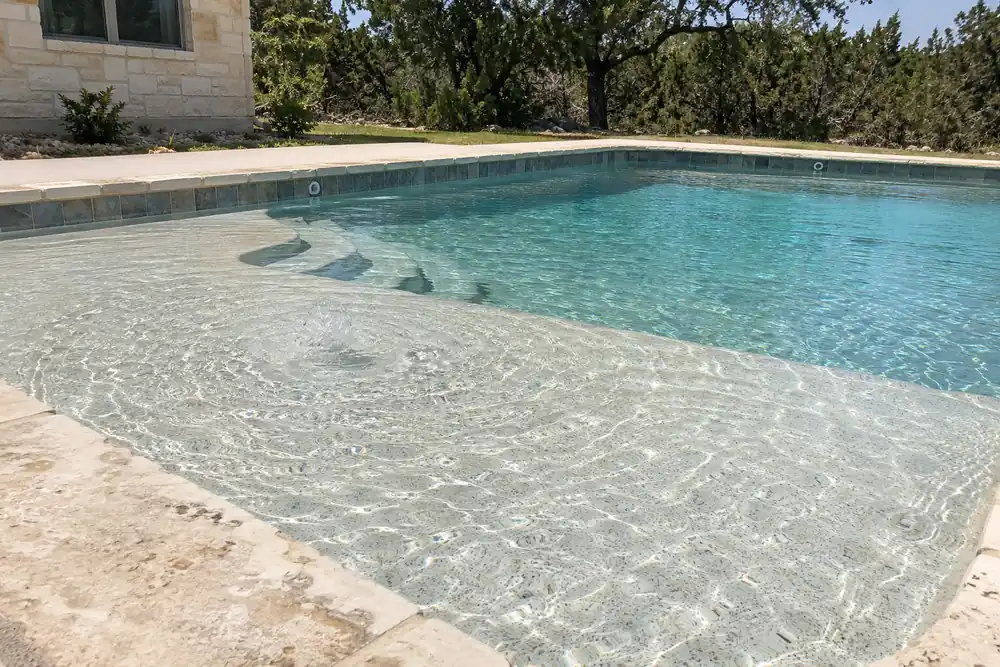
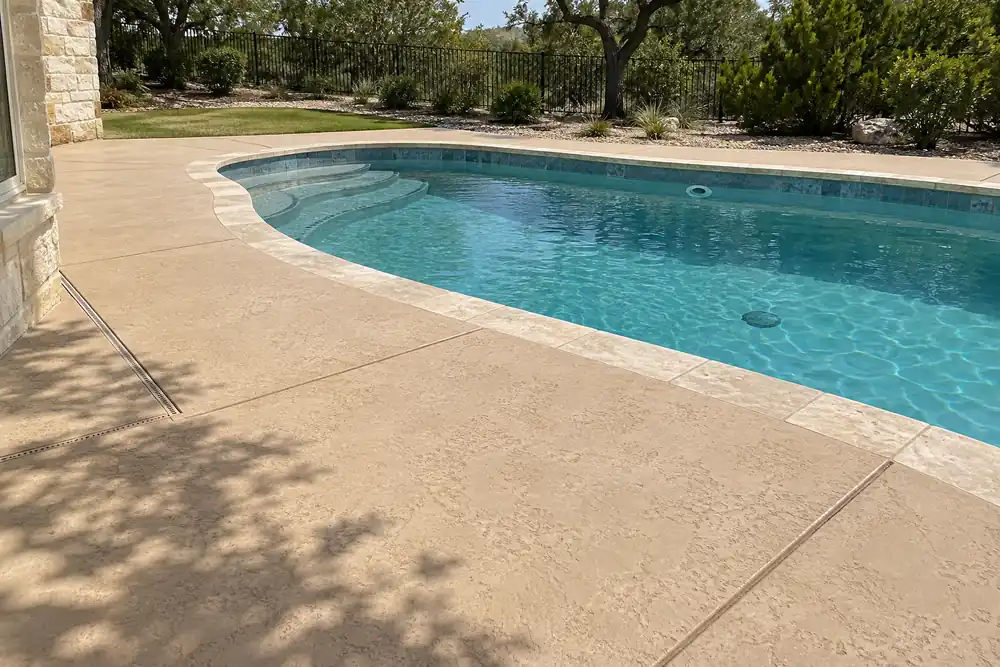
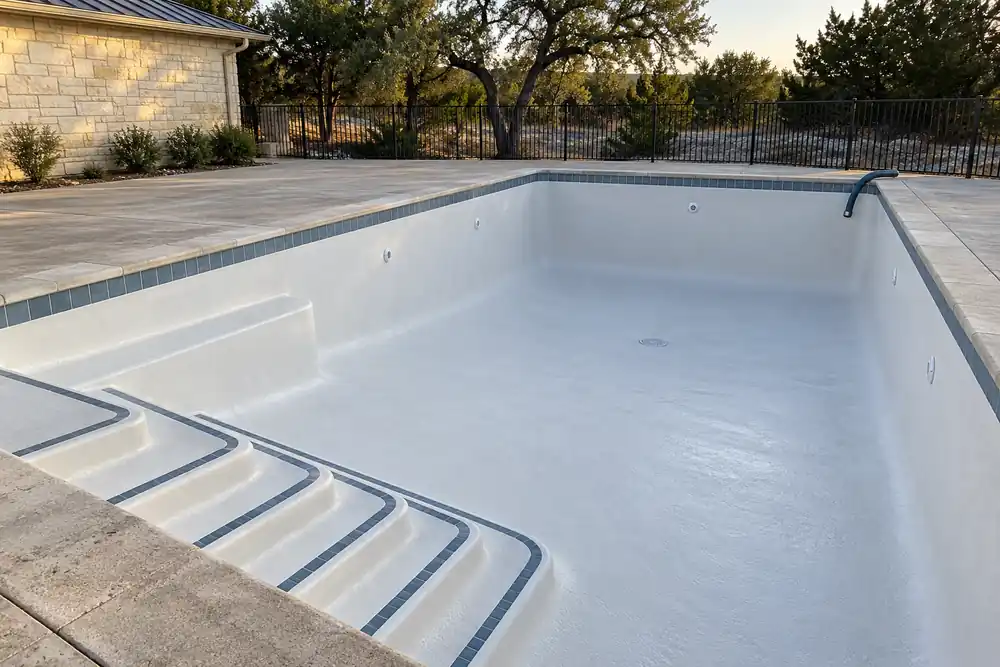
Pool Painting in Leander, TX
Leander Pool Resurfacing handles pool painting in Leander, Texas: epoxy, rubber-based or waterborne acrylic pool paint rolled onto a drained and cleaned concrete, plaster or fiberglass pool, matched to whatever coating is already on it. Ramuc, a pool paint maker, says paint is a viable option once a plaster finish has aged, roughened and stained to the point that an owner is considering a replaster.
Call or send the form for a free estimate. We'll talk through what is on your pool now, which paint can go over it, and how the cure fits Leander's weather.
Call or request a free estimate any time, 24/7
No charge · answered 24/7
Get free estimates
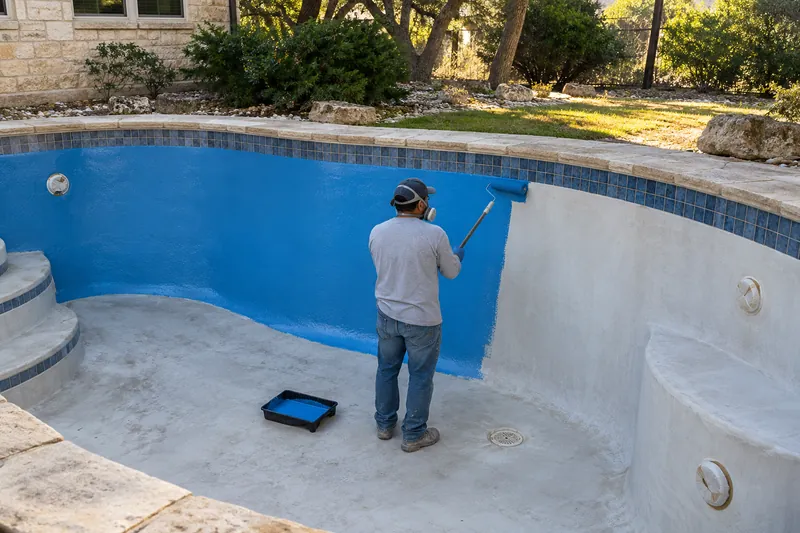
Pool paint types: epoxy, rubber-based and acrylic
Ramuc says any unpainted masonry pool can take rubber, epoxy or acrylic pool paint, while fiberglass calls for epoxy and steel needs a metal primer first. Paint is one of several ways to renew a concrete pool's interior; plaster, quartz, pebble and polished finishes are set side by side in pool finishes compared.
Epoxy
Insl-x, Benjamin Moore's pool paint line, describes its epoxy as a two-component polyamide coating made for properly prepared concrete, marcite, gunite, fiberglass and steel pools and resistant to common pool chemicals, chlorine included, and it steers public pools, which tend to run higher chlorine levels, toward epoxy or chlorinated rubber. Epoxy is also the paint the makers specify for fiberglass shells, a job covered under fiberglass pool resurfacing.
Rubber-based
Insl-x makes its rubber-based paint for new or old concrete pools: a durable low-sheen finish for residential and commercial pools, suited to fresh or salt water and chlorinated pools, and not recommended for fiberglass. Insl-x says its chlorinated rubber paint, the CR2600 series, isn't available in many parts of the country because of limits on solvent emissions (VOCs), and Ramuc suggests upgrading from traditional chlorinated rubber to newer synthetic rubber paints.
Waterborne acrylic
Insl-x describes its waterborne acrylic as a newer generation of pool paint that can go over most types of pool coatings in good condition, as well as bare concrete or plaster. Olympic, Kelley Technical Coatings' pool line, says its water-reducible acrylic enamel, HYDROLON, can even be applied to a damp surface, with no drying-out time after cleaning.
Call or request a free estimate any time, 24/7.
(737) 212-9378Repainting a pool: match the old coat or strip it
Painting over worn plaster
Kelley Technical Coatings says its ZERON epoxy may be used to refinish rough, stained or worn-out white plaster. Ramuc checks aged plaster for hollow or crumbling areas with a ball-peen hammer or a similar method, has them repaired before painting and says its coatings are not a repair for weak surfaces; joints and cracks are filled first with hydraulic cement or a polyurethane sealant, never silicone, which spoils paint adhesion. New plaster waits too: Insl-x holds off until the surface pH is 9 or less, or for a minimum of 30 to 60 days. Where the plaster itself has failed, the fix is pool replastering.
Finding out what paint is on the pool
Olympic's chip test tells the coatings apart: a chip that dissolves in denatured alcohol is water-based acrylic, one that dissolves in a 75/25 blend of mineral spirits and solvent is synthetic rubber, one that dissolves only in full-strength solvent or xylol is chlorinated rubber, and one that doesn't dissolve at all is epoxy. Ramuc offers a paint compatibility field test guide and will analyze chips that owners send in.
What can go over what
Insl-x's rules put epoxy only over another solvent-based epoxy, chlorinated rubber only over chlorinated rubber, synthetic rubber only over chlorinated rubber or another rubber-based paint, and its waterborne paint over any previous pool paint. Olympic recommends recoating with the same type of coating, allows synthetic rubber over chlorinated rubber but not the reverse, and converts old rubber to epoxy only after its FUSION PLUS conversion coating. Kelley's epoxy bulletin puts one rule in capitals: never recoat a rubber-base coating with an epoxy.
When the old paint has to come off
Insl-x says complete removal should be considered when the old paint is blistering and peeling or more than four older layers are present. Kelley Technical Coatings says never to recoat a pool that is scaling, peeling or blistering: a few small spots can be sanded and primed before the whole pool is recoated, but otherwise the old coating has to come off. Epoxy wears the other way: Kelley says it erodes slightly each year and shouldn't be recoated until it is so thin it is almost transparent. Insl-x also warns that scraping, sanding or removing old paint may release lead dust, and calls for a NIOSH-approved respirator and cleanup with a HEPA vacuum and a wet mop.
For a free estimate on repainting a pool, call Leander Pool Resurfacing or send the form.
Call or request a free estimate any time, 24/7.
(737) 212-9378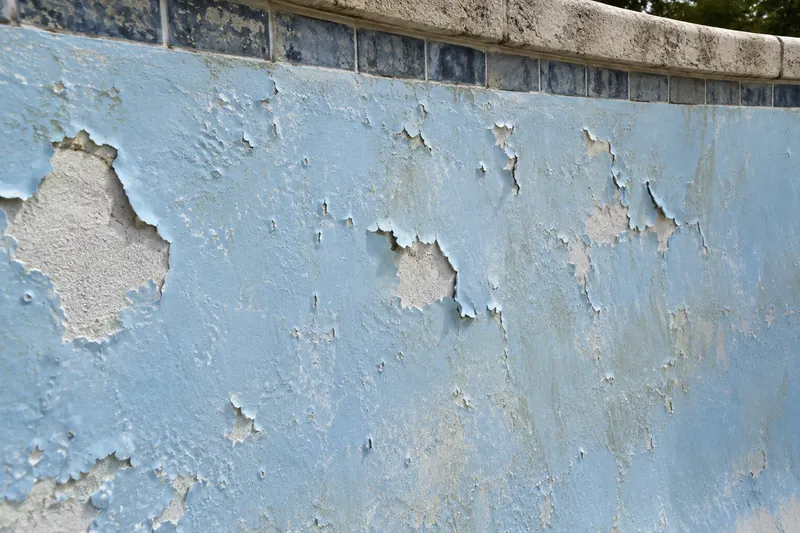
How a pool is painted
Each paint maker writes instructions for its own products, and they don't always agree. The steps below draw on Olympic, Insl-x, Ramuc and Kelley Technical Coatings.
Wash without soap
Olympic washes the pool with trisodium phosphate, its pool washing compound, and never with a soap-type detergent, because soap leaves a film on the surface that ruins the new coat's adhesion.
Etch bare plaster, scuff old paint
For unpainted plaster, marcite, gunite or Diamond Brite, Insl-x etches with a 10% muriatic acid solution applied evenly until it stops reacting, triple rinses and lets the pool dry 3 days; for unpainted concrete it adds that every trace of acid must be neutralized and rinsed away, with 1 lb of baking soda per 5 gallons of water. A painted pool is scuff sanded with 150 to 180 grit instead and never acid etched, by Insl-x's rule; Olympic disagrees and recommends an acid wash even on coated pools.
Prime where the maker says to
Ramuc says its EP Hi Build epoxy is self-priming and no other primer should be used, while Olympic primes bare plaster first, with GUNZITE on rough surfaces and POXOPRIME II on smooth ones, before its epoxy finish coat.
Two thin coats
Insl-x calls for two thin coats rather than one heavy one, since over-application can cause early failure, laid on with a short-nap roller, since long naps apply too much paint. Its epoxy and waterborne paints can be recoated in about 4 to 6 hours at 70 to 80°F and its rubber paints after 24 hours; Ramuc's EP epoxy is recoated within 16 to 72 hours, after which the first coat must be sanded.
Sand on the steps
Kelley Technical Coatings warns that steps, shallow water and wading pools become possible slipping hazards unless they are made slip resistant, which it does by very lightly sifting silica sand onto the coating while it is wet.
Cure before the water goes back
Ramuc's EP epoxy cures 5 to 7 dry days outdoors before filling, or 10 to 14 days indoors with ventilation, and Insl-x waits at least 7 days after the final coat. Insl-x also says never to cover a newly painted pool with a tarp or solar blanket during the cure, because it can trap solvent in the coating.
Call or request a free estimate any time, 24/7.
(737) 212-9378Painting a pool in Leander's weather
Paint makers set temperature windows, and the area's summer highs run past them. Insl-x applies its pool paints between 50°F and 85°F and out of direct sun, suggesting the east wall in the morning while it is in shadow and the west wall in late afternoon. Ramuc's range for its EP epoxy is 50° to 90°F, with overnight temperatures of at least 50°F, or the paint won't cure correctly and feels oily on top. The National Weather Service puts Austin's normal highs at 90°F by May 26 and above 90°F until September 23 (1991–2020 normals, rounded to the nearest degree), and Camp Mabry, Austin's official climate station, still counts about 12 freezing nights a year on the same normals.
Cure times follow the thermometer. Olympic cures its epoxy 3 days at 75 to 85°F before filling, 4 days at 70 to 75°F, 5 days at 65 to 70°F and 6 days at 60 to 65°F, its rubber-base paints an average of 5 days minimum and its acrylic 3 days at a 65°F average. Ramuc adds a dry day to its epoxy cure for each day of rain. NOAA's Leander 1.6 NW station, about a mile from the city's center, averages 34.27 inches of rain a year on its 1991–2020 normals; February, at 1.89 inches, is the driest month, followed by January at 2.07.
Etching and draining bring in the City's water rules. Leander's stormwater ordinance keeps pool water with 1 ppm or more of chlorine, or any harmful amount of muriatic acid or other pool chemicals, out of the storm drain system, with fines of up to $2,000 for each day a violation continues. The Phase 2 rules in force on October 1, 2026 let water go into a pool only where needed to keep its purification system running or the pool structurally sound, and the City doesn't say whether a full refill after resurfacing qualifies, so ask before the pool is drained.
Call or request a free estimate any time, 24/7.
(737) 212-9378Pool painting cost
Typical Austin-area figures for 2026 put repainting at $1,470 per 1,000 square feet, against $5,395 for replastering and $6,376 for an aggregate finish over the same area. National averages for 2026 put epoxy paint at $1 to $2 a square foot including labor, on concrete or fiberglass, and a paint or epoxy coating job as a whole at $1,500 to $5,000; national 2025 averages put painting a fiberglass or gunite pool at $1,500 per 1,000 square feet.
Draining the pool and repairing its walls first add to the bill. None of these figures is a price from Leander Pool Resurfacing; an estimate for your pool costs nothing.
- Repainting, per 1,000 sq ft, Austin (2026)
- $1,470
- Pool paint, per sq ft, Austin (2026)
- about $1
- Epoxy paint with labor, per sq ft, national (2026)
- $1–$2
- Painting fiberglass or gunite, per 1,000 sq ft, national (2025)
- $1,500
- Paint or epoxy coating job, national (2026)
- $1,500–$5,000
Published Austin-area and national figures, for planning only. Not a quote.
Call or request a free estimate any time, 24/7.
(737) 212-9378Pool painting questions
Can I paint my pool without draining it?
Not with these paints: the makers' instructions call for an emptied, cleaned surface, and most need it dry. Olympic says the surface must be 100 percent dry before its rubber-base paint, because water trapped under the film eventually causes blistering as vapor tries to escape. Ramuc's moisture test for its epoxy waits for 5 dry, sunny days, then tapes 2-by-2-foot pieces of clear plastic to the deep-end wall, the floor and other areas; if condensation forms under them within about 4 hours, the surface isn't dry enough, and the test is repeated 24 hours later.
How long does pool paint last?
It depends on the paint and the work. Olympic gives 2 to 3 years for acrylic enamel, 2 to 3 years for synthetic or chlorinated rubber and 5 to 8 years for epoxy. Ramuc's own figures run from up to 2 years for its DS Acrylic and Pro 2000 Rubber to up to 8 for its Hi Build and HB31 Epoxy, and it says paint life depends on preparation and application. Insl-x won't predict a paint's life, but says to expect 3 to 5 years before repainting, depending on the number of coats, climate, strength of chlorination, chemical balance, direct sun, color, use and cleaning.
Why is my pool paint blistering?
Ramuc names improper surface preparation as the number one cause of blistering and other performance issues, and it lists the other causes: a roller nap thicker than 3/8 inch, which draws air into the paint film, paint applied too thick, painting a damp surface, painting in direct sunlight, filling the pool before the paint has cured, and paints that aren't compatible. The fix isn't another coat on top: Kelley Technical Coatings limits spot repairs to a few small areas, sanded and primed, and otherwise calls for complete coating removal.
Does pool paint fade?
Yes, in time. Insl-x says all pool paints eventually fade in color when exposed to chlorine, and that its epoxy will chalk and fade in ultraviolet light. Ramuc calls the chalking of every epoxy film a natural degradation of the top surface, caused by the sun and water chemistry. Two mistakes make it look worse sooner: filling before the paint has fully cured leaves a blush that looks like fading or chalking, and calcium hypochlorite shock can leave a white, bleached look.
How much paint does it take to paint a pool?
By Insl-x's figures, paint on bare masonry may spread only 250 to 300 square feet per gallon, while repaints and second coats cover 350 to 400. Its example is a 30-by-10-foot rectangular pool averaging 5 feet deep, with about 730 square feet of paintable surface, which takes about 2 gallons a coat, or 4 gallons for two coats, over an existing coating. National 2025 figures say most pools need up to 10 gallons, putting the total cost of painting a pool at $1,400 to $2,500, and more if the pool isn't already drained and the walls need repair first.
Get a free pool painting estimate
Leander Pool Resurfacing answers calls and estimate requests 24/7 for pool painting in Leander and nearby towns. Tell us what the pool is made of, whether it has been painted before and what the surface looks like now.