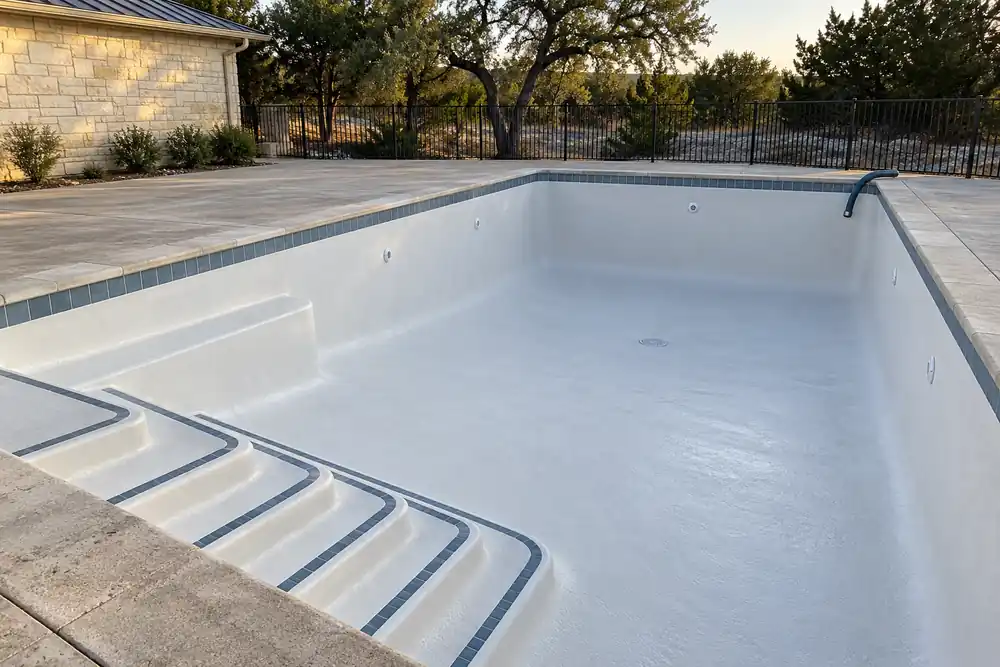
Pool Replastering in Round Rock, Texas
Leander Pool Resurfacing provides pool replastering in Round Rock, Texas, for backyard pools and for the HOA, apartment and community pools that Texas treats as public pools, from a white plaster refresh to colored plaster and quartz. The City says the town grew where the Chisholm Trail crossed Brushy Creek, at a low-water crossing marked by the round, table-shaped rock that gave it its name, and the Handbook of Texas dates the name to August 24, 1854.
Today Round Rock runs along Interstate 35, sixteen miles north of downtown Austin by the Handbook's measure, with Old Settlers Park, Dell Technologies and neighborhoods such as Vista Oaks, Forest Creek and Teravista. Its Census center point is about 12.3 miles east-southeast of Leander's. Call or send the form for a free estimate, and we'll talk through the finish, the drain and the start-up.
Call or request a free estimate any time, 24/7
No charge · answered 24/7
Get free estimates
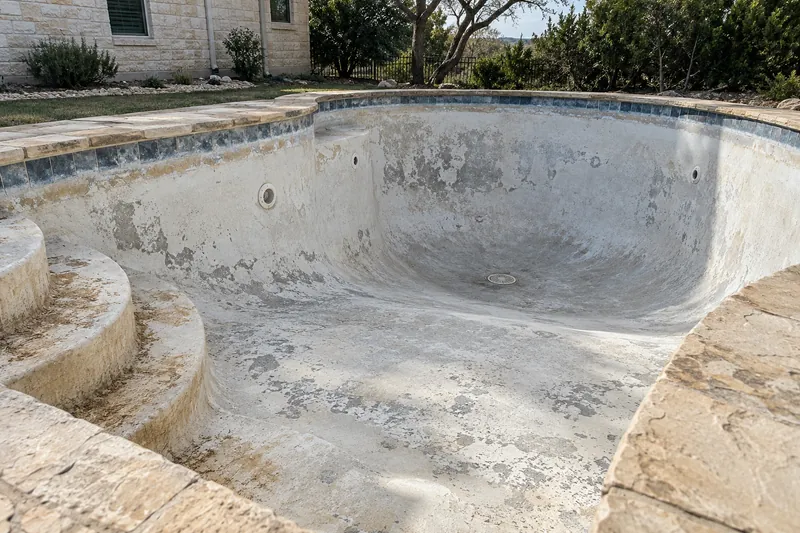
Replastering pools from the 1970s and 1980s
Round Rock grew early. The Handbook of Texas records 2,811 residents in 1970, 11,812 in 1980 and 30,923 in 1990, and the City's own history calls 1984 and 1985 years of "unprecedented growth", when the town added about 9,000 people to an 18,000 base at 18 to 20 percent a year. The Census Bureau's 2020–2024 survey counts 7,141 homes from the 1980s and 3,916 from the 1970s, part of 12,527 built before 1990, a larger pre-1990 stock than Georgetown, Pflugerville, Cedar Park or Hutto has in the same survey. In 2026 those 1970s and 1980s homes are 37 to 56 years old. The Census doesn't count pools, so a home's age is a guide to its pool's, not proof.
Later neighborhoods followed the same corridor: Vista Oaks was built from the late 1980s to the early 2000s, Forest Creek from the late 1990s to the mid-2000s, and Teravista from 2001. The median home in the city dates from 2002.
White plaster, colored plaster or quartz
The National Plasterers Council rates standard white plaster a "5 to 8 year surface" and calls it a relatively soft finish, more affected by water chemistry than newer products. It says colored ceramic quartz aggregates make a much more durable surface, harder and far more resistant to changing water chemistry, though they cost more than standard plaster and can still show surface problems under extreme chemistry.
Call or request a free estimate any time, 24/7.
(737) 212-9378New plaster in very hard water
The City of Round Rock supplies its own water: surface water mainly from Lake Georgetown, groundwater from the Edwards Aquifer, and Lake Travis water treated by the Brushy Creek Regional Utility Authority. Lake Georgetown was built by the U.S. Army Corps of Engineers and impounded in 1980, and the City opened its first surface water plant in 1981. Its 2025 report puts the average hardness at 249 mg/L, "commonly known as very hard water", and warns that customers may notice mineral deposits on fixtures, dishes and appliances. The report's table lists total alkalinity at 141 ppm, calcium at 70 ppm and pH at 7.53 for 2025.
Start-up when the fill water is hard
The National Plasterers Council's start-up card says its steps may need changing for unusual fill water, such as water with extremely high or low calcium hardness, pH or alkalinity. SGM describes an acid start-up that some crews use where fill water is high in alkalinity or hardness, but says that on its own, without water washing, it gives the least desirable result and a streaked look. Research funded by the Independent Pool & Spa Service Association rated a bicarb start-up ideal, the Council's traditional start-up a close second and the acid start lowest, because it caused microscopic etching.
Living with high calcium after day 28
The Pool & Hot Tub Alliance says the ANSI/APSP-11 standard accepts calcium hardness of 150 to 1,000 ppm in a pool. When hardness creeps up during drought, it says pH and alkalinity can be lowered to offset it, and it doesn't recommend calcium hypochlorite, which adds more calcium.
Call or request a free estimate any time, 24/7.
(737) 212-9378Commercial pool replastering for HOAs and apartments
Texas counts a pool run for an apartment complex, condominium, hotel, property owners association, club or school as a "Class C" public pool, even though the general public can't swim there; a pool serving only a single-family home or duplex stays residential. For those public pools, the Texas Department of State Health Services adopts the 2021 International Swimming Pool and Spa Code for construction, alteration, renovation and repair, and that edition sets a public pool's light-finish limit at no less than 6.5 on the Munsell color value scale.
Round Rock has a large rental and apartment stock. Census Bureau survey estimates put about 25.0% of the city's housing units in buildings of 10 or more units and about 44.5% of occupied homes as rented, and neighborhoods such as Teravista and Forest Creek have community pools. The City prices commercial pool permits on valuation.
For sales tax, Texas treats a pool that an HOA or an apartment complex owns for its residents as residential property, so the labor to remodel or repair it isn't taxed; a hotel pool is commercial, and the whole charge for remodeling or repairing it is taxable.
Public pools the City runs
Round Rock runs three outdoor municipal pools and an indoor one. Lake Creek is the oldest, Micki Krebsbach beside Round Rock High School was built in 1996, and Rock'N River reopened for the 2026 season at nearly twice its former size, a project in the voter-approved 2023 bonds. The Clay Madsen Recreation Center's indoor pool is open year-round.
Call or request a free estimate any time, 24/7.
(737) 212-9378Replastering costs for homes and HOA pools
Typical Austin-metro prices in 2026 put standard white plaster at roughly $4,500 to $6,500 for a standard residential gunite pool, and colored or upgraded plaster at roughly $6,000 to $8,500. National reserve-planning figures for 2026 put replastering a typical HOA community pool at $8,000 to $25,000 per pool, with a useful life of 8 to 12 years, and warn that boards often underfund by assuming residential prices, because commercial permits, NSF-rated materials and health department requirements add cost.
These are published figures, not our prices. A real number needs a look at the pool, and the estimate is free.
- White plaster, home pool (Austin metro)
- $4,500–$6,500
- Colored or upgraded plaster (Austin metro)
- $6,000–$8,500
- HOA community pool, per pool (national)
- $8,000–$25,000
- Diamond Brite quartz, per sq ft (national, 2025)
- $6–$7
Typical Austin-metro figures (2026) and national figures (2025–2026). Not a quote.
Call or request a free estimate any time, 24/7.
(737) 212-9378Pool permits, fences and drain rules in Round Rock
Round Rock requires a building permit for an in-ground or above-ground pool, spa or hot tub, and its adopted codes include the 2024 International Residential Code and the 2024 International Swimming Pool and Spa Code. The application needs one set of construction plans and a property survey showing the pool. The City's pages don't say whether replastering an existing pool needs a permit, so ask the Building Inspection Division before the job is booked. Residential fences need no building permit but must still be built to code, and the City suggests checking height and material rules with Code Enforcement.
Draining before the new plaster
The illicit discharge ordinance, adopted March 11, 2010, bans disposing of pool, fountain or spa water, backwash included, with total residual chlorine of 1 ppm or more, or any harmful amount of muriatic acid or other pool chemical. The City's pool discharge guidelines send drained water onto a vegetated part of the owner's property with no runoff or standing puddles, or to the street curb only below 1 ppm chlorine and with no other pool chemical. Saltwater should not go to the storm drain, and a hose may not be connected straight to it.
Refilling under Stage 1
Round Rock is under Stage 1 water restrictions, and the City's FAQ says a pool may be filled on the property's designated watering day. The National Plasterers Council wants a new finish filled without stopping, so the drain is best timed so the refill starts on that day.
Call or request a free estimate any time, 24/7.
(737) 212-9378How a replastering job runs
General practice from the industry's guidelines and Round Rock's rules; your estimate covers your own pool.
Look and test
The old finish is checked for hollow, etched and stained areas, and the fill water is tested for pH, alkalinity, calcium hardness and metals.
Drain within the ordinance
Water leaves only below 1 ppm chlorine, onto a vegetated part of the lot or to the curb, never through a hose fixed to a storm drain.
Prepare the shell
Loose and hollow plaster comes out, or the whole finish is stripped, and a bond coat goes on where new plaster covers sound old plaster.
Plaster and fill
The new plaster goes on and the pool is filled without a break on a watering day under Stage 1.
Start up for hard water
The National Plasterers Council's start-up calls for frequent brushing and daily testing through the first 28 days, and its card allows changes for unusually hard fill water.
Call or request a free estimate any time, 24/7.
(737) 212-9378A Chisholm Trail town that became Dell's home
The Handbook of Texas traces Round Rock to a settlement on the north bank of Brushy Creek, where blacksmith Jacob M. Harrell set up shop in 1848. Citizens voted to incorporate in 1912 and elected Jack Jordan as the first mayor, and the first City Council met in 1913. In 1994 Dell Computer announced the move of its world headquarters from Austin to Round Rock, and the City's 2024 financial report lists Dell Technologies (12,000), Round Rock ISD (6,341), St. David's Round Rock Medical Center (1,300) and Kalahari Resorts & Conventions (1,200) as its largest employers. Old Settlers Park covers 670 acres, which the City calls "the City's crown jewel of the park system". The Census Bureau estimates 141,282 residents on July 1, 2025, 139,317 of them in Williamson County and 1,965 in Travis County.
Call or request a free estimate any time, 24/7.
(737) 212-9378Other pool work in and around Round Rock
Replastering often comes with waterline tile, coping, a drain and acid wash or plaster repair, and some owners move up to a pebble or polished finish. Leander Pool Resurfacing handles all of these, and the estimate is free.
Next door, we also install pebble finishes in Brushy Creek and handle commercial pool deck resurfacing in Wells Branch.
Call or request a free estimate any time, 24/7.
(737) 212-9378Round Rock pool replastering questions
How long does a pool permit review take in Round Rock?
The City says review takes approximately 30 business days. Its residential fee is $350 for an in-ground pool and $125 for a spa or above-ground pool, and commercial pool fees are based on valuation. Those figures are for building a pool; ask the Building Inspection Division whether a replaster on your pool needs a permit at all.
What happens if chlorinated pool water reaches a Round Rock storm drain?
The City's stormwater page lists chlorinated pool water as an illicit discharge, while water from dechlorinated pools is an exception. Failing to fix an illicit discharge after a notice can bring fines of $500 to $2,000 a day.
Free pool replastering estimates in Round Rock
Leander Pool Resurfacing answers calls and estimate requests 24/7 for backyard, HOA and apartment pools. Tell us the pool's size, its current finish and what you would like it to become.