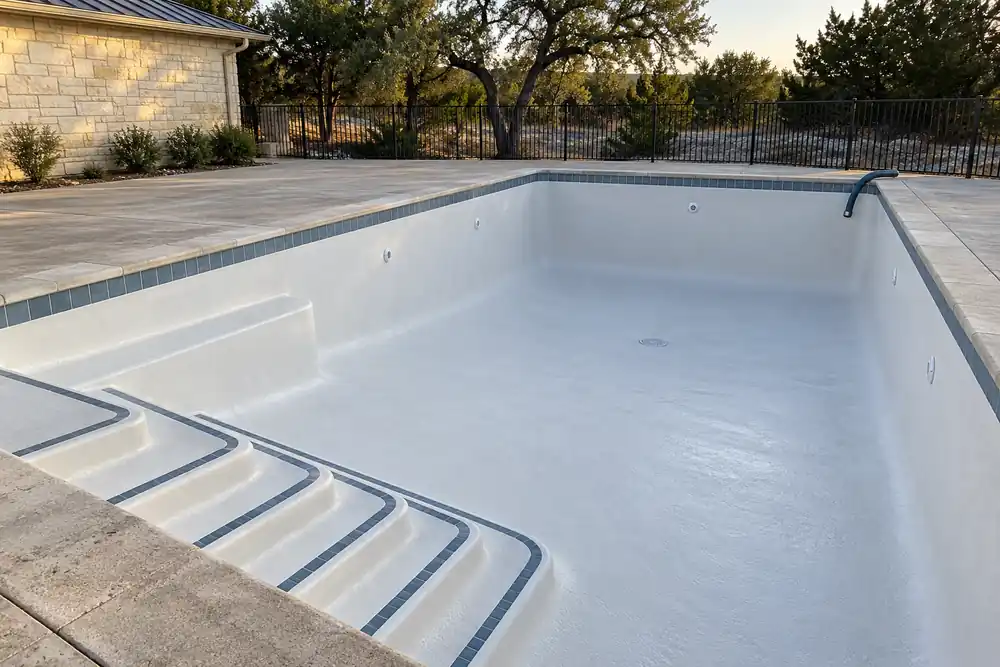
Fiberglass Pool Repair in Leander, TX
Leander Pool Resurfacing handles fiberglass pool repair in Leander, Texas: spider cracks, osmotic blisters, chips, stains and bulging walls in a one-piece fiberglass shell, fixed where the damage is rather than by refinishing the whole pool. River Pools, a fiberglass pool maker, describes spider cracks as small hairline cracks in the gelcoat surface and treats them as typically cosmetic, not structural.
Call or send the form for a free estimate. We'll talk through what the damage looks like, who made the pool, and what its warranty says before any repair starts.
Call or request a free estimate any time, 24/7
No charge · answered 24/7
Get free estimates
Fiberglass pool damage and what causes it
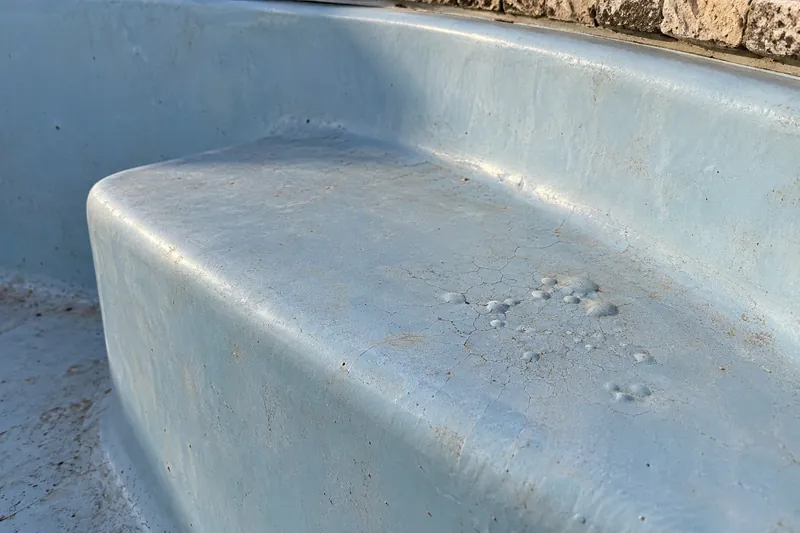
Spider cracks
River Pools says spider cracks usually form when pressure on the shell goes beyond what the gelcoat can flex. It names improper installation as the most common cause, and also lists an uneven base or debris under the pool, poor manufacturing or gelcoat application, and shipping or handling. Barrier Reef Pools, another maker, says this kind of crack most commonly starts while a fiberglass pool is being transported, when a point of pressure exceeds the gel coat's flexibility.
Osmotic blisters
River Pools explains an osmotic blister this way: water travels through the gelcoat, meets contaminants and forms a larger molecule that can't leave the way it came in, and the outward push eventually raises a blister that separates the gelcoat from the laminate layer behind it. River Pools puts a vinyl ester resin layer behind its gelcoat as a watertight barrier against this, and Barrier Reef Pools links osmosis to water chemistry, saying it typically follows erosion of the protective surface layer from chemical imbalance. Gougeon Brothers, maker of WEST SYSTEM epoxy, describes the same process in its guide to gelcoat blisters on fiberglass boats.
Bulging walls
River Pools traces bulging fiberglass walls to sand backfill that becomes saturated, liquefies and presses against the walls, and calls gravel the most reliable way to prevent it. Tallman Pools warns that excess hydrostatic pressure around the shell can cause shifting, bulging or even failure. Cracks in a concrete or gunite shell are a different repair, covered under pool crack repair.
Call or request a free estimate any time, 24/7.
(737) 212-9378How fiberglass pool repairs are done
Gelcoat putty for cracks, chips and dings
FGCI, a resin maker, sets out the basic gelcoat putty repair: clean and dry the area, rough up the gouge or crack so the putty grips, mix the putty with MEK-P catalyst at 1.5 percent, overfill the repair so it stands above the surface, let it cure and sand it flat. At 77 degrees the putty gels in roughly 10 to 15 minutes, sets as a thin film in 1 to 3 hours and reaches full cure in 12 to 24 hours. FGCI sells the kit mainly for boats.
Opening and drying blisters
Gougeon Brothers' blister guide calls for every blister cavity to be opened and the damaged material dug out, and it warns that the acidic fluid inside is frequently under as much as 200 psi of pressure, so eye protection and protective clothing are needed. It names thorough drying of the laminate as perhaps the most crucial step of the whole repair. The guide is written for boats, so a pool maker's own instructions come first where they exist.
When the water has to come out
A repair below the waterline can mean lowering or draining the pool, and Latham, River Pools and Tallman Pools each set rules for that, from bracing the walls to checking for groundwater first. Those rules are set out under fiberglass pool resurfacing, and they apply to a repair just as they do to a refinish.
For a free estimate on a fiberglass repair, call Leander Pool Resurfacing or send the form.
Call or request a free estimate any time, 24/7.
(737) 212-9378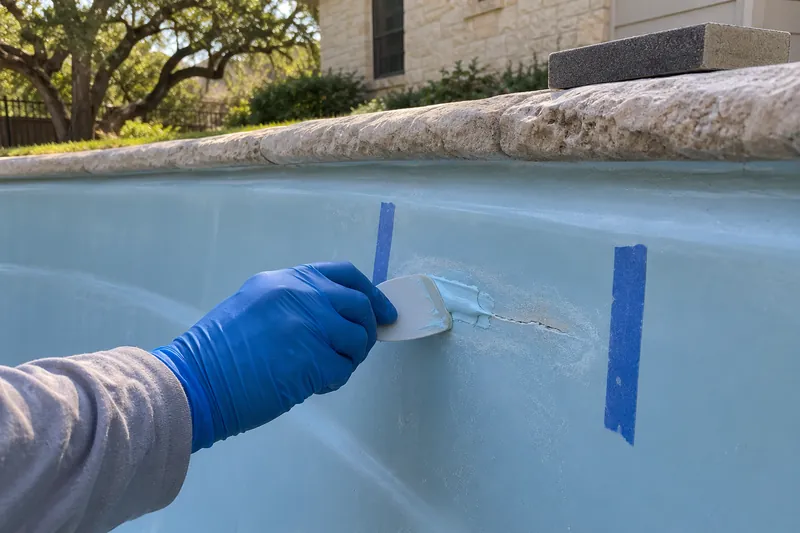
Stains, scale and spots on a fiberglass pool
Reading the color
Tallman Pools sorts stains on fiberglass into organic ones, from berries, dirt, pollen or algae, which show as green, brown or tan blemishes, and metal stains: iron leaves orange, brown or tan, copper green, blue or teal, and manganese brown, black or purple. Black spots can also be cobalt, which Tallman says is technically not a stain but a reaction, as water passes through the gelcoat and reacts with the resin beneath to leave a black byproduct.
Two kinds of calcium scale
White deposits come in two kinds, and Tallman tells them apart with a drop of muriatic acid. Calcium carbonate, white and flaky, foams and reacts; calcium silicate, white or grayish and hard to remove, shows no reaction, and for faster removal Tallman says it is best to contact a qualified fiberglass service technician.
Treatments, and what to keep off the gelcoat
For larger metal stains, Tallman describes an ascorbic acid treatment with the pH adjusted to 7.2 and a metal sequestering agent added afterward, though its stain page gives two versions of the rest: chlorine at 0.5–1.0 ppm, 8 to 16 ounces per 10,000 gallons and 12 to 24 hours of circulation in its summary panel, and chlorine at 0.0 ppm, about one pound per 10,000 gallons and 24 hours in its step-by-step text. It says to use only stain removers designed for fiberglass, never to sand, polish or buff the gelcoat unless a fiberglass pool professional directs it, and to keep abrasive cleaners, scouring pads, pressure washers, household cleaners, solvents and degreasers away from it. Latham's manual adds steel wool, metal scrapers, wire brushes and metal tools to that list, though the same older manual lets dull spots be restored with a body compound followed by a coat of fiberglass boat wax.
Call or request a free estimate any time, 24/7.
(737) 212-9378Fiberglass repairs in Leander: permits and heavy rain
Leander's building code doesn't require a permit for repairs and remodeling unless structural supports are changed, floor space is added, or a plumbing or electrical permit is needed, and it lets an owner or occupant personally make minor improvements and ordinary repairs that meet the codes without one; the City's building official may still inspect the work and decide whether a permit is needed. That section doesn't mention pools by name, and the City tells owners to confirm with a building inspector before work starts, so a repair that touches the plumbing is worth a call to the City first.
Groundwater is the other local question. Tallman Pools asks owners to check the pool's groundwater inspection port monthly, after any heavy rainfall or storms, and before any service that lowers the water. Heavy rain is part of life here: the National Weather Service places the Austin area in Flash Flood Alley, with severe weather mainly from March through May, and in the July 4–5, 2025 floods, 10 to 15 inches of rain fell across parts of Burnet, western Travis and western Williamson counties.
Call or request a free estimate any time, 24/7.
(737) 212-9378Fiberglass pool repair cost
Typical Austin-area figures for 2026 put repairs to fiberglass pools at $295 to $6,380, close to the national range of $300 to $6,500. Gel coat work on dinged, scratched and cracked surfaces runs $300 to $400 on national 2025 figures, with about $800 more if the surface is repainted afterward, and a second national 2025 guide gives the same $300 to $400, with repainting charged on top.
A whole new surface is a different budget: the same national 2025 figures put a complete fiberglass resurfacing at $6,500. These are published figures, not prices from Leander Pool Resurfacing, and the repair estimate is free.
- All fiberglass repairs, Austin (2026)
- $295–$6,380
- All fiberglass repairs, national (2026)
- $300–$6,500
- Gel coat repair of dings, scratches and cracks, national (2025)
- $300–$400
- Repainting after a gel coat repair, national (2025)
- about $800
- Complete fiberglass resurfacing, national (2025)
- $6,500
Published Austin-area and national figures, for planning only. Not a quote.
Call or request a free estimate any time, 24/7.
(737) 212-9378Fiberglass pool repair questions
Can fiberglass pools be repaired?
Yes. River Pools says gelcoat can be applied for smaller repairs, though it isn't suitable for resurfacing a whole pool already in the ground, and it calls osmotic blisters a cosmetic issue rather than a structural one. By River Pools' rule on gelcoat, wear across the whole surface, such as even fading or chalking, is a refinishing job rather than a gelcoat repair. A wall pushed in by saturated backfill or groundwater pressure is a structural problem of a different order, and Tallman Pools warns that excess hydrostatic pressure can end in shifting, bulging or even failure of the shell.
How can I repair cracks in my fiberglass pool?
Start by working out what kind of crack it is. Barrier Reef Pools says spider cracks run mainly along the gel coating rather than through the structure, and it names improper installation, including installation on an uneven surface, as the first and most common reason a fiberglass pool cracks. Latham's manual says hairline cracks in the gel coat are not uncommon and that patch and repair kits are available from its authorized dealers. The basic repair is the gelcoat putty method above: roughen the crack, overfill it with catalyzed putty, let it cure and sand it flat.
How much does it cost to fix a leak in a fiberglass pool?
The closest published figure groups leaks with other structural work: a Houston fiberglass pool company's 2025 guide puts structural repairs such as cracks and leaks at $1,000 to $5,000. Across all fiberglass repairs, typical Austin-area figures for 2026 run $295 to $6,380. Where the water is going decides the job, and finding and fixing it is covered under pool leak repair.
Does a fiberglass pool warranty cover cracks and blisters?
The makers treat the two differently. River Pools says a maker's surface warranty must specifically cover osmotic blisters. Latham warrants its gelcoat against osmotic blistering from defects in materials or workmanship for as long as the original buyer owns the pool, Glimmerglass for ten years and Barrier Reef Fiberglass Pools for a total of 15 years. Cracks are another matter: Latham's warranty excludes fading, staining, discoloration and cracking, hairline cracks included, and says crazing, spider cracks and chips in the beam, the top edge under the coping, are not cause for a claim, while Rainforest Pools excludes hairline cracks, blistering and other surface changes due to water chemistry or the gel coat's material characteristics. These are the makers' warranties, so read your own pool's papers before a repair.
Will a fiberglass pool repair match the rest of the pool?
Not invisibly, by the makers' own account. River Pools says most repairs won't be completely invisible, though a skilled pro can make them far less noticeable, and that single-layer solid gelcoats are easier to match than multi-layer metallic or flake finishes, whose layered look is hard to recreate outside a factory. Latham's warranty says a cosmetic or surface repair may leave a visible shade or color difference, which it deems acceptable.
Get a free fiberglass pool repair estimate
Leander Pool Resurfacing answers calls and estimate requests 24/7 for fiberglass pools in Leander and nearby towns. Tell us who made the pool, roughly how old it is and what the crack, blister or stain looks like.