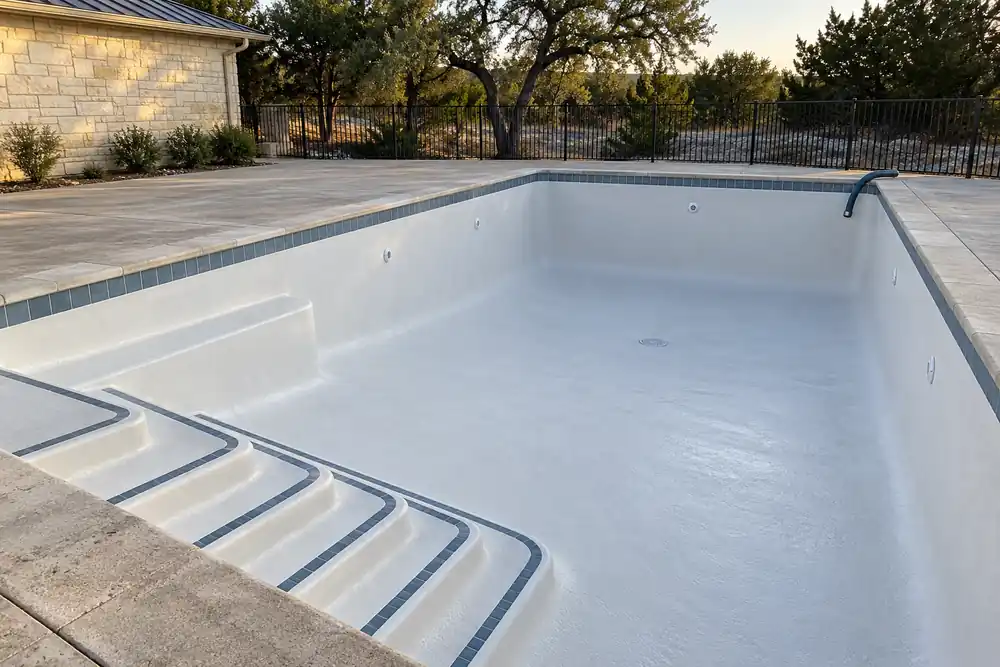
Pool Crack Repair in Leander, TX
Leander Pool Resurfacing handles pool crack repair in Leander, Texas: shrinkage and check cracks in the finish, structural cracks through a gunite or shotcrete shell, cracks along the bond beam, and cracks that leak. The National Plasterers Council keeps shrinkage cracks, which form while a finish goes on or within 24 hours of its final set, apart from cracks in the structural shell, and the repair follows from which one a pool has.
Call or send the form for a free estimate. We'll talk through what the crack points to, whether it is moving or leaking, and whether an engineer should see the shell before any repair.
Call or request a free estimate any time, 24/7
No charge · answered 24/7
Get free estimates
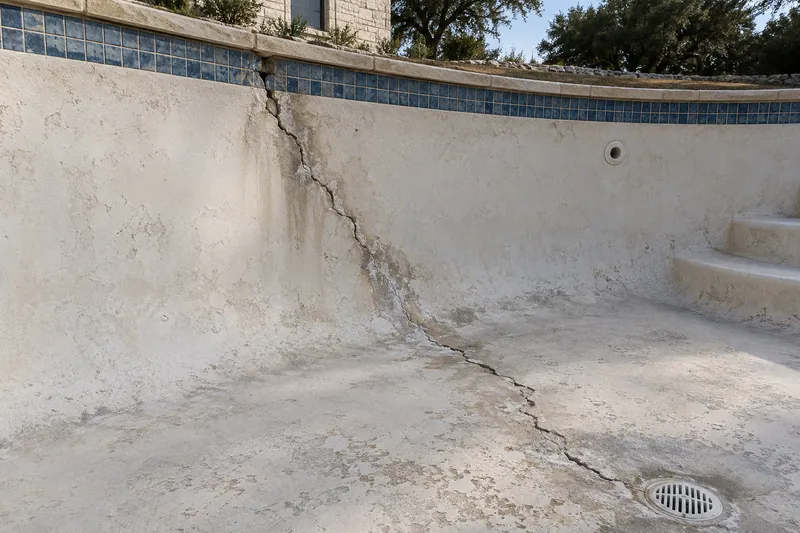
Finish cracks and structural cracks
Cracks in the plaster
Not every crack goes through the shell. Universal White Cement, a white cement maker, links circular or spider cracks gathered around one patch, along with blister-like or volcano-shaped spots, to plaster separating from the surface beneath, as opposed to a straight crack running through the shell. That is pool plaster repair rather than crack repair, and the questions below cover the fine cracks a new finish shows before it is filled.
Cracks in the shell
The shell is the structure under the finish. The National Plasterers Council defines it as formed concrete or shotcrete, wet-mix or the dry-mix kind known as gunite, sprayed over a steel reinforcing grid. The American Shotcrete Association's guidance puts small overlooked holes and certain shrinkage, autogenous or plastic cracks among the defects that can often be plugged or patched, and structural movement cracks, or cracks from stress inside the structure, among those that need an in-depth investigation of cause and remedy.
For a free estimate on a cracked pool, call Leander Pool Resurfacing or send the form.
Call or request a free estimate any time, 24/7.
(737) 212-9378How pool cracks are repaired
Injection for fine and moving cracks
For shrinkage cracks in a pool floor, the American Shotcrete Association notes that many epoxies and polyurethanes are used for crack injection, that smaller cracks need a lower-viscosity material to get in, and that an engineer or injection specialist experienced with shotcrete should evaluate the cracking first. Prime Resins' Prime Flex 900 XLV shows how the polyurethane kind works: a low-viscosity resin that reacts with water and expands into a closed-cell, watertight foam, injected under pressure into actively leaking cracks down to hairlines, and flexible enough to expand and contract with the structure it seals.
Plugging cracks that run water
Hydraulic cements are made to stop flowing water. QUIKRETE's Hydraulic Water-Stop Cement, a blend of portland and calcium aluminate cements, lists swimming pools among its uses and comes in a special white version for pool patching. Its directions call for clearing loose material, dirt and algae from the patch area, opening up small cracks while avoiding V-shaped cuts, pressing the cement in from the top down until the leak stops, and mixing no more than can be used in 2 to 3 minutes. Xypex describes its Patch'n Plug as a fast-setting hydraulic cement that stops flowing water in seconds.
Patching or rebuilding the shell
Where new shotcrete goes against the old shell, the American Shotcrete Association's conditions for a sound bond are a clean surface roughened to about 1/16 inch or more, by a water blaster of 5,000 psi or more or by abrasive blasting, brought to a saturated surface-dry state that feels damp without wetting a hand, and shotcrete placed at high velocity. It advises against any bonding agent, which can act as a bond breaker, and recommends gunite with at least 4,000 psi of 28-day strength placed by an ACI-certified nozzleman. Thickening a cracked or thin wall changes the pool engineer's design and calls for more reinforcing steel, to be checked with the pool's designer.
Call or request a free estimate any time, 24/7.
(737) 212-9378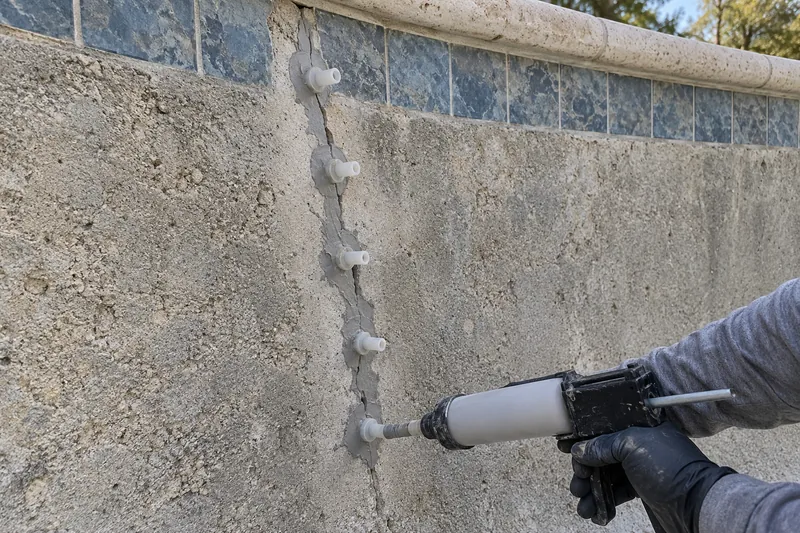
Cracks that leak, skimmers and fiberglass shells
Cracks that leak
A crack that loses water is part of a leak. The American Shotcrete Association's position is that a quality shotcrete shell should be functionally watertight by itself, and that the plaster or tile applied afterward isn't what makes a pool watertight. Finding where the water goes and stopping it is pool leak repair.
Cracks at the skimmer
A crack at the skimmer may be in the skimmer itself. CMP, a skimmer maker, warns against using a cracked or damaged skimmer and says overtightened port plugs can crack the skimmer body; in a concrete pool it wants the skimmer surrounded by at least 4 inches of structural concrete, poured monolithically and tied to the rebar. Replacing a damaged one is pool skimmer replacement.
Cracks in a fiberglass pool
Fiberglass shells crack differently. River Pools, a fiberglass pool maker, describes spider cracks as small hairline cracks in the gelcoat that are typically cosmetic, not structural, usually caused when pressure on the shell exceeds what the gelcoat can flex, with improper installation the most common reason. Their repairs are covered under fiberglass pool repair.
Call or request a free estimate any time, 24/7.
(737) 212-9378Engineers, codes and the ground under Leander
When an engineer should look
When spider-web cracking puts a pool's strength in question, the American Shotcrete Association advises a qualified local engineering firm to plan, take and test cores under ASTM C42/C42M or ASTM C1604/C1604M. It declines to advise on the structure of a remodel itself, suggesting a local engineer familiar with pools and spas. Leander has adopted the 2021 International Swimming Pool and Spa Code, which sends the structural design of residential in-ground pools to the International Residential Code.
Limestone and clay in Leander
The University of Texas Bureau of Economic Geology says soils west of the Balcones Escarpment are thin and rocky over the Hill Country's Glen Rose and Edwards limestone, and the USGS geologic map puts the Crystal Falls Golf Club and Travisso addresses in Leander on Glen Rose Limestone. The ground isn't uniform, though. Near the Leander Public Library and Devine Lake Park the USDA soil map shows Eckrant cobbly clay over hard, fractured limestone about 11 inches down, where the 1983 county soil survey says the rock makes site preparation difficult for foundations and buried lines. The same survey warns that soils with moderate to very high shrink-swell potential can damage buildings, roads and other structures.
Beyond Leander, Leander Pool Resurfacing also handles pool crack repair in Jonestown.
Call or request a free estimate any time, 24/7.
(737) 212-9378Pool crack repair cost
Typical Austin-area figures for 2026 put structural repairs at $1,000 to $5,000 for cracks or significant damage, and pool beam repair at $75 per linear foot. National 2026 figures also put small cracks in a concrete or gunite pool at about $75 per linear foot, with larger cracks, spider-web cracks and divots costing more. Nationally in 2025, a bond beam repair runs $70 to $80 per linear foot and typically includes tile and coping replacement, while resurfacing and patching a beam crack along the length of a pool comes to about $4,000 to $6,000.
A Dallas-area breakdown from 2025 scales the price with the damage: $500 to $1,500 for minor structural cracks, $2,000 to $5,000 for moderate cracks with rebar exposed, and $5,000 to $15,000 or more for major damage that needs resurfacing or a new shell. These are published figures, not prices from Leander Pool Resurfacing, which estimates a crack repair for free once the crack has been seen.
- Structural crack repairs, Austin (2026)
- $1,000–$5,000
- Pool beam repair, per linear ft, Austin (2026)
- $75
- Small cracks, per linear ft, national (2026)
- about $75
- Bond beam repair, per linear ft, national (2025)
- $70–$80
- Beam crack resurfaced and patched, national (2025)
- $4,000–$6,000
- Moderate cracks with rebar exposed, Dallas (2025)
- $2,000–$5,000
Published Austin-area, national and Dallas-area figures, for planning only. Not a quote.
Call or request a free estimate any time, 24/7.
(737) 212-9378Pool crack repair questions
Can a crack in a pool be repaired?
Most can, once the cause is known. Because shotcrete is simply a way of placing concrete, the American Shotcrete Association says any method used to repair cracks in concrete applies to a shotcrete pool; resin injection, hydraulic-cement plugs and new shotcrete bonded to the old shell all come from that toolbox. A structural movement crack still needs its cause worked out before the repair is chosen. Leander Pool Resurfacing gives free estimates on pool cracks of any size.
What is a good crack filler for swimming pools?
One that can move. For cracks that will keep moving or sit under water, the American Shotcrete Association advises a filler that tolerates thermal movement rather than a brittle product, notes that many injectable polyurethane grouts can do that, and says a coating laid over a moving crack needs enough thickness and elasticity to bridge it. Prime Resins, which makes both kinds, prefers water-seeking hydrophilic resins, which soak into the tight micro-cracks of wet concrete, and says water-repelling hydrophobic resins can fail a few months after the job; that is one maker's position. No industry body names a single best product.
How many times can a gunite pool be replastered?
No maker or industry body gives a number. What limits it is thickness: the National Plasterers Council says a cement-based finish should average at least 3/8 inch and no more than 3/4 inch thick, with small allowances for filled holes and dig-outs around fixtures, and that the finish can't be used to level an uneven shell beyond that maximum.
Do hairline cracks in new pool plaster go away?
Often, yes. The National Plasterers Council says every cement-based pool finish develops some shrinkage or check cracking before the pool is filled, and that these cracks typically reseal underwater as the cement keeps hydrating. Wind matters more than heat: in the Council's analysis, a 100°F day with little or no wind doesn't reach the critical rate of water loss, but sustained wind above 5 mph does, and even a mild 75°F day can with sustained winds of 12 to 13 mph. SGM adds that a hot, dry shell makes plaster set too fast, causing check cracking and delamination.
What causes cracks in a gunite pool?
Often the way the shell was built. The American Shotcrete Association's technical director lists the shotcrete problems he hears about most from pool owners and builders: reused rebound, lack of curing, too little velocity when the shotcrete is placed, inconsistent thickness and excessive porosity. The Association recommends at least 7 days of curing for new shotcrete and says that skipping it in windy, hot or dry weather raises the risk of shrinkage and cracking. An article in its magazine adds that too little concrete over the reinforcing steel lets water reach the steel and start corrosion that can spall the concrete off.
Get a free pool crack repair estimate
Leander Pool Resurfacing answers calls and estimate requests 24/7 for pool crack repair in Leander and nearby towns. Tell us where the crack is, roughly how long it is and whether the pool is losing water.