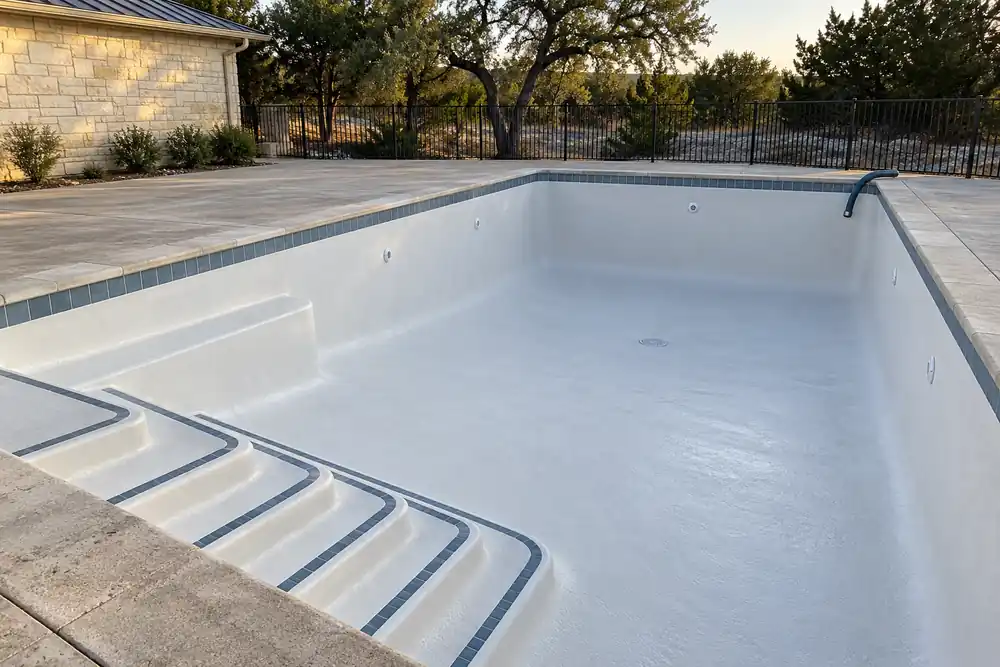
Pool Remodel Permits and HOA Approval in Leander, TX
Leander Pool Resurfacing sets out the pool permit and HOA approval steps for a remodel in Leander, Texas: the City requires a permit before any construction inside its limits and lists swimming pools among the work that needs one, and neighborhood associations such as Crystal Falls, Block House Creek and Travisso run reviews of their own.
This guide covers when a remodel needs a City permit, how to apply and what the fees are, the fence rules a remodel has to respect, the HOA reviews and the rules outside the city limits. The rules are the City's, the state's and the associations', and they change, so confirm with Leander Development Services before work starts.
Call or request a free estimate any time, 24/7
When a pool remodel needs a City permit
Leander's rules point two ways. The City's permit list names swimming pools and remodels that involve electrical, mechanical or plumbing work, and its list of work that needs no permit (painting, re-roofing, siding, windows and like-for-like fixture swaps indoors) leaves pools off. Its building code, on the other hand, frees repairs and remodeling from a permit unless they remove or change structural supports or supporting walls, add floor space, or need a plumbing or electrical permit; pools aren't named. An owner may also personally make minor improvements and ordinary repairs that meet the codes, and the building official can inspect that work and decide whether it needed a permit.
The City's pool packet speaks only of building a pool and never mentions resurfacing or repair, and the City says its permit list isn't complete. So ask Development Services before the pool is drained, whatever the job.
The codes behind the permit
Texas law adopts the International Swimming Pool and Spa Code as the municipal pool code and, in a city that regulates pools, applies it to all construction, alteration, remodeling, enlargement and repair, not just to new pools; Leander has adopted the 2021 edition. The model code's permit section asks anyone who wants to construct, enlarge, alter, repair, move or demolish a pool to get the permit first, though each city adopts and amends that section, so the City's version is the one that counts.
Remodels that bring in plans, trades and engineers
Additions change the picture. Tanning ledge and step additions with bubblers or lights put new plumbing and wiring into the shell, and adding a spa brings in the code's spa limits, such as water no deeper than 4 feet and incoming water no hotter than 104°F. In Leander, any pool wall or water feature 2 feet or more above grade needs engineer-stamped plans, electrical systems follow the 2023 National Electrical Code with local amendments, and where state-licensed work is involved the permit can be issued only in the licensed person's name. Moving the equipment counts too: Leander's zoning ordinance wants pool pumps, filters and related equipment placed or screened so they can't be seen from adjacent streets and lots. The plumbing and wiring in pool remodeling are the kind of remodel work the City's permit list names outright.
Outside the city limits
In Leander's extraterritorial jurisdiction, the unincorporated fringe beyond the city limits, the City currently requires permits only for signs and for water and wastewater connections. Williamson County hasn't adopted residential building codes for its unincorporated areas; its answer to whether a building permit is needed is a Certification of Compliance from its Road & Bridge Division, which checks for flood plains, and other bodies such as emergency services districts, the TCEQ and the Williamson County and Cities Health District may still require permits.
Call or request a free estimate any time, 24/7.
(737) 212-9378Applying for a pool permit in Leander
Applications go through the City's online Development Hub, which also shows their status, and one expires 180 days after filing unless the applicant is actively working on it or the Building Official extends it. Every contractor and subcontractor has to be registered with the City before the permit is issued, by opening a Development Hub account and emailing a current certificate of insurance and copies of its state trade licenses.
For an in-ground pool, the packet asks for a plot plan placing the pool against the house, property lines and public utility easements, a foundation plan that takes in the capping and decking, and plumbing and electrical details down to the lighting's bonding. The City posts 5 business days for the first review of a residential in-ground pool permit, and 5 again for a second or third, against 10 for a commercial pool or spa, and calls these general estimates.
Inspections can be requested only once the fees are paid and the permit is issued. The Building Final goes through the Development Hub, and requests made before 4:00 p.m. are typically done the next business day, between 9:00 a.m. and 3:00 p.m.; the Fire Final is booked through the Fire Marshal's office. The fees in the table come from the City's code, last amended June 18, 2026. The older printed sheet the City still links, dated 10/02/2025, adds $40 plumbing and electrical lines to the pool permit, so confirm the current figure with Development Services.
- Pool permit application
- $50.00
- Pool plan review
- $20.00
- Pool building permit
- $160.00
- Gas test, gas-heated pools
- $40.00
- New in-ground pool, no gas heater, total
- $250.00
- Residential remodel (habitable space): application; plan review
- $50.00 each
- Residential remodel (habitable space): trade permits, each if applicable
- $0.05 per sq ft, $40 minimum
- Stand-alone plumbing or electrical permit
- $50.00
- Reinspection
- $100.00
City of Leander code fee schedule, amended June 18, 2026. The pool total includes the $20 technology fee. The City hasn't said which line covers work on an existing pool. Confirm with Development Services.
Call or request a free estimate any time, 24/7.
(737) 212-9378Pool fence and barrier rules in a remodel
Leander's code sets the pool yard enclosure at a height of at least 48 inches, measured from the ground on the outside, away from the water, with no gap underneath that a 4-inch sphere could pass. Where a fence is built of horizontal and vertical members, the openings can't pass a 4-inch sphere if the tops of the horizontal members are at least 45 inches apart, or a 1¾-inch sphere if they are closer together. Chain-link fencing is banned for any new pool yard enclosure built after January 1, 1994, and so are diagonal members lower than 49 inches.
Climbable equipment, house walls and alarms
The code also says permanent equipment or structures can't be placed where they make the enclosure easy to climb, a rule worth checking when a remodel adds a raised spa wall, a waterfall or a new equipment pad near the fence. A house wall can form part of the enclosure only if its doors and windows meet the state's pool-yard rules in Texas Health and Safety Code sections 757.006 and 757.007. On the permit side, the packet wants the fence at least 4 feet tall and a self-latching gate of at least 54 inches drawn on the plot plan, plus an audible alarm, independent of the home security system, on every house door that leads to the pool.
Safety fences and HOA pools
A Texas HOA can't ban or restrict a pool safety fence that meets state or local safety rules, meaning a non-climbable fence of transparent mesh or clear panels in metal frames no more than six feet high; it can set appearance rules such as colors, but it can't ban a black mesh fence in metal frames. Apartment and HOA pools also fall under the state's pool-yard enclosure law: at least 48 inches high, with gates that self-close, self-latch, lock and open outward away from the pool, and a latch at least 60 inches above the ground, apart from narrow exceptions.
Call or request a free estimate any time, 24/7.
(737) 212-9378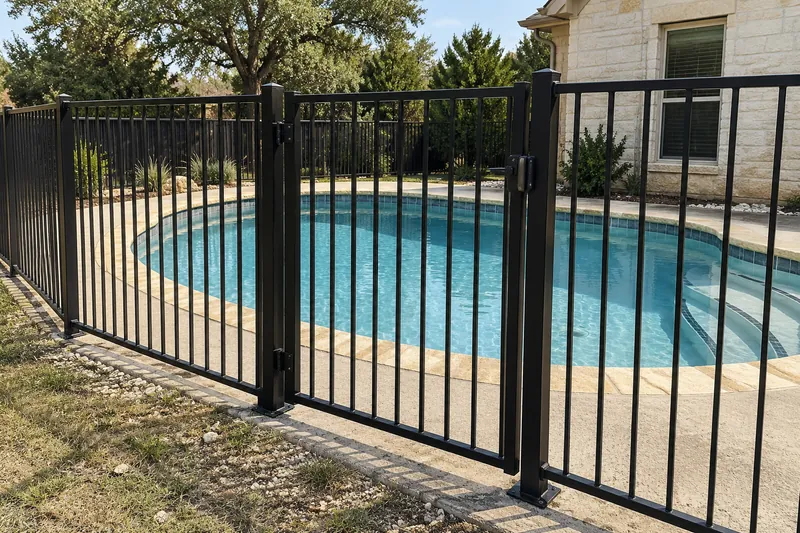
HOA and architectural committee approval
Crystal Falls, Block House Creek and Travisso all publish rules that reach pool work, and none of the three says whether a like-for-like replaster counts as an exempt repair, so ask the association before the drain-down.
Crystal Falls
The Crystal Falls Homeowners Association's Architectural Control Committee reviews most exterior changes, pools, decks and hardscaping among them, but not repairs or replacements made the same way with the same materials. The homeowner, not the contractor, files the application; contractors can't use the online portal, and the committee doesn't contact them. It has 30 days to respond and takes applications strictly in the order received, with no rush reviews. For a pool it keeps the water's edge at least 10 feet and the deck edge at least 5 feet from the property line, wants the equipment screened from the road and neighboring lots by native Hill Country plants or a masonry wall, and suggests warning neighbors about a week or two of jack-hammering.
Block House Creek
Block House Creek's deed restrictions require the Architectural Committee's written approval before any improvement, a term that covers swimming pools, patios, decks, fences, pumps and tanks, and its request form asks for the materials, colors and textures of the work. The committee charges up to $1,000 to review a pool application and up to $2,500 for other construction, including changes to existing structures; a variance costs $500 more if asked for before work starts and $750 after, and an application without its fee isn't processed. If the committee doesn't answer within 30 days of receiving everything it needs, the plans count as approved, though that approval isn't a finding that the work meets building or other codes.
Travisso
Travisso requires architectural approval for every exterior improvement, pools included, and exempts only a few like-for-like items such as minor fence or roof shingle repairs. Its design guidelines want written approval of a pool, spa or hot tub plan before construction, with the City permits attached; an application without finalized permits is rejected automatically, so there the City permit comes first. The Architectural Review Committee meets on the 1st and 3rd Tuesday of each month and emails decisions within three business days. A pool may need a $500 refundable compliance deposit, or $1,500 where it reaches the greenbelt or common areas, returned once a photo inspection within 7 days of completion shows the work matches the approved design.
Appealing a denial under Texas law
In a Texas association with more than 40 lots, once the developer no longer controls the committee, an owner can appeal a denial to the board. The denial has to be in writing, explain the reasons and the changes that would win approval, and tell the owner a hearing can be requested within 30 days; the board then holds it within 30 days of the request, with at least 10 days' notice, and can affirm, modify or reverse the decision. The law was last amended by S.B. 711, effective September 1, 2025. Leander Pool Resurfacing will talk through the order of approvals for your project at the free estimate.
Call or request a free estimate any time, 24/7.
(737) 212-9378Pool permit questions
Can you resurface a pool yourself?
Texas law leaves room for it. The state has no license for pool builders, contractors or plasterers; Leander lets an owner personally make minor improvements and ordinary repairs that meet the codes; and Texas law exempts owners doing electrical work on the home they live in, where no city ordinance regulates it, and plumbing in their own homestead. The practical limits come from elsewhere: River Pools advises owners not to drain a pool themselves, Premix-Marbletite calls a bond coat absolutely mandatory on every renovation, and NPT's lifetime limited warranties on its finishes need an approved applicator.
What happens if pool work starts without a required permit in Leander?
The City can stop it. Leander's building official may inspect owner work and decide whether it needed a permit, and anyone who keeps working after being served a stop-work order, other than to fix the violation, breaks the City's code, a misdemeanor punishable by a fine of up to $2,000. That makes the permit question one to settle with Development Services before the drain-down.
Who applies for the permit and the HOA approval?
It splits. On the City side, every contractor and subcontractor must be registered before a permit is issued, and where state-licensed work is involved the permit goes only in the licensed person's name. On the HOA side, Crystal Falls takes applications only from the homeowner, and Travisso wants the City permits attached before it will review a pool plan.
Plan your pool remodel permits with a free estimate
Call or send a request to Leander Pool Resurfacing any time, day or night. Tell us what you want added or changed and which neighborhood you live in, and we'll talk through the City and HOA steps before any work is booked.