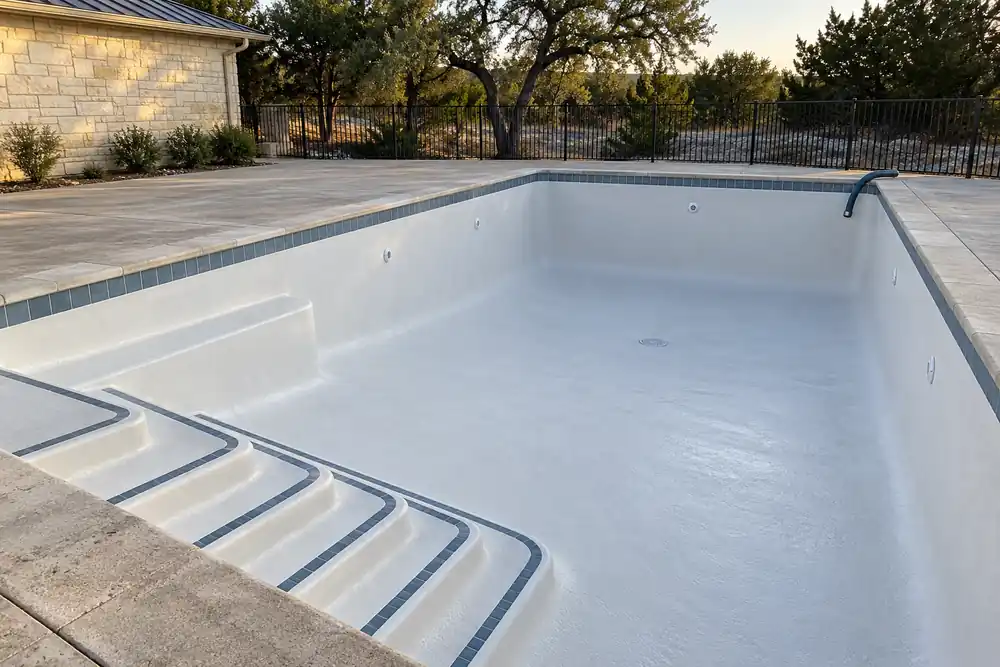
Infinity Edge Pool Repair in Leander, TX
Leander Pool Resurfacing repairs infinity edge pools in Leander, Texas, from the wall the water spills over to the trough and catch basin below it and the tile and finish on both sides. The International Swimming Pool and Spa Code calls this a vanishing edge, a water-feature detail in which water flows over at least one pool wall and is collected in a catch basin, and notes that it is also called a negative edge.
Call or send the form for a free estimate. We'll talk through what you're seeing on the wall, in the trough or in the water level, and what a repair involves.
Call or request a free estimate any time, 24/7
No charge · answered 24/7
Get free estimates
How an infinity edge pool works
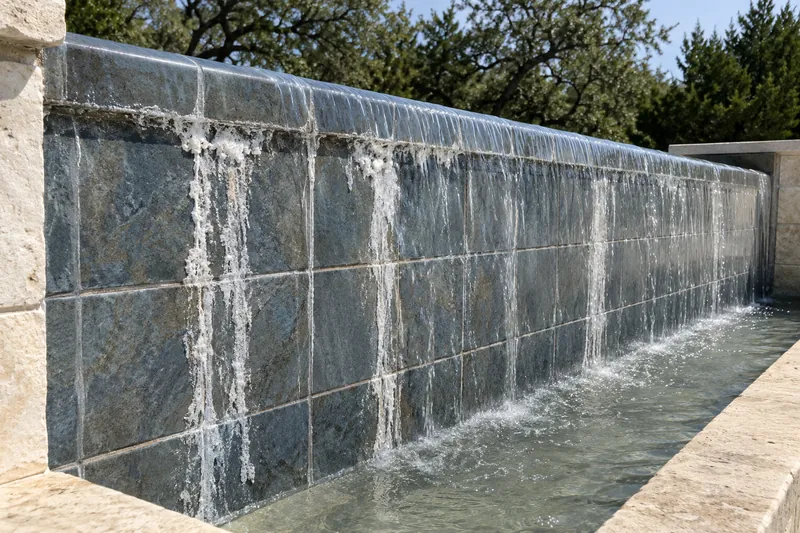
The edge, the trough and the catch basin
The CDC's Model Aquatic Health Code describes an infinity edge as a pool wall and adjacent deck built so their top is hidden from certain viewpoints. Water flows over the edge, is captured, and goes back through the pool's normal filtration to be treated and reused, and the design also goes by vanishing, negative or zero edge. In one project a pool designer described, the overflow trough fed the catch basin, so the system was plumbed to draw water from the basin constantly, whether the edge was running or not. Because the code files a vanishing edge as a water-feature detail, it sits in the same family as the waterfalls and deck jets covered under pool water features.
Overflow and surge capacity
Where a perimeter overflow is a pool's only skimming system, the code requires it to run along at least half the perimeter and to connect to a system with surge capacity of at least 1 gallon for every square foot of water surface. The overflow system and its piping can count toward that capacity.
Why the edge has to be level
One pool designer sets the final elevation of every edge with the pool full of water, because the level has to be as precise as possible and can shift under the weight of the water.
For a free estimate on an edge repair, call Leander Pool Resurfacing or send the form.
Call or request a free estimate any time, 24/7.
(737) 212-9378Common infinity edge problems
Efflorescence on the outer wall
An edge wall has water on one side and open air on the other. The American Shotcrete Association names negative-edge pool walls among structures in that condition and says they need measures that make them essentially watertight, because constant one-way water movement leaches calcium out of the concrete and can badly deteriorate it over time. Its guidance on this is written about efflorescence, the white deposit that forms on such walls.
Tile and coatings coming loose
The same guidance warns that salts can build up behind tile or a coating, which it calls sub-efflorescence, break down the binder and debond the covering, and it names swimming pool vanishing edges as especially vulnerable. Loose or hollow tile on the edge is a job for pool tile repair and replacement, and it makes sense to talk through the water moving through the wall at the same time.
Freezes and the finish above the water
On a negative edge, part of the finish sits above the water. SGM warns that in those spots any blisters trapped during troweling fill with water and may delaminate when it freezes, so the finish there has to be blister-free, and that the edge will develop a waterline ring from oils and dirt that needs regular maintenance. Freezes are a regular part of winter here: Camp Mabry, Austin's official climate station, averages about 12 days a year below freezing, with the average first freeze on December 1 and the last on February 15 (1991–2020 normals), and in January 2026 parts of the Austin area and Hill Country spent more than 48 hours below freezing.
Leaks in the trough and basin
Leak testing on an infinity pool can include the catch basin; one Central Texas leak company's price list (undated) adds $150 for it, on top of the detection itself. Cracks or failed fittings found that way are handled as pool leak repair.
Call or request a free estimate any time, 24/7.
(737) 212-9378Waterproofing and repairing an edge wall
Stopping water moving through the wall
The American Shotcrete Association lists ways to stop water moving through a wall like this: solid waterproof membranes, pozzolans or polymers in the mix, a lower water-cement ratio, integral waterproofing or efflorescence-reducing additives, and densifiers sprayed on or applied as a slurry coat. One pool designer sealed the whole shell of a vanishing-edge pool with a waterproofing product to keep efflorescence from forming behind the glass tile on the edge wall, saying efflorescence under tile finishes is common and can ruin an otherwise beautiful pool.
What not to put over efflorescence
The Association warns against non-breathable paints, sealers and other coatings on a surface that is already showing efflorescence, because trapped moisture and salts can spall or delaminate the coating, and often the top layer of the concrete with it.
Refinishing the edge
SGM lists negative-edge pools among the places its Diamond Brite finish is used, warning that the finish above the water will have a dry appearance next to the plaster below and that some check cracking may occur. Where it can be done, water curing the exposed areas for 7 to 28 days lessens that shrinkage cracking.
Call or request a free estimate any time, 24/7.
(737) 212-9378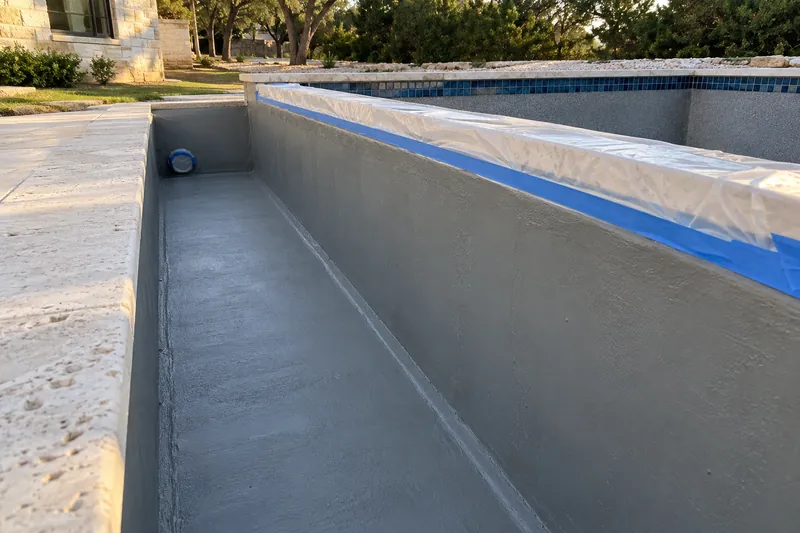
Leander's engineered-plans rule for raised edges
Leander's swimming pool packet requires an engineer-stamped set of plans for any pool with walls or other water features 2 feet or more above grade, and it names vanishing pools and infinity pools as examples. The code's chapter on inground residential pools covers modification and repair as well as new construction, including pools that are partly or entirely above grade. A lawfully built pool may stay in use when repairs follow its original design and create no hazard, while additions and alterations have to meet the requirements for a new system. Leander's permit list names swimming pools and remodels with electrical, mechanical or plumbing work and isn't complete, so confirm what an edge repair needs with Leander Development Services.
Outside the city, Leander Pool Resurfacing also handles infinity edge pool repair in Point Venture.
Call or request a free estimate any time, 24/7.
(737) 212-9378Infinity edge repair cost
An infinity edge repair is priced after a look at the wall, the trough, the basin and the plumbing, and the estimate is free. The one published figure tied to an existing edge is the catch-basin add-on to leak testing; the new-build and conversion figures beside it are background on why edge work costs more than work on an ordinary wall. These are published figures, not prices from Leander Pool Resurfacing.
- Catch-basin test added to leak detection, Austin area (undated)
- $150
- Upgrading a pool to an infinity design, national (2024)
- about $35,000
- New infinity pool, per sq ft installed, national (2025)
- $100–$300
- New infinity pool over a traditional pool, national (2025)
- 20–25% more
Published Austin-area and national figures; none is a repair price. Not a quote.
Call or request a free estimate any time, 24/7.
(737) 212-9378Infinity edge pool questions
What are common problems with infinity pools?
Trade guidance names several, most of them about water moving through the edge wall. The American Shotcrete Association warns of calcium leaching and efflorescence on walls with water on one side and air on the other, and of salts building up behind tile or coatings until they debond, naming vanishing edges as especially vulnerable. SGM adds that an above-water finish on a negative edge can check-crack, look dry, and collect a waterline ring that needs regular maintenance. One pool designer also notes that the level of the edge has to be as precise as possible.
How much does infinity edge add to pool cost?
On a new pool, national 2025 figures put an infinity pool at $100 to $300 per square foot installed, or $60,000 to $150,000 on average, 20 to 25 percent more than building in a traditional style. It costs more to run as well, because of the extra filtering and recirculating from the catch basin. For a repair to an existing edge, call Leander Pool Resurfacing for a free estimate.
Can the white crust on an infinity edge wall be cleaned off?
Often, if it is caught early. The American Shotcrete Association says new efflorescence, or bloom, can usually be removed with a bristle brush and water when it is only days old, but once it hardens into a dense deposit, removal can be very difficult. If it keeps coming back, the Association's answer is measures that make the wall essentially watertight.
Can an existing pool be converted to an infinity edge?
It can, as an alteration. National figures put upgrading a pool to an infinity design at about $35,000 on average (2024). The code says alterations must meet the requirements for a new system, and in Leander any wall 2 feet or more above grade needs engineer-stamped plans, with infinity pools named as an example.
Does an HOA or community infinity pool follow different rules?
Yes. In Texas, a pool run for an apartment complex, condominium or property owners association is a Class C public pool under the Department of State Health Services rules, and the state adopts the pool code's public-pool chapters for its construction and repair. For public pools, the CDC's Model Aquatic Health Code, a model code rather than Texas law, asks for infinity edges of reinforced concrete or another impervious, rigid material, watertight troughs free of structural cracks with a smooth, slip-resistant finish, an edge on no more than half the perimeter unless an accessible deck is added, and an outside wall no more than 30 inches above the adjacent grade and capture drain.
Get a free infinity edge repair estimate
Leander Pool Resurfacing answers calls and estimate requests 24/7 for infinity edge repairs in Leander and nearby towns. Tell us what you see on the edge wall or in the trough, and how the water level has been behaving.