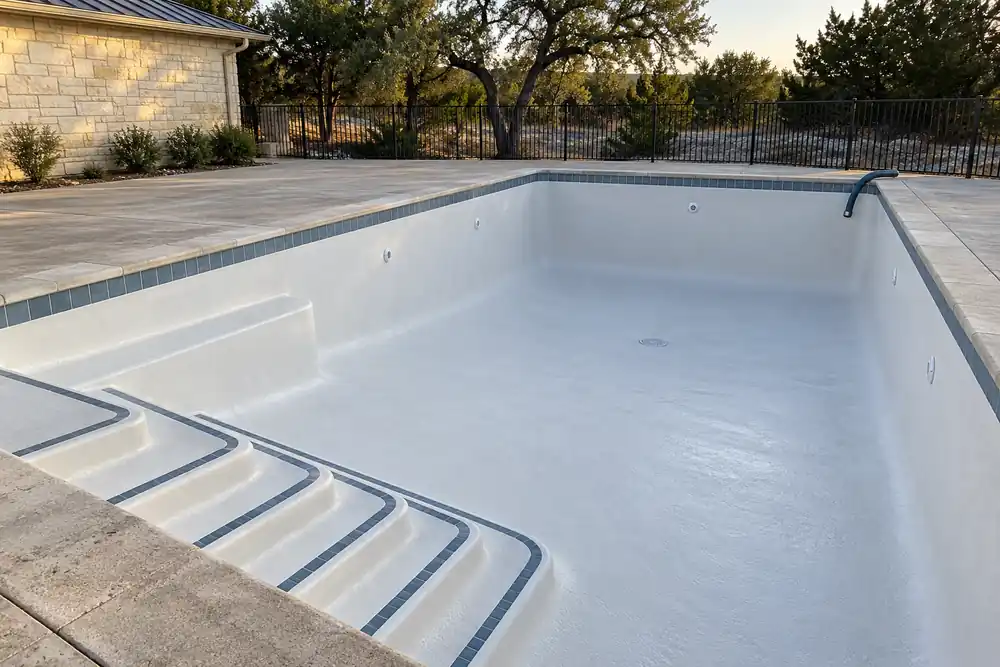
Diving Pool Conversion in Serenada, Texas
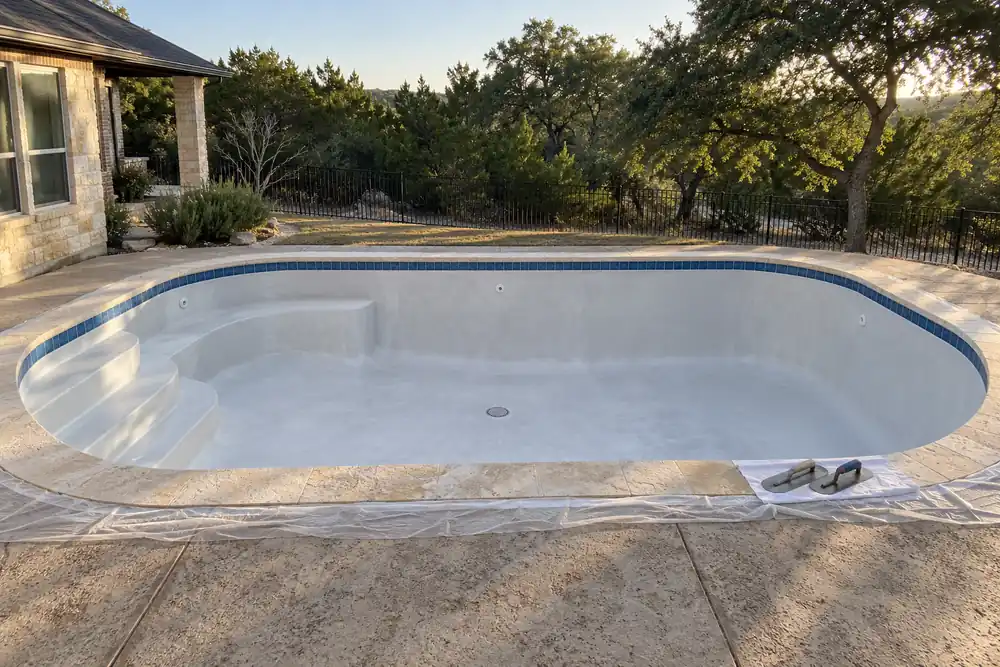
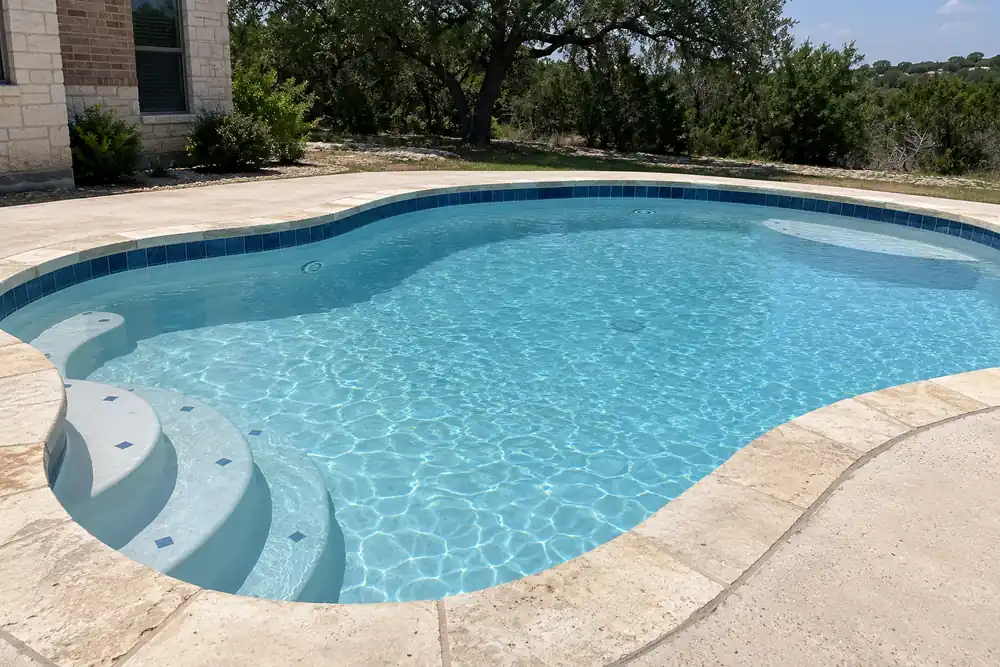
Leander Pool Resurfacing handles diving pool conversion in Serenada, Texas: removing a diving board and raising the floor of a deep end so the pool meets the depths of a non-diving design, in a neighborhood where most homes date from the 1970s and 1980s.
The Handbook of Texas places Serenada west of Interstate 35, about twenty-seven miles north of Austin and three miles northwest of Georgetown in central Williamson County, and dates its start to Serenada Estates, begun just northwest of the Georgetown Municipal Airport by January 1974. Most of it lies in three recorded subdivisions, Serenada Country Estates, Serenada West and Logan Ranch, on streets such as Logan Ranch Road, West Esparada Drive and Serenada Drive. Call or send the form for a free estimate; we'll talk through the pool's depths, the board and what the new floor would look like.
Call or request a free estimate any time, 24/7
No charge · answered 24/7
Get free estimates
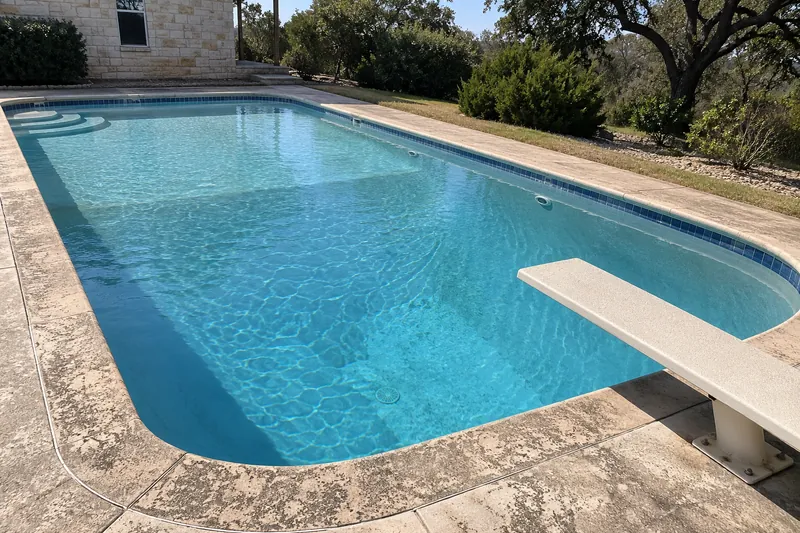
Diving pools behind 1970s and 1980s homes
Serenada had 2,098 residents in the 2020 Census and 951 housing units, 901 of them occupied. Of the 552 housing units in the Census Bureau's smaller 2020–2024 survey, 225 date from the 1970s and 265 from the 1980s, about 88.8%, and none were estimated before 1970. The median home was built in 1982, about 44 years ago, and the first homes went up around 1974. That is the highest share of pre-1990 homes of any Census place on our town list, though Lost Creek's median home, from 1977, is older. The survey's margins are wide (the total alone is ±114), so the shares are rough. Nearly every home is a single-family house lived in by its owner, and the median owner-occupied home is valued at $480,100.
By our count on the City of Georgetown's subdivision map, Serenada Country Estates covers about 28% of Serenada's Census area, Logan Ranch about 22% and Serenada West about 20%. The recorded restrictions for Serenada Country Estates Unit One and Serenada West allow no resubdivision into tracts under one acre and only one single-family home per tract. No source counts pools or diving boards in Serenada; the age of the homes is the only link to this service.
What the code means by a diving pool
The 2021 International Swimming Pool and Spa Code calls a non-diving home pool Type O and ranks home pools suitable for diving equipment as Types I to V, and it bars diving equipment from a Type O pool. Its smallest diving pools, Types I and II, need water at least 6 feet deep at Point A and 7 feet 6 inches at Point B, rising to 8 feet 6 inches and 9 feet for Type V, with no negative construction tolerance on those figures. A board has to sit in the deep area where it gets that envelope, its maker must state the water dimensions each board needs, and each board carries a permanent label with the maker's name and address, its date of manufacture, its minimum diving envelope and its weight limit. S.R. Smith, a diving board maker, warns that using a board on an improperly sized pool may result in death or serious injury.
Call or request a free estimate any time, 24/7.
(737) 212-9378The depths a converted pool is checked against
A converted pool is a non-diving pool, Type O in the code's terms. The model code sets its shallow end at no less than 33 inches and no more than 4 feet deep, puts the change from shallow to deep slope at least 33 inches down and at least 6 feet from the start of the shallow end, limits the deep-end floor to a slope of 1 in 3, and keeps the walls within 11 degrees of vertical down to a transition point at least 33 inches below the waterline. If the deep area stays deeper than 5 feet, it needs its own way in and out, and a pool with a slope break needs a rope and float line across it, 1 to 2 feet toward the shallow side.
The code's chapter on inground home pools covers modification and repair as well as new pools, and its general rule is that alterations meet the requirements for a new system without forcing the rest of the pool up to current code. Williamson County applies no building code to homes in unincorporated areas like Serenada, and the City of Georgetown requires no pool permit in its ETJ, where most Serenada lots lie, so these are the model code's figures, a benchmark for the design rather than a county rule.
The safety appendix of ANSI/APSP/ICC-5 (2011), which is informational, tells owners never to allow diving, jumping or sliding into shallow water, and its rules include never diving head first into water 5 feet deep or less. Another appendix of the same standard says that if warning signs are used against shallow-water diving, they should follow the ANSI Z535 series for safety signs.
Call or request a free estimate any time, 24/7.
(737) 212-9378Filling a deep end with new shotcrete
No maker, trade body or agency found publishes a step-by-step method for filling in a deep end, so the structure of a conversion is a job for an engineer who knows pools. The American Shotcrete Association says as much of any structural remodel: it won't advise on one and suggests a local engineer familiar with pools and spas. Adding thickness to a pool wall changes the engineer's design as well, and the Association notes it would need more reinforcing steel. For the board itself, the only maker detail found is S.R. Smith's: the mounting jig for its residential board sits in concrete at least 6 inches thick.
Bonding new concrete to the old shell
What the Association does publish is how new shotcrete bonds to old concrete. The old surface is roughened and cleaned, to a roughness of about 1/16 inch or more, with a water blaster of 5,000 psi or more or by abrasive blasting, then brought to saturated surface-dry, damp to the touch with no water coming off on a hand. No bonding agent goes between them, because it can act as a bond breaker, and the shotcrete goes on at high velocity so the joint acts as one piece rather than a cold joint. The Association recommends dry-mix gunite of at least 4,000 psi at 28 days, an ACI-certified nozzleman, and at least 7 days of curing, since hot, dry or windy weather without curing raises the risk of shrinkage cracks.
Call or request a free estimate any time, 24/7.
(737) 212-9378Pool conversion permits in Georgetown's ETJ
Serenada has no city government, but most of it lies in the City of Georgetown's extraterritorial jurisdiction (ETJ), the buffer area just outside the city limits. By our count on the City's map, 663 of the 664 single-family address points inside Serenada's Census boundary fall in the ETJ, and 98.06% of the Census area is ETJ only. Williamson County's own map puts Serenada's center point in the same ETJ and in no municipal utility district.
The City says there is no zoning in the ETJ, though it still regulates and reviews the subdivision of land, stormwater, utility evaluation, and driveway and sign permits there. Its pool permit page says a swimming pool permit is required only inside the city limits, and that a pool with an autofill device in the ETJ needs a plumbing permit. Williamson County applies no residential building code in unincorporated areas; its own step is a Certificate of Compliance from the Road & Bridge Division, which checks whether the property is in a floodplain, and it notes that other agencies may require permits.
ETJ status can change parcel by parcel. Landowners may petition to leave the ETJ under Senate Bill 2038, and released land follows Williamson County's rules. The City's disannexation map shows a 2.45-acre tract in Serenada released on July 28, 2026, and a 43.13-acre tract at 2000 Shell Road released on January 23, 2024 and annexed back into the ETJ on April 22, 2025, so each lot's status is checked before work is planned.
Call or request a free estimate any time, 24/7.
(737) 212-9378Septic tanks, sewer mains and the pool
Most Serenada homes were built for septic tanks. The recorded plat of Serenada Country Estates Unit One, filed August 9, 1973, says every dwelling on its lots must be served by a septic tank meeting the requirements of the County and State Health Departments, and the Serenada West plat of March 28, 1977 says the same. On the City of Georgetown's utility map, 622 of the 664 single-family address points lie more than 200 feet from any mapped City gravity sewer main, by our count. No official list of the homes connected to sewer today was found.
In unincorporated Williamson County and in city ETJs other than Austin's, septic systems come under the Williamson County Engineer's Office, which the Texas Commission on Environmental Quality (TCEQ) has authorized to run the program. The County's septic guide keeps a pool at least 5 feet from the tank and field and from a watertight sewer pipe, and 25 feet from a surface spray application area. Its care brochure tells owners not to build driveways, buildings or structures within 5 feet of the tank or drain field, not to drive heavy equipment over the system and not to let water sit over it. Whether the County reviews pool work on a septic lot wasn't found, so the tank and field are located, and that question goes to the Engineer's Office, before the pool is drained or equipment comes onto the lot.
Call or request a free estimate any time, 24/7.
(737) 212-9378The 1973 and 1977 deed restrictions
Serenada Country Estates Unit One has deed restrictions, recorded on August 9, 1973, that bind every later owner of each lot, and Serenada West's, from March 1977, repeat the same wording. Apart from fences, no building or structure may stand closer than 25 feet to a street line or 20 feet to a side or back line unless the Architectural Control Committee approves a variation in writing. A fence or wall within 25 feet of a street line, or higher than 4 feet, needs the committee's written approval, barbed wire is banned, and plans for any building to be erected, placed or altered go to the committee first.
The restrictions name a three-person committee from 1973, say that plans left unanswered for 30 days need no approval, and are enforced by lawsuit rather than by an association. None of Unit One's 21 items mentions swimming pools by name, and the text doesn't say whether a pool counts as a structure, so it doesn't settle whether pool work goes to the committee. Whether either committee still acts wasn't found, and the restrictions for Logan Ranch and for Serenada West Sections 2 to 4 weren't read, so these rules can't be assumed for every lot. The Serenada Neighborhood Association posts the Unit One and Serenada West restrictions without calling itself a homeowners association, and no registered association named Serenada or Logan Ranch was found in Williamson County on the Texas Real Estate Commission's register.
Call or request a free estimate any time, 24/7.
(737) 212-9378Draining and refilling on Georgetown water
A conversion empties the pool. Williamson County's storm water program says water containing chlorine should not go into roadside ditches, storm sewers, creeks or rivers, and pool water isn't on its list of exempt discharges; its tips say not to pump pool water into the storm drain and, where possible, to drain it into the sanitary sewer. The County's permit rules apply only in the urbanized parts of the unincorporated county. About three-quarters of Serenada's area (74.77%) falls inside the urbanized area on the County's stormwater map, by our count, but the map uses the 2020 Census urban area while the County's page cites the 2010 map, so which lots are covered isn't settled. Georgetown reviews stormwater in its ETJ, but whether its own drain-down rules apply there wasn't confirmed.
By our count on the City of Georgetown's water service map, all of Serenada falls within City of Georgetown water service areas, and the Texas Water Development Board's map agrees. Georgetown's report names Lake Georgetown and Lake Stillhouse, under a Brazos River Authority contract, as its main surface sources. For a home on Georgetown water, the refill comes under Georgetown's drought plan. Every Georgetown water customer was in Stage 1 on October 4, 2026, and Stage 1 sets no pool rule. Stages 2 and 3 allow water into a pool only to keep its purification system running or protect its structure, and Emergency Stage 4 allows none for filling or maintaining any pool or spa, so the stage is checked before the old water goes.
Georgetown's 2025 report prints no hardness figure. TCEQ samples from 2025 and 2026 put the total hardness of its treated water at 174 to 320 mg/L as calcium carbonate, depending on the plant, from the South Lake surface-water plant at the low end to the San Gabriel plant at the high end. Which plant's water reaches a Serenada home isn't known, so the fill water itself is tested.
Call or request a free estimate any time, 24/7.
(737) 212-9378How a diving pool conversion runs
General practice from the pool code, the American Shotcrete Association, and the County's and Georgetown's own rules. Your estimate covers your own pool.
Check who regulates the lot
Most Serenada lots are in Georgetown's ETJ, where the City asks for no pool permit but does want a plumbing permit for a pool with an autofill device. The County's Certificate of Compliance checks the floodplain, and the deed restrictions for the lot's section are read.
Measure the pool
The shallow end, the slope break, the deep-end floor and the wall angles are measured against the code's figures for a non-diving pool.
Bring in an engineer
The new floor and any added wall thickness are designed by an engineer familiar with pools, since added thickness changes the reinforcing.
Remove the board and drain
The board and its stand come off, and the pool is drained once the current drought stage allows the refill that follows, with chlorinated water kept out of ditches and storm drains and from sitting over the septic tank and field.
Prepare and shoot the new floor
With heavy equipment kept off the septic system, the old shell is roughened, cleaned and brought to saturated surface-dry, with no bonding agent, and the new shotcrete goes on at high velocity.
Cure, finish and mark the slope break
The new concrete is cured for at least 7 days, the minimum the American Shotcrete Association recommends, and a rope and float line goes across any remaining slope break.
Call or request a free estimate any time, 24/7.
(737) 212-9378Replastering and other work on older pools
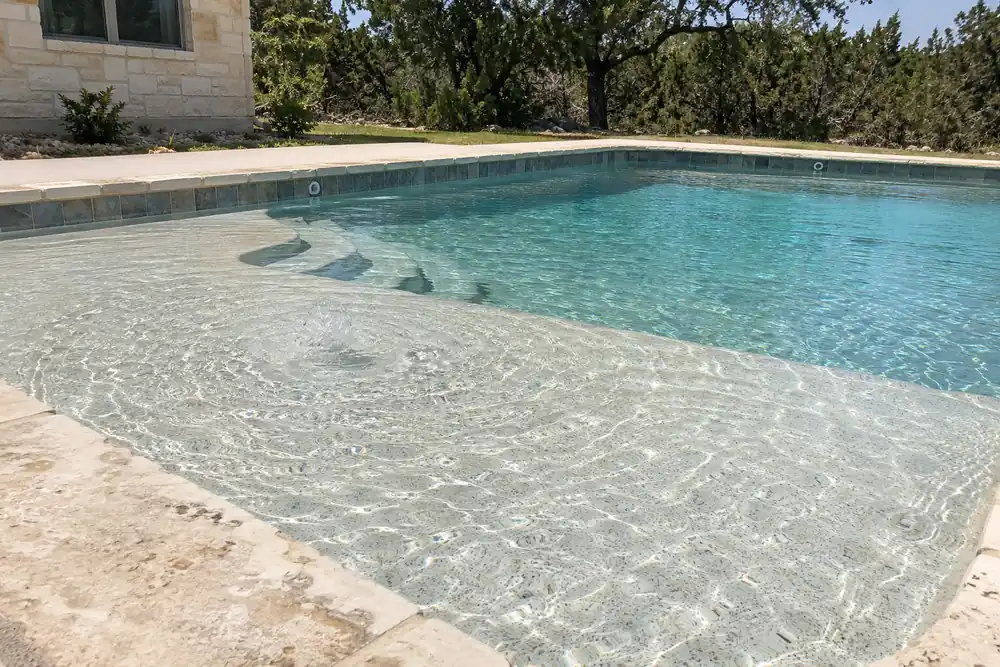
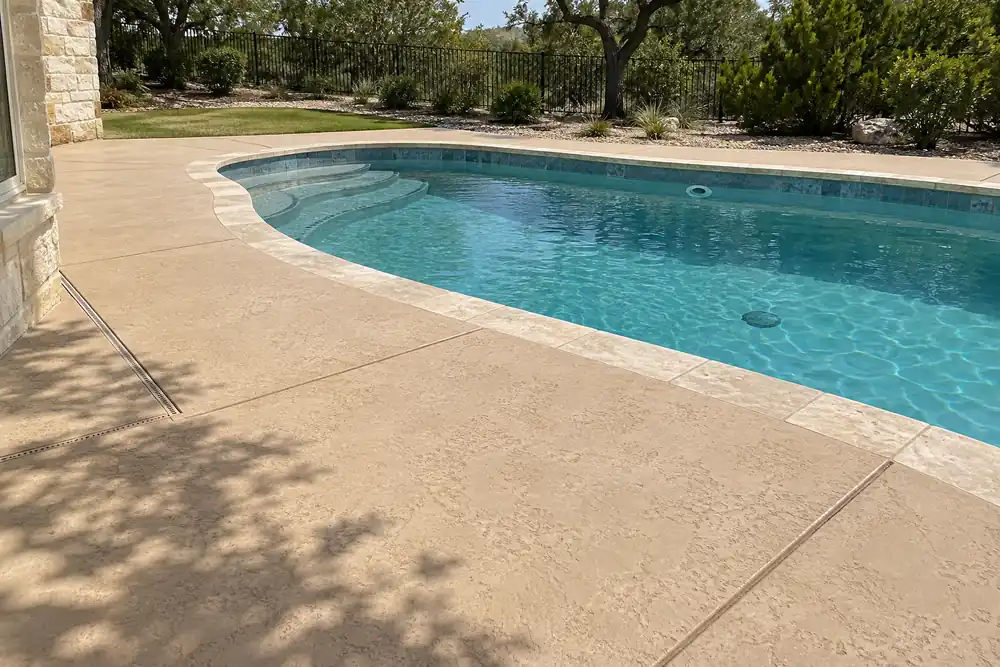
A conversion is often the moment for other work on an older pool: a new plaster, pebble or quartz finish over the new floor, new waterline tile, a tanning ledge or new steps, or a broader remodel. We handle each of these, and the estimate is free.
Nearby, Leander Pool Resurfacing also handles commercial and HOA pool resurfacing in Georgetown and fiberglass pool resurfacing in Weir.
Call or request a free estimate any time, 24/7.
(737) 212-9378From Serenada Estates to a 2,098-person community
Williamson County's subdivision records date Serenada's main plats from 1973 to 1981. Serenada Country Estates Unit 1, with 124 lots, was approved by the Georgetown City Council and filed on August 9, 1973. Unit 2 was approved that September, and many of its lots were vacated in April 1974 and replatted in two resubdivisions that May. Serenada West followed on March 28, 1977, with Sections 2 to 4 in 1978 and 1979, and Logan Ranch Section 1 on June 16, 1981. The Handbook of Texas says Serenada's first population figures came from the 1990 census, which recorded 3,242 residents, and that the count fell to 1,847 in 2000. As a census-designated place it gets no yearly population estimate, so the 2020 count is the latest official figure. The Census Bureau's 2025 boundary holds 2.154 square miles of land, against 2.205 in its 2020 list, and in a straight line Serenada's center point lies about 13.9 miles northeast of Leander's.
Call or request a free estimate any time, 24/7.
(737) 212-9378Serenada pool questions
Is there zoning in Serenada?
No. Williamson County has no zoning regulations, and city zoning applies only inside city limits; the City of Georgetown also says there is no zoning in its ETJ, where most of Serenada lies. The County applies no residential building code there either, though the recorded deed restrictions, the City's other ETJ reviews or other agencies may still have rules for a lot.
Free diving pool conversion estimates in Serenada
Leander Pool Resurfacing answers calls and estimate requests 24/7. Tell us the deepest point of the pool, whether the board is still on, and roughly how long and wide the pool is.