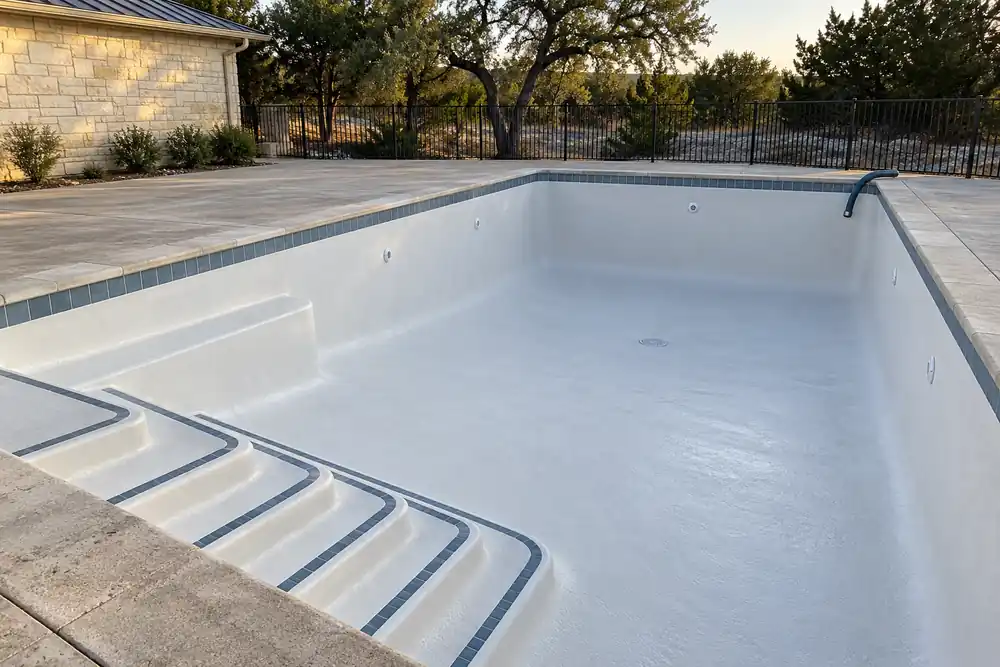
Spa Resurfacing in Leander, TX
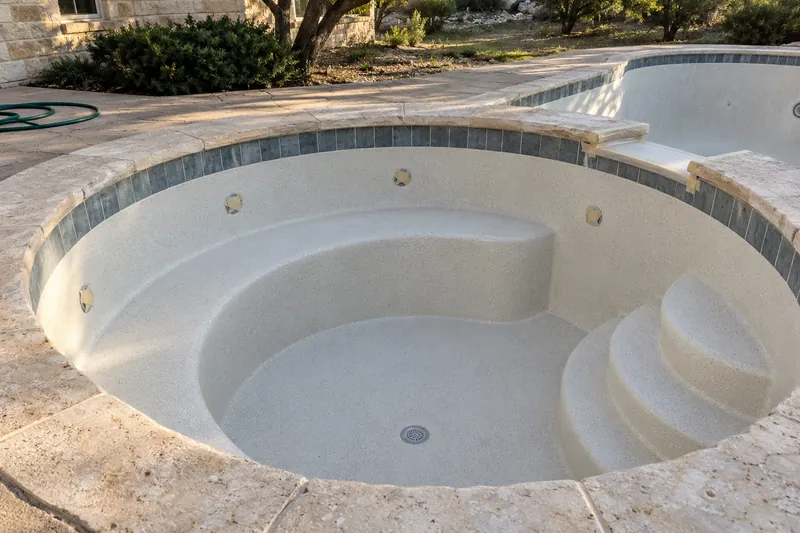
Leander Pool Resurfacing handles spa resurfacing in Leander, Texas: a new plaster, quartz or pebble finish over the walls, floor and bench seats of a concrete spa, whether it stands alone or spills into a pool. The International Swimming Pool and Spa Code holds the plastering of permanently installed concrete spas to the same APSP/NPC/ICC-12 standard as pools, and the National Plasterers Council describes white plaster as a pool and spa finish.
Call or send the form for a free estimate. We'll talk through the finish for your spa, how it ties in with the pool beside it, and when the heater can go back on.
Call or request a free estimate any time, 24/7
No charge · answered 24/7
Get free estimates
What spa resurfacing involves
A finish under constant attack
The National Plasterers Council points out that pool and spa finishes, unlike other masonry, sit constantly under water treated with a variety of powerful chemicals, so the minerals in the surface and in the water are always interacting. Universal White Cement adds that heaters, salt systems and spillways create local zones of higher stress on plaster, and that poor circulation, poorly sized equipment or adding chemicals in one spot can shorten plaster life in those areas.
Plaster, quartz and pebble in a spa
The usual finish choices carry over to a spa. Pebble Technology International describes its PebbleTec exposed-aggregate finish as a coating for pools, spas and water features, with a durable, non-slip, stain-resistant surface, and national cost figures price white plaster, quartz or Diamond Brite, and pebble or aggregate finishes for spa shells as well as pools. A white or colored plaster finish for the pool and spa together is covered under pool replastering.
Preparing around jets, lights and fittings
On a resurface, SGM's Diamond Brite manual has the old plaster undercut 2 inches back from every existing tile edge and fitting and 3/8 inch deep, and it calls for hollow or delaminated plaster to be sounded out and cut away first, with the saw cut 3 inches outside each hollow spot. A spa's jets, lights and suction outlets are fittings in that sense.
Call or request a free estimate any time, 24/7.
(737) 212-9378Heat and water chemistry in a spa
Hot water leans toward scale
Water temperature is one of the inputs to the Langelier Saturation Index used to balance water for plaster, and on the National Plasterers Council's calculator its factor climbs with the heat: 0.6 at 76°F, 0.7 at 84°F, 0.8 at 94°F and 0.9 at 105°F. A positive index has scaling tendencies, so the same water leans further toward scale at spa temperature than it does at pool temperature.
Temperature limits in the code
The International Swimming Pool and Spa Code, adopted by Leander in its 2021 edition, caps incoming spa makeup water at 104°F and water at the heater return outlet at 140°F. It also requires a way to monitor water temperature, and it bans continuously burning pilot lights on gas-fired heaters.
Leander's water and the spa's tile line
City of Leander tap water is surface water from Lake Travis, and the City's 2024 water report lists hardness of 194 ppm and total alkalinity of 156 ppm. Scale that builds on a spa's waterline tile is cleared as pool tile cleaning and calcium removal, and Orenda, a pool chemical maker, warns that scale usually returns unless the water's saturation index is corrected.
For a free estimate on a spa, call Leander Pool Resurfacing or send the form.
Call or request a free estimate any time, 24/7.
(737) 212-9378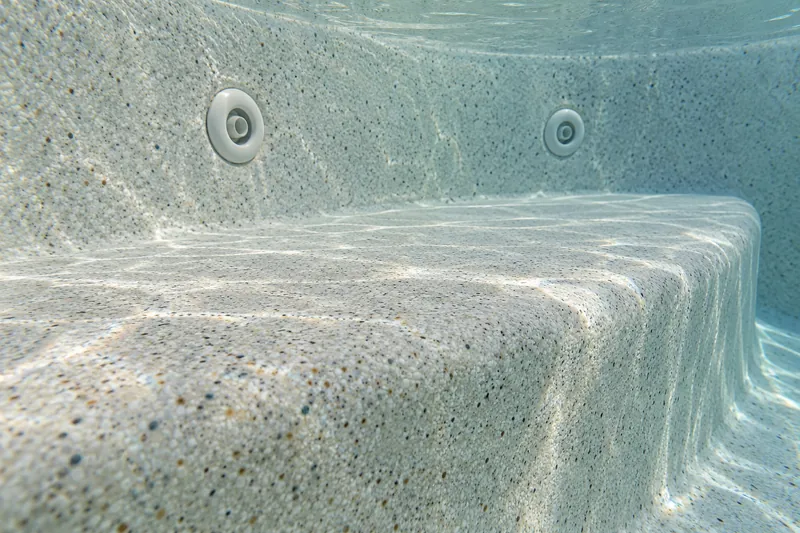
Spa rules in Leander when the finish is redone
The code's spa chapter covers permanently installed residential spas, and its scope names repair alongside design, installation and construction. Through it, the code also applies its public-spa chapter to residential spas, and so limits spa water depth to 4 feet from the design waterline and the water over any seat or sitting bench to 28 inches, and caps the floor slope at 1 unit vertical in 12 horizontal.
Leander requires a permit before any construction inside the city limits. Its building code exempts repairs and remodeling unless structural supports are changed, floor space is added or a plumbing or electrical permit is needed, but that section doesn't mention pools, so confirm a spa job with a City building inspector before it starts.
Refilling is the other City rule. Leander's code lists among its nonessential water uses the use of water "to fill, refill, or add to any indoor or outdoor swimming pools or Jacuzzi-type pools only to the extent to preserve the structural integrity and/or functionality of the pool". The rule that applies comes from Phase 2 Water Conservation, the City's level on October 1, 2026: it bans nonessential water use with three exceptions, one of them adding water to a pool where necessary to keep the purification system in service or the pool structurally sound. Neither the City's page nor its code says whether a full refill after resurfacing counts, so ask the City before the spa is drained. Building a spa where there isn't one is a different job, covered under adding a spa to an existing pool.
Outside Leander, Leander Pool Resurfacing also handles spa resurfacing in Lost Creek, where the Census Bureau's 2020–2024 survey puts the median home's year built at 1977.
Call or request a free estimate any time, 24/7.
(737) 212-9378Spa resurfacing cost
Published spa figures treat the spa as part of a pool job. National figures for 2026 say most contractors price attached spa replastering at $15 to $25 a square foot, against $8 to $18 for the main pool, because the curved spa shell is slower to plaster. A typical attached spa has 40 to 80 square feet of shell, so at $20 a square foot it adds $800 to $1,600 to the pool's price.
By finish, the same national 2026 figures put spa shells at $12 to $18 a square foot for white plaster, $15 to $22 for quartz or Diamond Brite and $18 to $28 for pebble or aggregate. Replastering a pool with an attached spa or wading area runs $8,000 to $20,000 for most homes, against roughly $5,500 to $12,000 for a pool alone, with white plaster landing around $8,000 to $11,000 for the two together and pebble aggregate at $14,000 to $18,000 or more. These are published national figures, not prices from Leander Pool Resurfacing, which estimates spa work for free.
- Attached spa replastering, per sq ft (2026)
- $15–$25
- Spa shell, white plaster, per sq ft (2026)
- $12–$18
- Spa shell, quartz or Diamond Brite, per sq ft (2026)
- $15–$22
- Spa shell, pebble or aggregate, per sq ft (2026)
- $18–$28
- Pool with attached spa, replastered (2026)
- $8,000–$20,000
Published national figures, for planning only. Not a quote.
Call or request a free estimate any time, 24/7.
(737) 212-9378Spa resurfacing questions
What is the difference between replastering and resurfacing a pool?
The two words overlap. Replastering puts a new cement-based plaster finish on a concrete pool or spa, and the plastering standard behind it, ANSI/PHTA/NPC/ICC-12, revised and published on April 14, 2025, covers that cementitious finish for residential and public pools and spas alike. Resurfacing is the broader word for any new interior surface. Quartz and pebble finishes are still cement-based, since an aggregate finish is plaster with quartz, stones or glass beads mixed in, but resurfacing also takes in paint, which Ramuc offers as an option once plaster has aged, roughened and stained to the point of a replaster, and coatings for fiberglass shells, where River Pools' standard recommendation is a polyethylene powder sprayed on and set with heat.
Can a spa be painted instead of replastered?
The paint makers split on it. Insl-x, Benjamin Moore's pool paint line, doesn't recommend painting spas and hot tubs because of their extended high temperatures. Ramuc takes the other side: it describes its EP Hi Build epoxy as its longest-lasting protection for concrete, plaster, gunite and fiberglass pools, slides and spas, and calls epoxies the coatings of choice for indoor pools, spas and whirlpools. If a spa is painted, the paint maker's own rule for that product governs.
When can the heater go back on after a spa is resurfaced?
Not right away, and the sources give different waits. The National Plasterers Council's white paper on start-up says not to turn on the heater for 28 days, while its start-up card says to wait until the water is chemically balanced and no plaster dust remains, as the maker recommends. The Pool & Hot Tub Alliance's start-up fact sheet says to read the manufacturer's recommendation, normally 2 to 4 weeks, and NPT says to hold off until all plaster dust is gone, typically between day 4 and day 10. The maker of the finish on your spa decides.
How often should a spa be drained?
The Pool & Hot Tub Alliance ties it to total dissolved solids (TDS): a spa should be drained completely once its TDS exceeds the source water's by 1,500 ppm or more, or when its calculated water replacement interval has passed, and elevated TDS can stain or etch the surface. It recommends testing TDS monthly in residential pools and spas. Leander's 2024 water report lists the TDS of City water at 305 ppm. As for the water that comes out, the City's code bans pool or spa water with 1 ppm or more of chlorine from storm drains.
Does a spa need new drain covers when it is resurfaced?
Only if the old ones are due, and a drained spa is the easiest time to check. Pentair says drain covers should be inspected regularly and replaced if they are cracked, broken or older than the design lifetime the manufacturer marks on them. The U.S. Consumer Product Safety Commission's drain-cover rule requires every pool or spa drain cover made or sold in the United States to meet ANSI/APSP/ICC-16 2017, and the pool code says spa suction fittings must be listed to APSP 16 and that a spa must not be used if a suction outlet cover is missing, damaged, broken or loose.
Get a free spa resurfacing estimate
Leander Pool Resurfacing answers calls and estimate requests 24/7 for spa work in Leander and nearby towns. Tell us whether the spa is attached to a pool, what finish it has now and how it is heated.