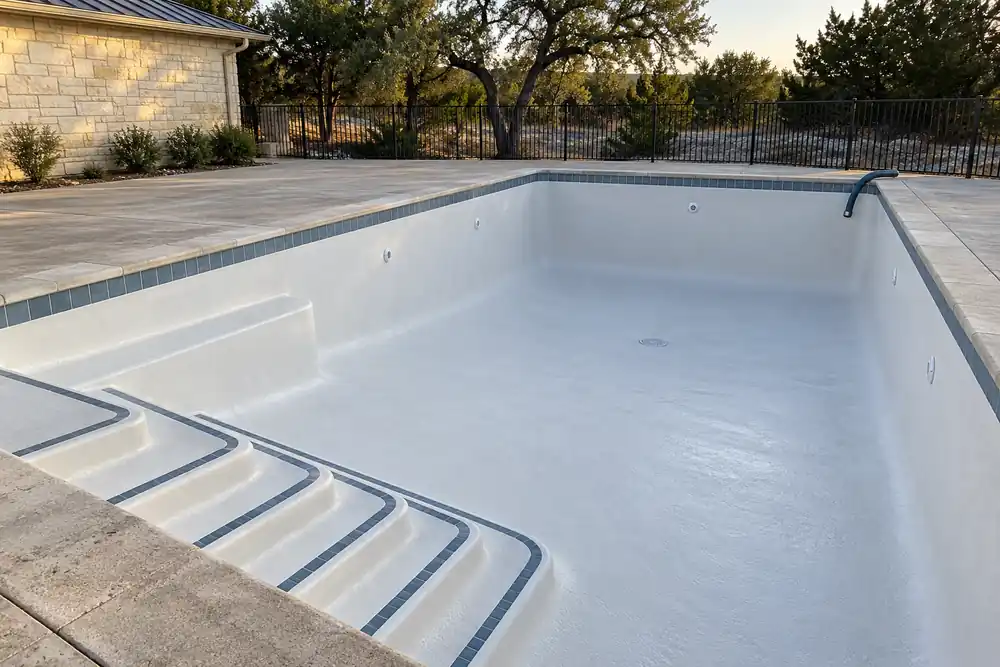
Travertine and Paver Pool Decks in Leander, TX
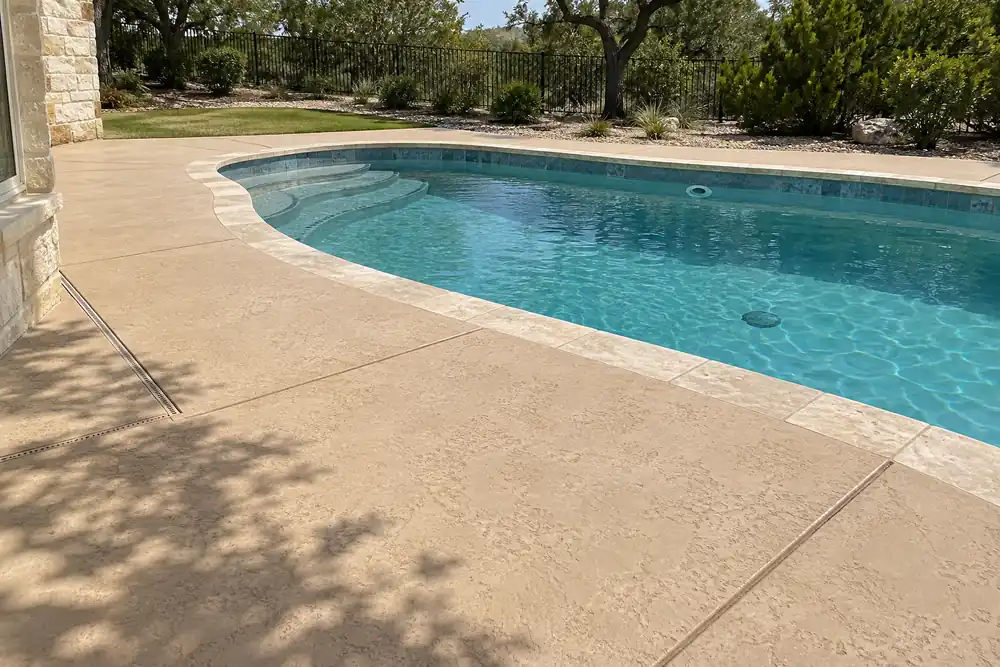
Leander Pool Resurfacing handles travertine and paver pool decks in Leander, Texas: natural travertine or concrete pavers laid around the pool over a compacted base, sloped to drain, and finished with a flexible joint at the coping. Pavers drain fast and grip well underfoot, which is why the Interlocking Concrete Pavement Institute (ICPI) calls them a desirable surface around residential and commercial pools.
Call or send the form for a free estimate. We'll talk through stone or pavers, how the deck should be set, and what your yard's soil and slope mean for the base.
Call or request a free estimate any time, 24/7
No charge · answered 24/7
Get free estimates
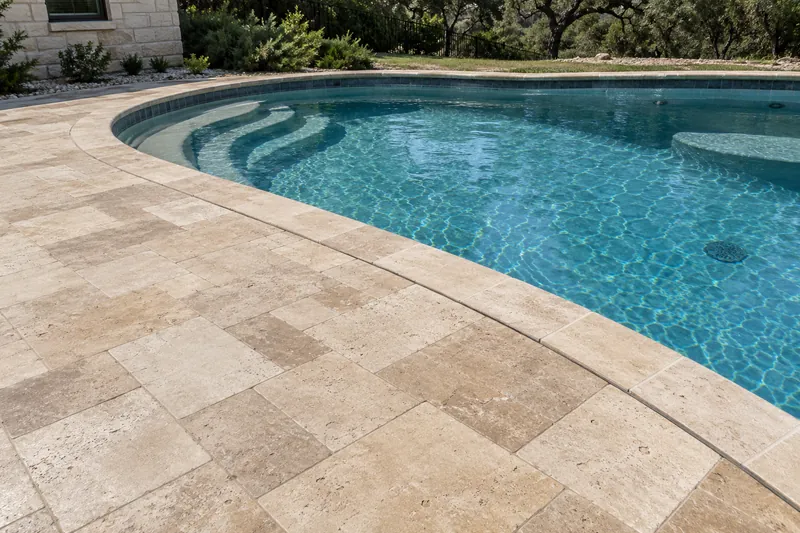
Travertine and paver choices for a pool deck
Travertine, a land-formed limestone
Travertine is often sold as travertine marble, but the Natural Stone Institute classes it as a type of limestone, the version formed on land, and like marble it is made mostly of calcium carbonate. That places it among the calcareous stones; the Institute rates siliceous stones such as granite, quartzite and sandstone as generally harder and more resistant to abrasion and chemicals. All true travertine has voids left by gases trapped as it formed, and most is now sold with them filled with a cement-based or resin filler.
Concrete pavers
Concrete pavers are modular: ICPI points out that when the base sinks in one spot, or a buried line needs work, the same pavers can be lifted out and laid back, and it holds lippage, the step in height between neighboring pavers, to 1/8 inch at most. Stone and pavers replace a deck's surface outright; when the concrete underneath is sound and only its finish has worn, the deck can be recoated instead under pool deck resurfacing.
For a free estimate on a stone or paver deck, call Leander Pool Resurfacing or send the form.
Call or request a free estimate any time, 24/7.
(737) 212-9378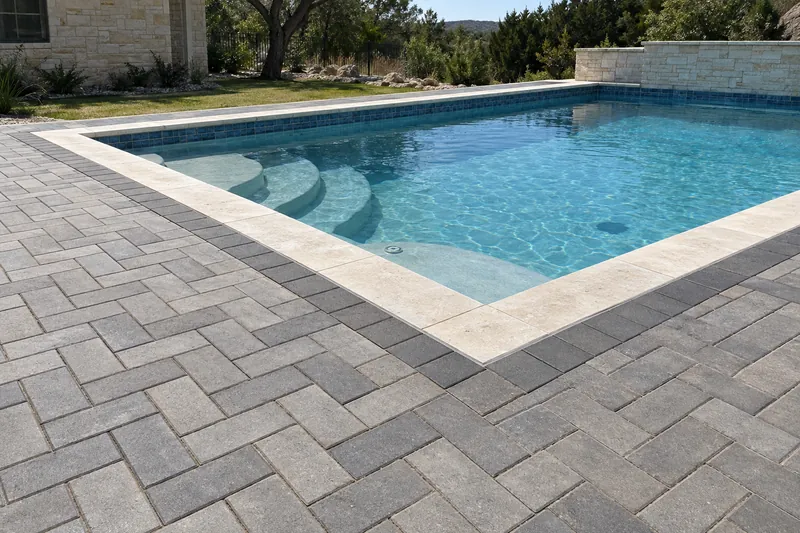
Installing travertine and pavers around a pool
Three ways to set stone paving
Stone paving goes down in one of three ways, by the Natural Stone Institute's account: on a mortar bed when stability is the priority, on sand, the usual choice for outdoor paving, or on pedestals that leave room for drainage and access. On a mortar-set deck, Leander's stormwater ordinance covers the leftovers, since neither mortar nor the wash from equipment used to carry or spread it may go into a storm drain.
Base, bedding sand and edge restraints
ICPI builds a paver deck from the ground up: compacted soil, a compacted aggregate or stabilized base, a bedding layer of sand with a nominal thickness of 1 inch, then the pavers with sand swept into their joints. ICPI calls edge restraints essential, because they hold the pavers and sand together and keep the system interlocked. Right beside a pool, where the backfill soil or an aggregate base can't be compacted well enough, it typically switches to a concrete base at least 4 inches thick.
Where the pavers meet the coping
Between the last course of pavers and the coping, ICPI places a backer rod and a urethane or neoprene sealant of the kind used in pool construction, keeping water out of that joint while the pool wall and the paving move independently. Belgard fills the gap between coping and deck pavers with foam expansion material to protect the bond seam. If the coping itself is cracked, loose, or due for a stone that matches the new deck, that work comes under pool coping replacement.
Deck slope and drains
The International Swimming Pool and Spa Code, adopted by Leander, sets the minimum fall for travertine or brick-set pavers at 1/8 inch per foot around a home pool and 3/8 inch around a public one, unless another drainage method keeps water from pooling. No deck other than wood may be steeper than 1/2 inch per foot, and every deck has to shed water so that, 20 minutes after water stops landing on it, no more than 1/8 inch is left standing.
Call or request a free estimate any time, 24/7.
(737) 212-9378Grip, cleaning and stains on a stone pool deck
Slip resistance around the pool
Leander's adopted pool code requires decks, coping and similar step surfaces to be slip resistant and cleanable, along with any markers or insignia set into them. With stone, the Natural Stone Institute says grip comes down to the texture and porosity of the surface, any treatment applied to it, and what it is exposed to, water and dust included, and that a stone surface can be finished to resist slipping.
Cleaning travertine without acid
Because calcium carbonate reacts with acid, the Natural Stone Institute points owners to mild, non-acidic cleaners and away from products with lemon, vinegar or other acids, which can leave calcareous stone dull or etched. For an outdoor pool or patio, its routine is a flush with clear water, with a mild bleach solution where algae or moss take hold. It also cautions against nozzle pressures and stiff brushes strong enough to pull filler or grout out of the voids.
White powder (efflorescence) on travertine
A white, powdery film on stone is efflorescence: mineral salts that water carries up from below the surface and leaves behind as it evaporates. When it keeps coming back, the Natural Stone Institute's advice is to have the installer track down and remove the source of that moisture.
Call or request a free estimate any time, 24/7.
(737) 212-9378Pool decks on Leander's limestone
Digging a base in rocky ground
A lot of Leander sits on shallow, rocky soil. At the Leander Public Library and Devine Lake Park, the federal soil map shows Eckrant cobbly clay, with hard, fractured limestone about 11 inches down and limestone pieces covering about half the surface, and NRCS rates it very limited for shallow digging because of that bedrock. At the Travisso address, bare rock outcrop makes up 20 percent of the mapped soil. Map points aren't a test of any one yard, and clay turns up too: the Fairlie clay mapped at the Block House Municipal Utility District office opens wide cracks when it dries. A concrete deck that has only cracked or sunk in places is a question for pool deck repair before it is one for new stone.
Heat and freezes on natural stone
The Natural Stone Institute warns that in hot climates, thermal expansion and long hours of sun can affect a stone's color and its movement joints. In 2023, Austin's official station at Camp Mabry reached 100°F or more on 80 days, including every day from July 8 to August 21. Freezes come too: NOAA's Austin 33 NW station, about 13.7 miles west-northwest of Leander, averages 19.5 nights a year at or below 32°F (1991–2020 normals), and the Institute notes that few limestone varieties have a successful history in outdoor paving where it freezes and thaws.
HOA review and City permits for a new deck
Several Leander associations review a new deck before it goes in. Crystal Falls wants drawings of the finished project with the materials marked, a survey with the work drawn to scale and its distance to each property line, and a materials list or specification sheet; on a pool application it keeps the deck's edge at least 5 feet from the property line. Block House Creek's request form asks for the grades and drainage and the materials, colors and textures to be used. Inside the city limits, Leander requires a permit before any construction begins and says its list of permitted work isn't complete, so ask a City building inspector what a new deck needs.
Outside the city, Leander Pool Resurfacing also handles travertine pool decks in Liberty Hill.
Call or request a free estimate any time, 24/7.
(737) 212-9378Travertine pool deck questions
How much does a travertine pool deck cost?
A US stone-price index's 2026 figures put a dry-set, tumbled travertine pool deck at $14 per square foot installed at the low end, $24 typical and $36 at the high end, counting the stone, base, sand and labor; base preparation alone runs $3 to $8 per square foot, more on clay or slopes. A Texas travertine supplier's 2026 guide gives $12 to $25 per square foot installed, $3 to $7 of it material and $7 to $18 labor, or $3,600 to $7,500 for 300 square feet and $7,200 to $15,000 for 600. National 2026 figures put concrete pavers at $12 to $45 per square foot as a pool deck. These are published figures, not prices from Leander Pool Resurfacing, which estimates stone and paver decks for free.
Is travertine a good choice for a pool deck?
It can be, if the deck is built around the stone's limits. The Natural Stone Institute lists travertine among the natural stones that are good options for paving. It also groups travertine with the calcareous stones it sees indoors or outside where conditions are relatively controlled, and it warns that a durable stone still runs into trouble when drainage, movement or the ground beneath it isn't dealt with.
What are the downsides of travertine stone?
The Natural Stone Institute's guidance points to four. Acids, from lemon and vinegar to acidic cleaners, can dull or etch it. Its water absorption varies from under 1 percent to over 10 percent, depending on the stone. Voids hidden just under the face can break through after installation when a small, concentrated load lands on them, though the Institute calls filling them in place as they appear acceptable, common practice. And travertine varies more than any other natural stone, even within one quarry, so the Institute advises seeing a range of samples before installation.
Which is better for pool decks, porcelain or travertine?
It depends on what you weigh most: price, upkeep or how grip is measured. A Texas travertine supplier's 2026 comparison puts installed travertine decks at $12 to $25 per square foot and porcelain pavers at $15 to $30; as a seller of travertine, it isn't a neutral source. For porcelain and other tile, the tile maker Crossville says pool deck tiles should have a textured surface with an elevated wet friction rating, known as DCOF, suggests its Exterior Wet class for pool decks, and adds that no tile is slip proof.
Does a travertine pool deck need to be sealed?
Not always. The Natural Stone Institute says many stones don't need sealing, though applying an impregnating sealer is common practice, and that what the trade calls a sealer really works as a repellent: it makes stone more resistant to stains, never stain proof. Whether a given deck needs one depends on the stone, where it is and what it faces. For concrete pavers, ICPI recommends sealing the pavers and joints to hold the joint sand in place.
Get a free travertine pool deck estimate
Leander Pool Resurfacing answers calls and estimate requests 24/7 for travertine and paver pool decks in Leander and nearby towns. Tell us roughly how large the deck will be, what surrounds the pool today and whether you are leaning toward travertine or pavers.